Dee Depoe: Celebrating a career spent championing literacy
Published 1:30 am Tuesday, April 7, 2026
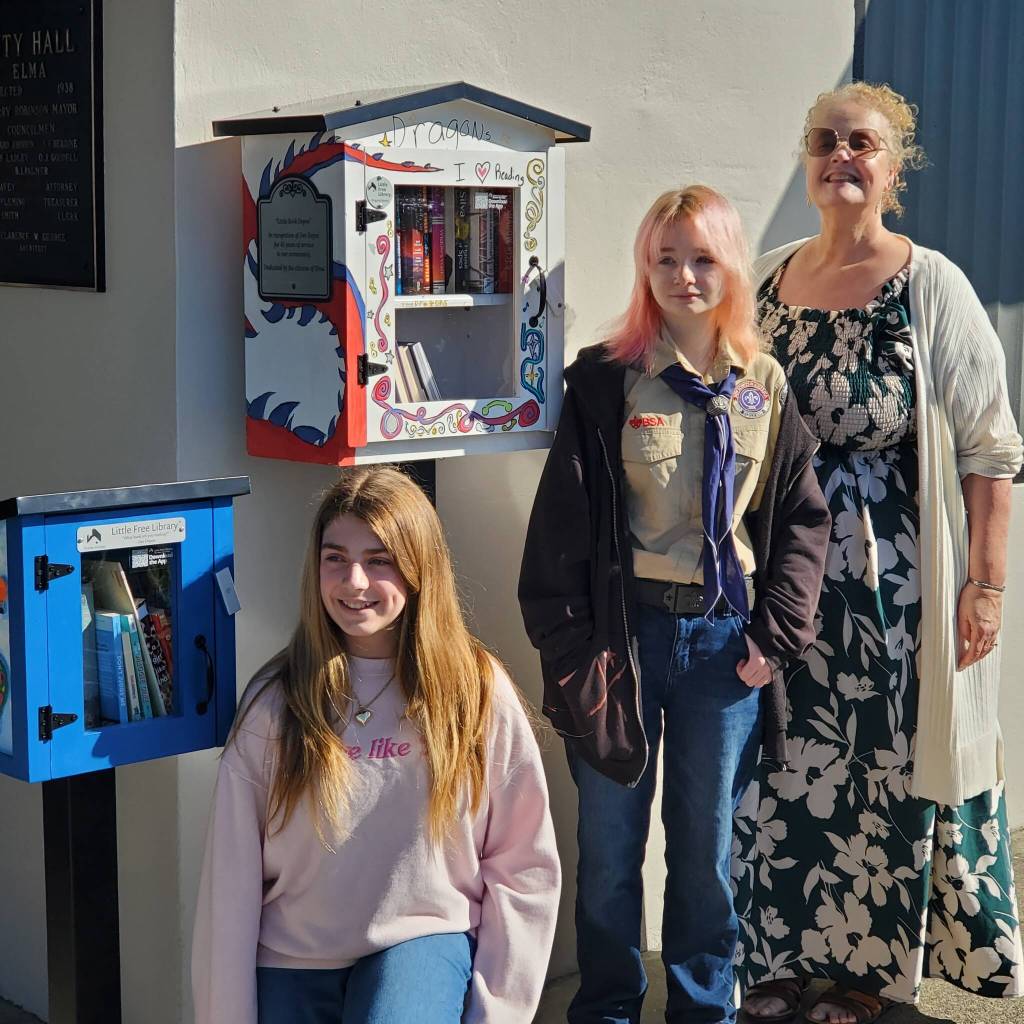
On the morning of April 4, city staff and community members gathered outside Elma City Hall to honor Dee Depoe and her 45-year career with Timberland Regional Library (TRL).
In 2017, Depoe became manager of the Elma Library and when she retired in September 2025, she was the regional manager for East Grays Harbor County.
“When we learned Dee was retiring, we learned that she had committed 45 years of service to our community. … As the city, how do we honor such an investment into our community?” said Mayor Josh Collette. “A lot of times the city will pass a resolution and say, ‘Thank you for our service,’ but we came up with an idea that represents Dee, and we’re hoping it has as lasting of an impact on our community as Dee has, and that is the Little Free Libraries.”
Outside of city hall are two Little Free Libraries, whose heights are sized for younger children and adults. Eighth grader and scout member Abby Roussard created the taller Little Free Library that is decorated with dragons, and Pearl Collette created the shorter Little Free Library that highlights autism awareness.
Beginning at the South Mason Library, Depoe’s career spans the trajectory of how TRL has changed, with budgets cuts in the ’80s transferring her to Olympia. She returned to Shelton, this time at the newly named Shelton Timberland Regional Library, because the city could no longer staff the city library, which prompted their joining TRL. While working full-time and with two children, Depoe earned a Master of Library Science in 2008; she credits her husband for holding down the fort while she attended school.
Before the unveiling of the Little Free Libraries, The Daily World chatted with Depoe and asked her to reflect upon her career. What follows are highlights of the conversation, edited for length and clarity.
How I came to join Timberland Regional Library
At the time, there were very few jobs in 1980. I had turned 16 and got a job at the South Mason Library as a page. I happened to be a 4-Her — I grew up in the 4-H program — and though the manager of the library said she never gave a preference to 4-H members, there were sure a lot of them.
I had a couple of years of calling people for overdues. I would do anything not to put away books, so I would shelve books as fast as I can and call people to tell them that they had overdues. I can’t imagine that being fun, but apparently at 16 and 17, it was fun to me.
At the time, Mason County had two libraries. They had the City of Shelton Library and the county library, which was South Mason and where I was at. It was located where the Mason Conservation District office is now across from the airport.
How library operations changed over the years
When I started, there was a card catalog at our service center, which we called the central reference center. When you wanted to borrow a book from another library, it took someone looking in a big card catalog to find out where that book was and then they would call you in the morning.
People didn’t have library cards at that time. There was a sign-out sheet that would have your name and telephone number, and you were assigned a number on that sheet, and then the checkout card was stamped with that number. We did not get the first automated computer system until 1983.
Books were circulated by being mailed. Whichever library had that book on the shelf, they mailed it directly to the patron. It was a great service until postage went up, and they thought there were better ways to do that. We still did this for those folks who are homebound.
While attending college and still working, TRL offered me a full-time job on the bookmobile in 1983. (I took what I thought was a sabbatical from college, but I did go back; it just took me a couple of years because I had a couple of kids in between.)
We would go out on routes, some of which are very similar to the ones that they are currently doing with Anywhere Library. Our bookmobile did a couple runs in Thurston County, but predominantly Mason County. I was in that until they ended the service, which I think was probably 1984-ish because the models weren’t working. They ran mostly during the day, but families were now two-income families in the ’80s and people weren’t around during the day. They phased it out and then they phased back in a different fashion.
The value of community programming
At Shelton Library, I did youth services until I finished my master’s degree and then I went to adult services. Adult services is easier than youth services, but I liked both. There are adults who remember my school visits and my storytimes — some of them can say what story was their favorite.
I did impactful programs as an adult librarian. One was on immigration, which was a very successful program. We had a group discuss the Finnish and Norwegian communities who immigrated around 1910 to work in the lumber camps. Then we did a panel of immigrants who had immigrated at different times in the ’40s and ’50s, and I had our now former director who had immigrated from Canada.
We did another program about homeless populations and another on opiates in 2017 [Mason County Hopes Opioid Overdose Awareness and Prevention]. We had the Shelton chief of police on the panel and he was asked why none of the first responders were carrying Narcan. Based upon public comment, he looked for a grant and looked at his own prejudices, and that was when the city of Shelton officers started carrying Narcan.
Because of that program, the police were able to save lives. And for a long time, the police chief would email me to say, “Another life saved.” It wasn’t just my program — it was everybody’s program and the community benefited.
We did craft programs because 1) people like them and 2) art is healing. We have a community that has trauma and drama. And if we can do something to enrich their lives and make it better for a couple of hours, that’s wonderful.
Navigating the politics of managing a library
In 2017, I took the position as the manager of the Elma Library, and, by far, that was my favorite job. I worked with an amazing group of folks there who absolutely gave it their all every day to serve the community.
When at Shelton, I dealt with the Shelton City Council, but they knew me. At Elma, not being the hometown kid, I had to work with the city council, and they taught me the most valuable lesson.
The first or second time I attended a council meeting, I had to ask for additional money for carpeting. The former librarian had gotten a grant that paid for most of the carpeting and there was still money left on the bond that was available. I didn’t think about getting on the agenda or asking them beforehand; I figured that I’d ask and they’d just give me money. To my request, they said nothing — it was completely just crickets. After that I learned the right way to make requests.
The Elma City Council was very good to the library. They always made a place at the table for the library. They wanted to hear what was going on, and most of them were all library users. Of all the city councils that I have worked with, Elma was the longest and they were always incredibly kind.
The services libraries provide beyond books
As technology gets more technical and expensive, rural areas don’t always have internet. We saw it at the start of the pandemic, folks who worked from home used the library because their internet isn’t as fast. And people can’t always afford internet but everything they’re being asked to do is online so libraries having a computer lab is one service. And having staff who can provide technical assistance is another service. And how many people have copiers?
Also, we’re barraged on social media and the news, so being able to find vetted, neutral sources are what your libraries are for. Through the libraries, collectively, you can afford online services that you couldn’t buy individually. And these online systems are available anytime so we can say the library is now never closed.
The reaction of people coming to the library
For some, it’s like a rite of passage of getting a library card when they reach a certain age. For some, libraries are what people look at when they’re moving to an area; it used to be in the Top 10 of why you would want to move someplace. There are people where libraries are their safe place, I call it their second living room. They can hang out with their family and play games with the kids and look at a magazine.
I’ve never had people be unhappy having a library card. That’s the great part. Where do you get a job where you get to tell people about the free things that they’re already paying for? You get to help them with things that affect their lives. You get to be part of that journey to watch a child go from a non-reader up to reading — that is the best.