How to protect your home from a wildfire
Published 1:30 am Monday, August 10, 2026
With hundreds of structures burned in the recent Spokane-area fires and more hazardous weather on the way, the prospect of losing a home to wildfire feels terrifying, massive and inevitable.
But the truth is — regardless of where you live — there are highly effective and science-backed ways to boost the chances your house survives a wildfire.
From Lahaina in Hawai’i to Malden in Whitman County, many neighborhoods that were devastated by wildfire have had some structures spared. Often, there was more than luck at play.
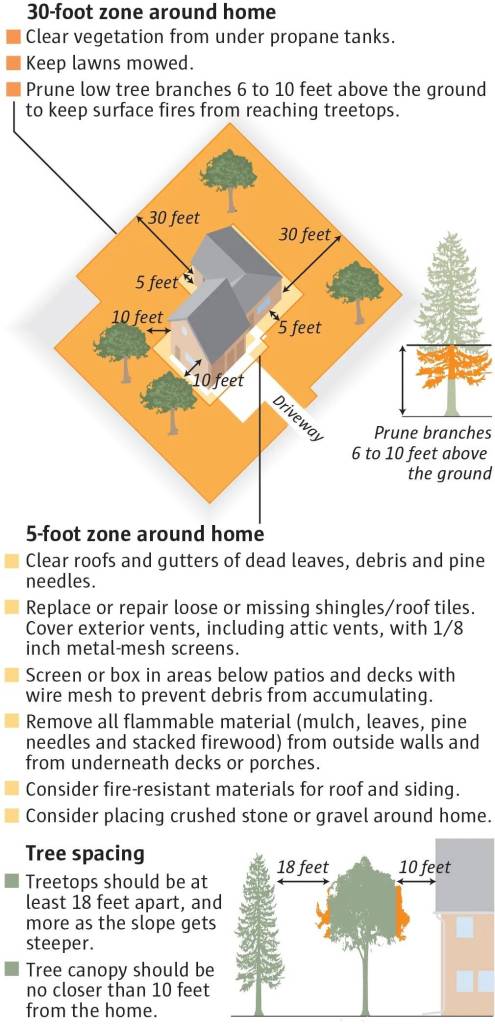
Simple fixes like removing mulch, plants, debris in gutters and other flammable material within 5 feet of a house can make it significantly more likely to survive a wildfire, according researchers who have analyzed computer models, set buildings on fire in controlled environments and surveyed dozens of scorched neighborhoods.
Other fixes in the immediate vicinity of the home include removing wooden furniture and cardboard boxes near decks, and screening in gaps and vents.
While more involved, homeowners can also remove plants or wooden fencing up against a home, and ensure their home’s siding and roof are fire-resistant. Trees should be pruned and spaced out to ensure they won’t spread more fire, and doors and windows should be well sealed.
These tips essentially boil down to a simple principle: It’s harder for a house to burn if there isn’t fuel around it to burn in the first place.
Don’t believe it? The Insurance Institute for Business & Home Safety has a two-minute video that shows two homes being showered by nonstop embers in a warehouse. The one surrounded by mulch and built with wooden siding catches on fire, while the other survives unscathed.
These principles around how to protect the “home ignition zone” or the immediate 5 feet around a house are so effective that the state Department of Natural Resources has spent time and money in the past giving residents in wooded areas wildfire home assessments.
While it’s still too early to know exactly what happened to cause homes to burn in the Spokane-area wildfires, a common misconception about wildfires is that houses burn due to a wall of advancing flames. In reality, 90% of them are damaged by embers blown in front of the fire line (which in times of high wind can be from quite a distance), according to the Insurance Institute for Business & Home Safety.
While the immediate area surrounding a house is the most important for preventing a wildfire, smart landscaping in the surrounding 30 and 100 feet can also influence how a fire behaves. These changes can include removing heavy accumulations of debris, protecting sheds and propane tanks, mowing lawns, spacing out trees and removing fuel under trees so surface fires cannot travel upward.
Those seeking a wildfire home assessment can reach out to either the Department of Natural Resources or their local fire or conservation district.