Timberland Regional Library trustees visit McCleary Library
Published 1:30 am Monday, May 18, 2026
Editor’s note: This is the second installment of recent Timberland Regional Library activities in Grays Harbor County.
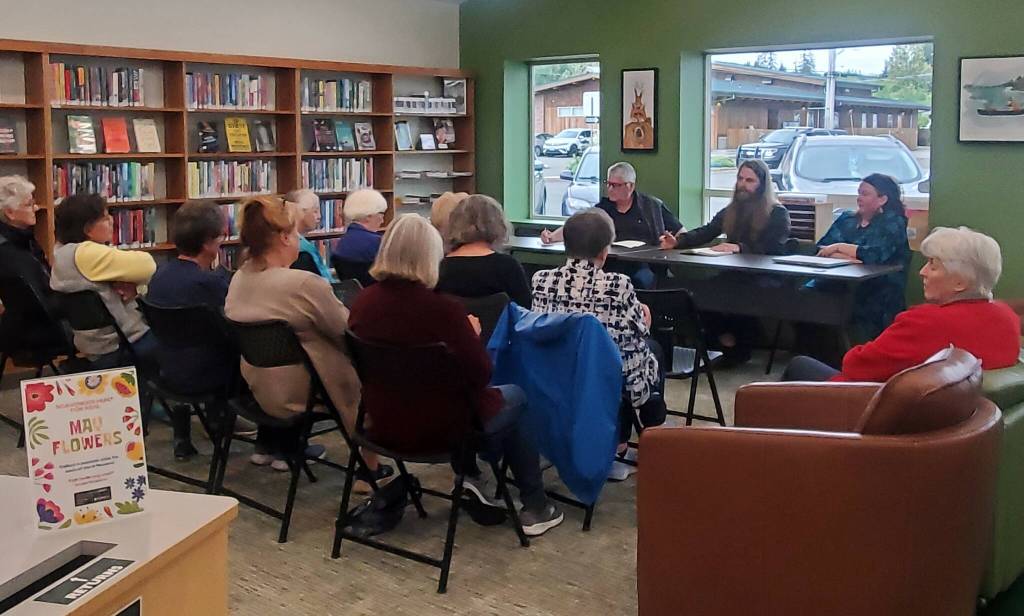
After visiting the Hoquiam Library on Tuesday to speak with the Hoquiam and Aberdeen friends groups, Timberland Regional Library (TRL) board of trustees Dustin Loup [Grays Harbor County] and Hal Blanton [Member-at-Large Lewis County], along with East Grays Harbor District Manager Tania Remmers, visited the McCleary Library to speak at a McCleary Friends of the Library meeting.
That McCleary friends of the library attended the meeting in Hoquiam, and Montesano friends of the library attended McCleary’s meeting reflects the spirit of TRL system: libraries are individual buildings located miles apart and library patrons are the connective tissue.
As he had for the Hoquiam meeting, Loup opened the discussion by recapping how TRL got into the budget situation, that in January there was the realization that TRL had a $3.8 million budget deficit.
“And that led to cascading series of decisions that were rushed and, thankfully, have been, at least in part, rolled back, mainly the initial announcement of the 61 layoffs, several of the branches would have been moving to EAH [Expanded Access Hours] only, including this one,” Loup said. “We’re very happy that this is not the case.”
Loup provided an update on the interim director search mentioned at the Hoquiam meeting.
“We anticipate that we will have a decision finalized by Wednesday of next week,” he said. “We have a special board meeting on Wednesday where we anticipate that that decision will be made.”
With former Director Cheryl Haywood having resigned, Library Services Director Andrea Heisel is serving as acting director until the interim director is hired.
“We, as a board, wish we would have done a lot of things differently, asked harder questions, and made decisions differently over the past years. And we are doing a lot of things to make sure that this doesn’t happen again,” said Loup. “And to the extent that when we do have to make hard decisions, that they are well thought out, and not driven by urgency and panic.”
To the McCleary attendees, Loup repeated what he had shared at Hoquiam, including the formation of an ad hoc committee, which includes an assessments committee comprised of Loup and Toni Gwin, who represents Pacific County. In addition to documenting at a granular level how the situation unfolded, the assessment committee is also conducting a workplace environment assessment.
“We understand that there are a lot of feelings that things aren’t handled properly and we want to get more of an independent, external look at that,” Loup said. “To find a way for people to share their stories in an independent and secure way.”
A policy committee is reevaluating current policies and drafting new ones as applicable, such as a financial transparency and planning policy.
Additionally, there is a levy lift committee comprised of Blanton and Loup. Blanton outlined their efforts to explore how to proceed with a levy lid lift and the organizations they need to connect with.
“It was really clear to us probably 10 or 15 years ago that we were coming to this; I mean, it’s not a surprise when we look back,” said Blanton. “That being said, we didn’t attack the things that we ought to have going out for more revenue, and it’s more and more common anymore. People are doing an awful lot more levy lid lifts than we did before.”
What Blanton emphasized to the group is that, “I’ve said this for a long time since I’ve been on the board, is that we’re still staying open. We’re still paying our bills. We’re still getting books out. We’re not doing it as well as we probably could. … And we’re going to continue to work on that because there’s a base of good stuff.”
Blanton addressed the issues regarding the lack of a quorum, which was also discussed at the Hoquiam meeting.
“Having seven [trustees] means our quorum is four instead of three, which means we can’t talk as much between ourselves and everything too, because of the open public meeting requirements, which we work real hard to adhere to,” he said.
With the audience invited to share comments or pose questions, Tami Bowen Hickle, who described herself as a card-packing member since 1965, said, “If you want to pass some levies, you’re missing some people who could really help you. And that’s the school superintendents, because we all pass levies every year or two, and we’re all basically library people.”
To Bowen Hickle’s comment regarding people complaining about the number of people in administration, Loup thanked her for raising that topic.
“In terms of the number of people you see, that is a problem that we’ve named and identified, which is that there’s too much decision-making concentrated at the top with too few people involved,” he said. “The leadership team for TRL has been basically three people and an executive administrator for at least since the restructure and since Kendra left, actually, because then it was one additional person. This isn’t necessarily a decision we make as a board, but one that we want to see, which is more distributed decision making, and more transparency about who’s involved.”
As for the consternation of the administration salaries, Loup said, “There is a plan, once the interim is in place, to roll back the executive and some of the administrative level salaries back to the pre-restructuring amounts that would be essentially back to like December 2024 and January 2025 levels.”
Discussion on revenues touched upon the declines in timber revenue generated from harvests on state lands and that TRL used to have a foundation. The cost of also putting a levy on the ballot was also raised.
To the point of making TRL’s budget information easier to find and read, Blanton said, “One of the people we interviewed spoke of having a very clear dashboard so that people can find those things very simply online.”
An audience member suggested having an annual work plan that outlines goals to accomplish and breaks down the steps for how it will happen.
“When you have a work plan and it has specific timeline assigned to the different tasks, it really keeps you on track, but it also keeps the public informed about how things are going, and it helps you build agendas,” she said. “It’s just that it creates a really useful roadmap for people outside.”
Loup thanked her for her ideas, saying, “It also goes feeding into an annual report at the end to show how we did. To be transparent, I went and presented to the county commissioners a couple of weeks ago. Our annual reports have not been very thorough in terms of actually tracking. They show some cool things, but it didn’t have a whole lot in there about what actually happened on the ground in Grays Harbor.”
After the audience posed a few more questions on the levy lid lift and the value of libraries, Blanton and Loup encouraged the friends members to contact them with suggestions.
One comment made by an audience member, regarding the need to better get the message out before putting out a hand for a levy lid lift was particularly relevant to the McCleary Library, which had been slated for moving solely to EAH with all three of its staff being laid off through a combination of voluntary and involuntary layoffs. With the layoffs being rescinded, McCleary Library will remain open, and unlike nearby branches, its hours have not been reduced.
This decision would have significantly affected patrons’ access of the library. One older patron, when told of the move to EAH only, said he wouldn’t use the library anymore then because he didn’t want to deal with needing a card to enter the library. Susan Zetty, the superintendent for the McCleary School District shared via email that McCleary library staff “support our school community in a variety of ways. If [libraries] weren’t staffed, then we wouldn’t have Timberland Library employees available to host events, put together resources, host students on field trips, etc.”
As the conversation with Blanton and Loup wound down, an audience member observed, “we don’t realize specifically, with the library, how intertwined it is with our community until it’s not there. It works so well, but if it’s not there, it can’t work. And so we need to get that message to locally, but also to the regional Timberland Library constituency to say, ‘This is where we’re at. This is where we want to be. And this is our vision of how we want to get there. But we’re going to need your help at the end.’ That message needs to start now.”