Mekong to Willapa: Lao refugees make a new home in Pacific County
Published 1:30 am Tuesday, March 24, 2026



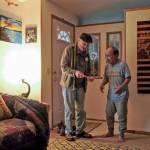
Not long after Vientiane, the capital of Laos, fell in December 1975, Singkham Souphommanichanh fled from his village and disappeared into the mountains. Communist forces knew that he had worked with the Americans and were coming to kill him, his brother warned. He had two hours to escape.
Manichanh hid in the jungle for three days with nothing but the clothes on his back. When the coast was clear, he snuck back home and convinced his wife, Soumountha, to take their children to live with their grandparents until he could find a way to extract them.
Then he fled again — this time, with a bag of sticky rice. And this time, instead of heading into the mountains, he swam across the Mekong River, to Thailand.
He would swim the river many times in the ensuing months — always at night and always at great personal risk. The communists shot those trying to flee, including a friend of Souphommanichanh’s, the man’s wife, and his two children. The riverbanks were clogged with corpses.
On Manichanh’s first crossing, he dove deep to avoid the bullets strafing the surface of the water. The next time he returned to look for his family, he brought a gun — an M16 given to him by a friend.
Souphommanichanh did not manage to rescue his family on those trips back. Instead, Soumountha left the children behind with their grandparents and struck out on her own to find her husband. The pair reunited at Ubon refugee camp in Thailand in 1979, where they spent another two years trying to secure passage to the United States.
When they arrived in Washington state in 1981, Souphommanichanh went straight to work cleaning airplanes at McChord Air Force Base in Pierce County. One night the following May, he awoke to Soumountha calling to him from the bathroom. She had just given birth to their son, David, in the bathtub. Souphommanichanh retrieved a knife from the kitchen, sterilized it, and cut the umbilical cord. Then, he and his wife cleaned up their newborn and brought him to St. Joseph’s Hospital in Tacoma.
“Doctor ask me, ‘How you know?’ I know! I clean everything.”
He knew because back in Laos, Souphommanichanh had effectively been the village midwife — a skillset acquired by watching his own mother help women through difficult labor.
In 1986, he and Soumountha received the news that their three older children had made it to Thailand, along with the children’s grandfather. By then, the pair had joined a growing Southeast Asian community on Willapa Harbor, where Souphommanichanh was throwing himself at all the work he could find: a regular job shucking oysters at Coast Oyster Company, foraging for mushrooms or whatever else was in season, fixing boat engines and gill-netting in Alaska during the summers.
It would ultimately take two more years — not just of making and saving money, but of dogged, bureaucratic wrangling on the part of friends and benefactors, including then-congressman Don Bonker — to get David’s siblings to America. And it would take another three years after that to bring over their grandfather, Khamphanh Souphommanichanh, who may have been 111 years old when he died in 2008 in South Bend.
It was also in 1986 that Souphommanichanh and Soumountha went mushroom picking with a cousin one afternoon and got lost in the woods. Night fell and the trio had not yet made it back to the pickup truck, so they folded down some tall grass, laid on top of it and went to sleep in the hills. Back in town, four-year-old David was too young to fully grasp the situation.
“A tiger ate my parents,” he said to the aunt who was babysitting him.
The aunt still teases him about it to this day.
But there were no tigers in these woods. No communist soldiers or unexploded ordnance or fleeing refugees either. Only deer, elk, mushrooms and tall, evergreen trees covered in dark bark. Maybe a bear or two. New bedfellows in a new land.
Across the Mekong
Between 1975 and 1985, some 350,000 Laotians — well over 30% of the country’s population — fled the same way Manichanh did: across the Mekong River and into refugee camps in Thailand.
In the decade prior, the United States dropped roughly 2.5 million tons of ordnance on northeastern and southern Laos in an attempt to disrupt communist supply lines — one ton for every person in a land area the size of Oregon, or, one bomb every eight minutes for nine years straight. Up to a third of these failed to explode on impact, leaving the land salted with booby traps. To this day, Laos remains the most heavily bombed country in human history.
The vast majority of the refugees — more than 250,000 — ultimately emigrated to the country that had done the bombing. They came in two waves — the first in the immediate aftermath of the American withdrawal from Southeast Asia, and the second beginning in the late 1970s as the new Laotian government consolidated power and cracked down on restive ethnic minorities. The greatest number settled in major metropolitan areas — many in California, and others in the South and Midwest. Seattle and Portland each accommodated their own sizable communities. But as word spread about where good jobs and other Laotians could be found, even denser pockets of the diaspora sprang up in rural and suburban communities.
Among these were South Bend and Raymond. By 1993, some 400 refugees had settled on Willapa Harbor. Some struggled to adapt, or else remained trapped in cycles of poverty. Others found it easier to subsume their trauma in new lives and identities. They ran businesses, bought homes, joined churches and civic groups, and raised families. Like the Chinese, Japanese and Koreans who preceded them, and the Hispanics who succeeded them, Southeast Asians formed a critical mass in the local seafood processing workforce. Their children constituted anywhere from 12-18% of students in local schools. Those days have long since passed.
But the refugee community of Raymond and South Bend, while much smaller now, remains intact. Everybody still knows everybody. Family and friends still gather to celebrate, mourn and keep each other company. Old traditions are still kept alive, even if it gets harder and harder with time. Census data collected as recently as the 2010s showed that after a handful of counties in southern Minnesota and northern Iowa, Pacific County was still home to the next highest concentration of Laotians as a percentage of total population.
This seeming fluke of a statistic belies the region’s history. The refugees were neither the first nor the last people to end a long and difficult journey on the Willapa. Against the backdrop of its shifting tides and evergreen shores, many newcomers have seen fit to begin hoping for previously unhoped-for things.
What they hoped
What they hoped for depended on what seemed possible. And what seemed possible varied according to the alchemy of life experience and individual personality.
For many refugees, nothing was more hoped-for than an education — and, beyond that, a career. Sada Oneprachanh, who died of cancer in 2014, hoped as much for his daughter, Thinh Gunnarson, now a math teacher at Raymond High School. After the 1998 Willapa Hotel fire rendered the single father jobless and homeless in one fell swoop, he and Gunnarson spent a decade on the move, chasing jobs and housing. His steadiest source of income during these years was from foraging. By the time Gunnarson graduated from South Bend High School in 2011, she had attended ten different schools up and down the Washington coast. But father-and-daughter’s shared conviction never wavered.
“I remember in third grade, my dad said to me, ‘You’re gonna go to college but I’m not gonna be able to afford it, so you have to get good grades,’” said Gunnarson.
Others had the opposite experience, aspiring to bigger and better without the full support of loved ones for whom there were more urgent, less risky things to hope for. Today, Touk Sinantha holds an MBA from the University of Chicago and co-manages a Bellevue-based hedge fund with over $1 billion under management. As a senior at Raymond High School in 1994, she and a friend forged their parents’ signatures on financial aid forms.
“I knew my parents were trying to survive. But I also knew that they didn’t have the knowledge and the understanding of what I wanted to do, which was to go beyond survival mode,” said Sinantha. “Only recently have I come to be at peace with my relationship with my mom, because we struggled and fought so hard when I was growing up. I couldn’t understand her, and she couldn’t understand me.”
Needs of the heart
What one hoped for was often intangible. There were needs not just of the body, but of the mind and the heart. And these too took on different shades of meaning and urgency, depending on who you asked and what they had been through.
David Souphommanichanh, who wondered if a tiger had eaten his parents, is now an IT specialist living in Houston. He still speaks Lao — better than many of his cousins. He still eats Laotian food — the real food, the down home food, the food that his parents and grandparents would have eaten after a full day of work in the rice fields. Over the years he has had many long conversations with his parents — about the village, the landscape, the war. Despite being born and raised in the U.S. — or, maybe, because of it — he has done everything within his power to stay connected to his family’s culture. But no amount of deliberate cultural immersion can ever substitute visiting Laos for himself.
“Just to know it’s real. The dirt, the grass, the air. Just to know it’s real, instead of a picture or video that I see on a screen or in a book,” he said. “It’s that simple. … I think that would be enough for me. Until I experience that, there’s this fire, and I have no idea why I have it.” But for David’s friend since childhood,
Justin Mounkhoune, who now also lives in Texas and works in IT, returning to Laos would not mean the same thing. It would be less completion, and more obligation — to appear successful, to play the part of a returning refugee, perhaps even to support distant relatives financially and logistically. Instead, what Mounkhone has hoped for as a Laotian-American is what many Americans with similarly hyphenated identities have hoped for: that he be treated no differently than anybody else. That what precedes the hyphen not be seen as a reason to question what comes after it, as some have: “What part of me is not American? I was born in America. I was educated in America. I have three different degrees from American universities. I served in the military. Every company I’ve ever worked for has been an American company. So what are you talking about?”
Hard work and rewards
Above all else, what one hoped for depended on what had been deprived — on what one no longer took for granted. And for so many refugees who had seen just how cheap a human life could become, the single, abiding hope of a lifetime was to survive.
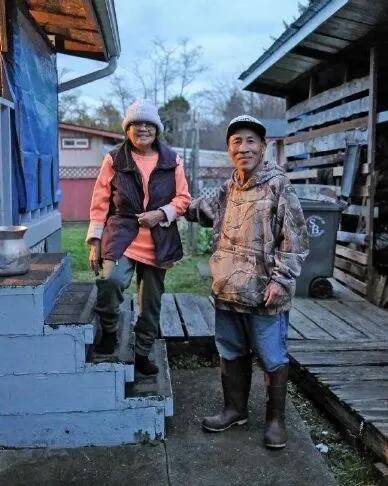
A half-century after he swam to freedom across a river full of death, Souphommanichanh’s entire being still vibrates with it. He has long since bought a house, paid off his truck, become a naturalized citizen, and retired from full-time work. The man is 78 years old. But he cannot help living his life as if tomorrow he might lose it and everything else he has ever worked for. His backyard woodshed is brimming with 30 truckloads of firewood. His yard is meticulously kept. His food — of which there is plenty, both for himself and for any guest who comes to the house — is still the same, simple food that sustained him when he first arrived: “Sticky rice, or fish, or egg. All day not hungry. Eat two times a day.”
His truck breaks down in the parking lot of the Shoalwater Bay Casino and he is under the hood with a hammer and pliers. His granddaughter’s partner — recently graduated and now working the oyster beds — falls on hard times and he takes the boy in. Out razor clamming at Twin Harbors, he zig-zags up and down the beach like a hound, making everybody else look like they’re sleepwalking.
Survival hasn’t meant further deprivation or tolerance of scarcity. Souphommanichanh has had enough of that. It has meant hard work, living within his means and never cutting corners. One could hope for such things in this new land. One would be rewarded for nothing less.
The Gaugers step up
What so many refugees hoped for, they dared to hope for largely because of one couple: Dave Gauger, former Navy lieutenant and publisher of The Raymond Herald, and his late wife, Mary “Rick” Gauger, former director of the Willapa Harbor Community Chorale. In their largess, much of the Laotian community on Willapa Harbor found a reason to keep hoping, whether for survival, advancement or acceptance.
The Gaugers alone sponsored 40 refugees. Of the refugee children mentioned thus far in this article, three actually lived with them for a time as foster children: Mounkhone, Gunnarson and Sinantha. In those early years of struggle and scarcity, when this new land seemed newest and when divergent senses of what was possible first began to fracture families, the Gaugers were both a safe haven and tireless advocates, and the children knew it. From opening a bank account to helping prepare a college application, renewing a registration to mediating a custody battle, no administrative task or life situation was too small or big for them to help with.
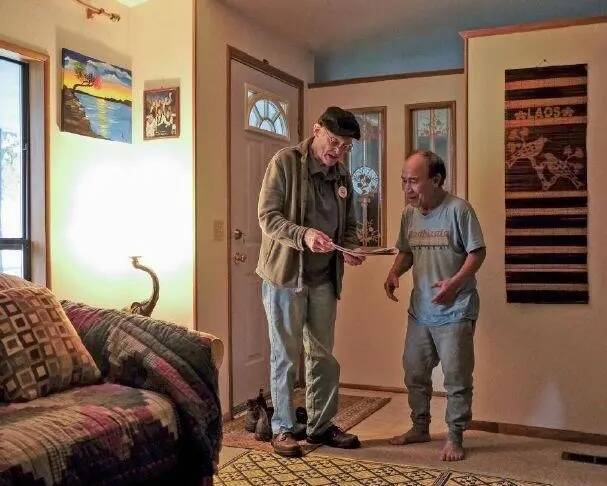
For two years Dave Gauger lobbied the U.S. Embassy in Bangkok to have Souphommanichanh’s older children released from the refugee camp, before finally getting Congressman Bonker involved. He was there at Sea-Tac Airport the day those children were reunited with their family. He drove Justin Mounkhone’s mother to the hospital the night he was born. If somebody was in trouble, he and Souphommanichanh would be called to mediate and translate. Once, Gauger spent an entire night in county jail comforting a distraught Laotian man. Only later did he learn that the man was Sinantha’s stepfather.
After his wife passed in 2022, Gauger realized that he would need to sell the five-bedroom, three-bathroom house that the couple had bought new in 1976 and lived in ever since.
“I started looking for a place to build a one-story bachelor pad, and Touk found out, and she said, ‘You quit looking. I’m going to build you a house. I have space behind my house.’ And I thought, ‘I can’t let her spoil me like that.’ And my Laotian foster son, Justin Mounkhone, flew in from Austin, Texas, and said, ‘Grandpa, let her love you. Let her love you.’”
In October, Mounkhone flew back up to help Grandpa Dave move in. Large, bay windows overlook the garden between his house and Sinantha’s. Gauger can see when her mother, who never knew that she could hope for any of this, comes over to check on the place.
And should he ever not pick up his phone twice in a row, Souphommanichanh will be over to check on him.