Color of Justice event connects students to careers in the law
Published 1:30 am Wednesday, February 25, 2026

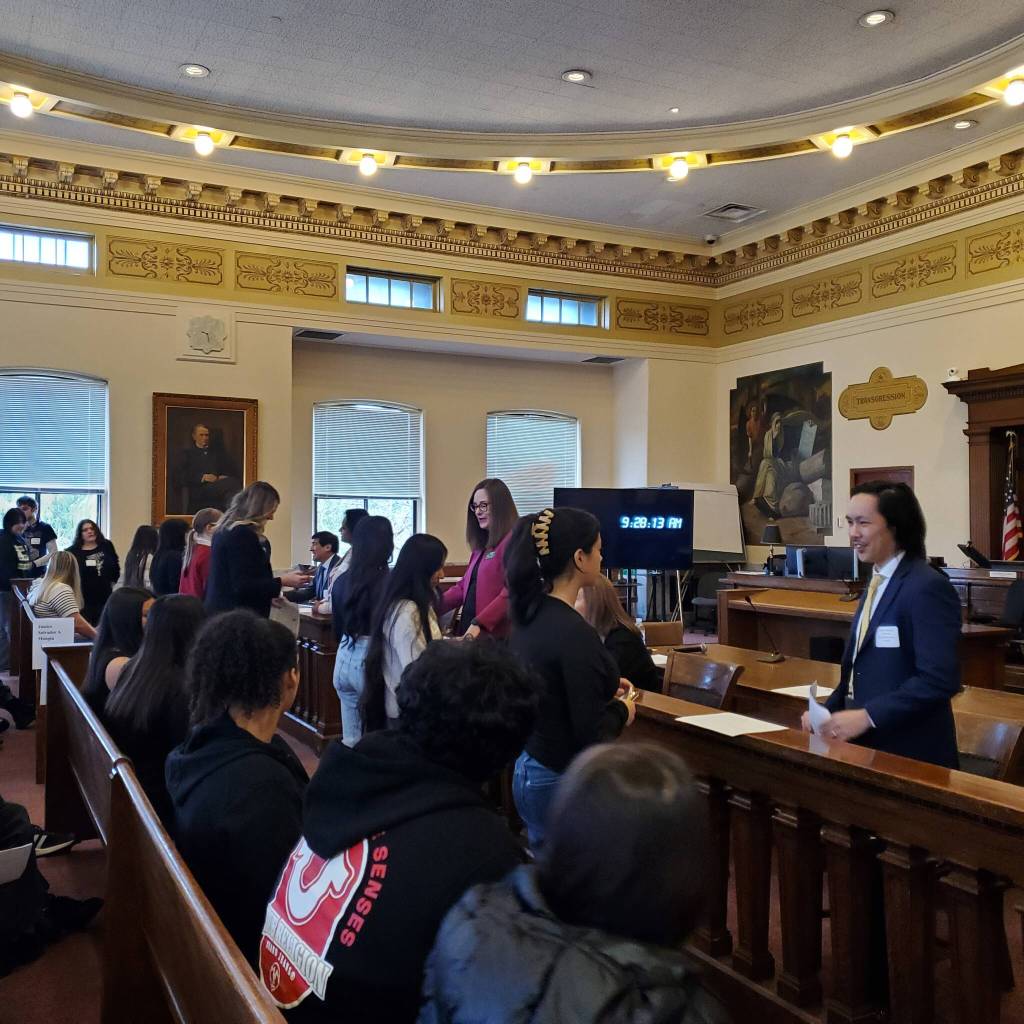


On Friday, Feb. 20, Grays Harbor County Superior Court had a modified day with only Judge Steven G. Jackson presiding over cases. Although Judge Katherine Svoboda and Judge Vini Samuel were in a courtroom, they were participating in the Color of Justice event that brought over 40 students in grades 8-10 from Aberdeen, Elma, Hoquiam, Lake Quinault, Montesano, North Beach, Ocosta, Oakville, and Taholah school districts to the Grays Harbor County courthouse in Montesano.
Regarding the closure of two of the courtrooms, “This is not possible unless your bench, and that is the Grays Harbor Superior Court bench, decides that this is a priority,” said Samuel, adding, “Your bench, which is the three of us and our commissioner [Jon Beltran], cannot express to you how important we believe each one of you are and the hope that we have in all of you in growing into the best person you can be. And also, maybe if we’re really, really lucky, that you will consider the legal profession in your future, and that you will also maybe become attorneys, and then maybe you’ll become a judge.”
Samuel applied for a Washington State Superior Court Judges Association scholarship in fall 2025 to cover the cost of the event, and lunch was sponsored by the Grays Harbor County Bar Association. To build this day’s agenda, she looked at Color of Justice events that were held elsewhere and tailored the topics to Grays Harbor students.
The day began with introductions. The panelists, in addition to Samuel and Svoboda, were Chief Judge Leona Colegrove, Quinault Tribal Court, Jason Vilaysanh, an attorney with Northwest Justice Project, Jon Beltran, commissioner with Grays Harbor County Superior Court, and Justice Salvador A. Mungia, Washington Supreme Court.
An icebreaker got everyone talking, with each student rotating to a panelist to ask questions, such as why they chose their law practice area, what is the most challenging thing about their job, and do all lawyers spend time in court.
The first half of the day featured the panelists discussing what inspired them to purse a career in law and what they find rewarding and challenging. In some cases, the panelists unflinchingly shared the ugliness of their inspiration, while the women described the challenge of balancing motherhood and law school. Collectively, the panel showed the students that there is no one path for entering the legal profession and that there is no single way in which law school is experienced. For some, they had the lowest grades in their academic careers and others enjoyed the law school experience.
Among the stories shared:
Mungia, whose mom came from Japan and his dad was from Mexico, saw how his parents were mistreated because of who they were. “Especially my mom,” he said. “I can never forget the look on my mom’s face when she knew she was being taken advantage of. And there was absolutely nothing she could do about it.”
As a second grader, one of Mungia’s favorite shows was Perry Mason. “I saw how he could stick up for those who had been wrongly accused. And I said, from second grade, that’s what I’m going to do,” Mungia told the students. “I’m going to be a lawyer because the stuff that’s happening to my parents isn’t going to happen to me or my family, so that’s what drove me to become a lawyer.”
Svoboda shared being told by a teacher in high school that she would waste her parents’ money attending a four-year university. After earning a degree and working in a job that she loved but thought was boring, it was reading So You Want to Go to Law School that prompted Svoboda to take the LSAT, which upon getting a good score and then being accepted into law school, prompted her to follow through.
Though she wanted to quit during her second year of law school, an internship with the Spokane County Prosecutor’s Office in the criminal division caused her to fall in love with the work and prompted her to chose being a prosecutor.
“Being able to be that voice in the courtroom for a vulnerable population meant a lot to me,” she said. “And now as a judge, some of the most important work we do is with our drug court and our mental health court, helping people that getting them off the criminal track and into a therapeutic track where they can get sober, get into recovery, work in the community.”
For Beltran, after he was discharged from the U.S. Army, he went to school for public relations and marketing but didn’t find it meaningful. It was Legally Blonde that prompted him to take the LSAT and then attend law school.
Why he likes law is that “I love to learn,” Beltran said. In his job, he deals with criminal law, family law, property law and local government law.
“I come from a family that was very political and from a very young age decided that I wanted to make a difference in my community and that’s why I decided that I wanted to be an attorney,” Colegrove told the students. “I very much believed that if you were on the right side of the law and you fought for your community, that you were on the right side…and I learned very quickly that that is not necessarily the case in the law.”
To counter this reality, Colegrove studied alternative dispute resolution, because “becoming a big negotiator would benefit my community more than fighting, [but I] ended up becoming a fighter anyway, and a judge.”
The panelists were also asked to define the law and how to improve the legal system.
“A lot of countries have the rule of whoever’s in charge at that particular moment, and so it’s very tough on people, it’s very tough on businesses, depending on whether you’re in favor of the person who’s in charge or not,” said Mungia. “Here, we have the rule of law, which means that regardless of who’s in charge, they have to abide by certain rules.”
Beltran prefaced his answer on how to improve the legal system by saying it is a bit odd. “I would improve it by making it less necessary. By the time that cases get to court, that’s usually years and years of things, like domestic violence, have been occurring, or because people didn’t have access to food, housing, shelter,” he said. “A lot of things that are the result of society’s issues end up in the courts because there’s nowhere else to go. … The court ends up having to, at time to deal with those things. I think that if we had more access to health care, more access to social services, more access to education, then we wouldn’t have to go to court so much.
And the panelists were also asked to describe the most challenging or rewarding aspects of their jobs.
“Being compassionate to the people that appear in front of me and understanding that they may not be their best self because they are in crisis of some kind and trying to give them some grace,” said Svoboda. “The rewarding thing is sometimes we really see people change their lives and do amazing things.”
Samuel shared that the least favorite part of the job are cases that involve dependencies, when the state intervenes to take children away and place them in foster care, and sentencing.
“When you sentence somebody to 10 years, or 20 years, or even five years, two years, they lose their job. Oftentimes they lose their families. They often lose custody of their children,” Samuel said. “You are devastating somebody, and the act is always justice and mercy, right? Balancing community and the individual, balancing the person who committed the crime versus the person who is the victim of that crime.”
“Being involved in the legal system can be a lot of trauma that you’re taking from the people who are your clients, because oftentimes they’re not coming to you unless something has gone terribly wrong in their lives or something terribly tragic has occurred,” said Vilaysanh. “And they’re really looking to you to be the person that can enforce their rights.”
To the question of how does it feel knowing they can’t make everyone happy, Colegrove said that happens a lot.
“I constantly grapple with decisions that I make because it’s such a small community,” she said. “I go into every decision knowing that I have to apply the law to the facts and put everything else outside of my head and not worry about what other people think, what other people say. … I know it going into it that the next day Facebook is going to blow up and my aunties are going to be ‘Did you see what she did?’”
Lunch gave the students opportunities to mingle with the panelists and other attorneys who visited for lunch, and the second part of the day focused on the options available for students to purse becoming an attorney and how to access funding.
“I do not want you to ever think that you are limited by your finances,” said Samuel. “Finances are a hardship and a challenge. This community is phenomenal in its support financially for its children.”
These speakers were Lori Christmas, director of educational partnerships with Grays Harbor College, Patty Lemon, dean of admissions and enrollment at Saint Martin’s University, Ashley Cummins, associate director of Access to Justice Institute at Seattle University School of Law, Katherine Skinner, the lead of the Law Clerk Program with the Washington State Bar Association and Dalma Ashby, a law clerk.
And though the focus of the panel was on funding opportunities, in their introduction each speaker also shared their career path, further reinforcing to the students that there isn’t a standard way to obtain an education and to not listen to the naysayers.
For example, Christmas, who has worked at GHC for nine years, shared that “I am so envious of people who know at a young age what they want to be or what they want to explore.”
In her remarks, Lemon dispelled some anxiety the students may have about the admissions process. “Basically, for a lot of people, they might think of it as gatekeeping, and I want you all to think of it differently,” she said. “I want you to think of it as you are raising your hand to saying yes and looking at going to pursue college.”
Lemon shared her background, a first-generation college graduate raised by an immigrant mother who didn’t learn English very well. “She wanted to provide me with a wonderful education, and she knew hat was the only way that would change the trajectory of our family’s life. She basically said, ‘You need to go to college,’ but she didn’t know how to navigate college.”
After a high school counselor told Lemon that she wasn’t college material, Lemon described herself as being crushed and embarrassed because she had applied to the University of Washington. She was accepted to both the University of Washington and the University of Puget Sound, the latter which is where she attended and earned a degree in music education.
“You can be anything you want. You have to look at yourself and look at all the gifts that you have and talents that you already have, and look at ways that you can see that in the future in your post-high school life,” Lemon said. “That’s what I wanted to share with you. Just know that you know how passionate I am about serving you and supporting you through your journey, because it is such a personal one.”
Skinner shared a bit about the Washington State Bar Association’s Law Clerk Program, which is an alternative to law school, whereby law clerks work and study with an attorney for four to six years and upon completing the program, they can sit for the bar exam. The financial expense is $2,000 a year, which is an affordable alternative to law school.
Following her introduction, Cummins thanked the students for taking the time to “come listen to a bunch of attorneys talk at you. I so wish that I had something like this as a high school student,” she said. “I was a first gen[eration] college grad, so even college was mystical to me, let alone law school.”
She described several programs that are available to reduce the cost and time of attending law school, such as the 3 plus 3 program, which is three years in undergrad and then three years in law school, or the Flex JD program, which allows students to attend law school while working.
“I’m all about trying to find different ways for you guys to get involved in the system and the justice system,” Cummins said.
Dalma Ashby, who was 2025 Miss Grays Harbor, described her path to being a law clerk through the Law Clerk Program. “I’m really, really excited for you all,” she told the students. “I really wish I had the opportunity to do something like this when I was your age.”
At the age of 24, Ashby broke from her family’s expectations to pursue a career in law on her own.
In the Q&A portion, Running Start was an option to earn college credits while attending high school. The panelists also encouraged students to apply for scholarships, as many go unawarded, and the importance of identifying deadlines early to avoid becoming overwhelmed when pulling together the scholarship materials. And not to be afraid of applying.
“Please, please, please apply. That’s just for anything and everything—jobs, school, and scholarships—apply,” said Cummins. “Don’t select yourself out of it, because you don’t know what doors you’re shutting on yourself when you do that.”
The panelists also emphasized that grades are a snapshot and that the admissions process looks at a student holistically. They also discussed how to build job or volunteer experience that can be added to a resume and the counseling resources available at college.
In closing out the day, Samuel said, that if any student returned to Grays Harbor to practice law, “it would be my honor, if I am here to swear you into this bar.”
Although the students still have a couple of years before deciding where to apply, to Samuel’s question of how many were now considering a career in law, more students raised their hand than they had in the morning when she posed the same question.