‘Pledge’ debate: A lesson in good manners; politeness wins
Published 1:30 am Monday, January 19, 2026
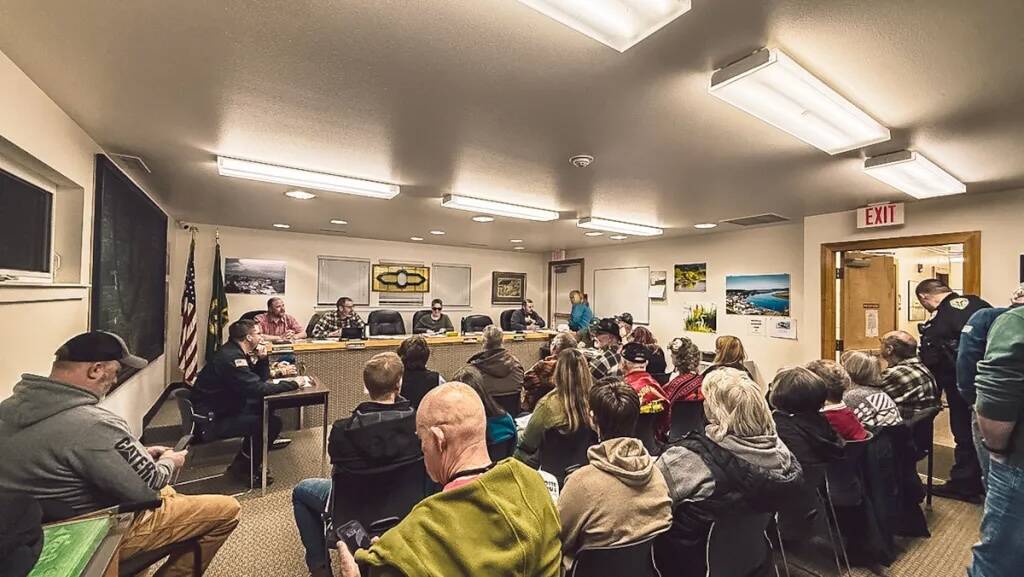
The country could learn a lesson in civil discourse from what transpired at the South Bend City Council meeting on Monday, Jan. 12. Tensions over the Pledge of Allegiance bubbled up in a remarkably respectful manner.
News trickled out on Friday, Jan. 9 that Bethany Barnard, the new mayor of South Bend, was planning to remove the pledge of allegiance from council meetings. In fact, it was learned over the weekend of Jan. 10-11 that she had sent out an email to city officials about the decision.
“As you may have noticed, the Pledge of Allegiance has been removed from the agenda,” Barnard said in an email dated 2:15 p.m. on Jan. 9. “I would like to invite a Council discussion on this topic during the meeting. Because I am not permitted to discuss this matter with more than two council members outside of our official meetings, I felt it was most appropriate to include everyone in this conversation. I would also like to share my perspective and note that, from a legal standpoint, we are not required to recite the Pledge of Allegiance during our meetings.”
“When we open every meeting by saying the Pledge of Allegiance, we make a promise. ‘Liberty and justice for all’ only works if it’s true for everyone in our community. Right now, it isn’t. Not for every family. Not for every worker. Not for every neighbor who struggles to be seen, heard or treated fairly. I believe in those words. I take them seriously. And because I take them seriously, I can’t start our meetings with something that asks people to recite a commitment we know we, as a nation, haven’t fully lived up to,” Barnard said.
The decision was criticized by residents who felt Barnard was pushing her personal beliefs through her official position. At the council meeting, the room was packed with residents who wanted to have their voices heard — and it didn’t take long.
Attendees speak up
Less than 30 seconds into the meeting, Don Corcoran, a retired fire chief from the South Bend Fire Department, stood up and interrupted Barnard challenging her decision and stating it was a disservice to start the meeting without the pledge.
Instead of turning the meeting into a free-for-all, Barnard asked Corcoran to just wait a few minutes until the topic would be formally discussed. She also thanked him for his comments and made it clear voices would be heard — good, bad or indifferent.
“If this is a definite result of somebody’s personal belief, then it is a violation of Chapter 4, Page 12 of your city council protocol to impose a personal opinion to be that of the entire council,” Jewel Hardy said. “So, if there is a personal agenda…then I would like to see transparency and know what that agenda is that has to do with the pledge of allegiance.”
“A lot of you know me already, I worked here before for 26 years and I’ve found that people don’t usually attend meetings unless there is something like this that comes up and then you are gonna have a house full,” Millie Clements said. “But I wanted to tell people, don’t take it out on the employees because they are at the whim of the mayor and the council and the mayor and the council are at your whim.”
“So, if you have complaints, you guys need to come in, in numbers and let the mayor and council know that you are unhappy about it, and the mayor answers to the council. I also disagree with [the decision] and I think a lot of people who have lost their loved ones, fight for that flag, and to say that it’s because it doesn’t have justice for all or whatever – those are words, I feel like we fought for that flag for years and that’s something that mean a lot to most of us that are American’s,” Clements added.
Carla Webber, a former council member who served for a number of years, provided the council with a heartfelt speech.
“You know how to bring a crowd, that is good,” Webber said. “So, of course what I want to talk about is eliminating the pledge. So, I prepared a statement. The pursuit of justice does matter deeply in this community. Many people have dedicated their lives to it, and some have lost their lives in its name. In this town, justice is not absent. It is lived out every day by hundreds of people doing valuable, often unseen work, both within our community and beyond our city limits. These efforts don’t contradict the pledge of allegiance, they embody it. Given that reality, I think it’s fair to ask why we are questioning the pledge of allegiance when the need for justice and the work being done in its name is so visible and so real in our community.”
Webber also read out a long list of the work being done locally and nationally including local crisis support workers, police officers, and the soldiers who continue and have fought for freedom.
“Removing the pledge risks sending the message that shared civic values should be set aside when they are difficult to live up to; history shows us otherwise,” Webber said. “The pledge has always been spoken during times of imperfection, during struggle, reform and change because it represents who we aspire to be, not who we plan to be. If we recite the Pledge of Allegiance once justice is fully achieved and only, do it that way we would never say it at all. So, I would like to ask you to please vote to reinstate the Pledge of Allegiance. Thank you.”
Another perspective
Not everyone in attendance was against the decision. Bob Hall, a former council member, even noted there was a long period in the council’s past that they did not use the pledge of allegiance at meetings, and that during that time business went on as usual.
“I have seen a lot of documentaries of the accounts with Hitler and with other dictators,” Cait O’Neil said. “And I see them doing these unthinking rituals, and I have not and will not ever salute the flag of this country. Part of the reason is, I am part Cherokee and am familiar with that history as well, very. So, even though – of course my father fought in World War II – and a number of my friends were drafted, so did not come back from Vietnam. It is not something that I can possibly do, I just cannot.”
Quick response
Following the public comment period, Barnard asked for a motion for the meeting’s agenda to be approved, and Councilman Darren Manlow immediately objected, and formally requested it be amended to immediately bring back the Pledge of Allegiance.
That motion was immediately seconded and subsequently approved by Councilwomen Teresa Ariss and Jan Davis and Councilmen Wyatt Kuiken, Norm Olsen and Manlow.
Following the vote, Kuiken asked, “Can we do the pledge now?”
Nearly everyone in attendance stood for the pledge, including Barnard, and many of those standing verbally recited, “I pledge allegiance to the flag of the United States of America and to the Republic for which it stands, one Nation under God, indivisible with liberty and justice for all.”
Liberty and justice for all?
It wasn’t until later in the meeting that the council members formally provided comments on the issue. Barnard also explained her decision, which was similar to her email on Jan. 9.
“I brought this forward, just like my oath of office to serve as mayor, words matter,” Barnard said. “Making a statement such as liberty and justice for all to our community doesn’t feel right and we all come to this discussion with different life experiences. I understand that not all of us have the same opinion, and I respect that. That is why we are here to grow and listen and learn from each other’s perspective. And so, I just wanted to say that, and I appreciate everyone for sharing their thoughts.”
Throughout the public commenting period on the issue, Barnard thanked each and every speaker for offering their remarks.
Following her remarks, Barnard also asked the council members if they wanted to speak, and Kuiken immediately spoke up.
“I 100% believe in conducting the pledge,” Kuiken said. “When you look at it from patriotic unity, the pledge serves as a reminder that citizens are part of something bigger than themselves, fostering a sense of national unity and respect for the country, honoring the sacrifice. For many, reciting the pledge is a way to honor the soldiers and veterans who have fought and died for the freedoms [that] the U.S. Constitution provides, including my family, acknowledges the founding.”
“I don’t believe under God is not a religious statement, but an acknowledgement of the founders belief that American freedoms come from the creator not from the State providing the basis for our unalienable rights. Optional participation, granted to you by your Constitution — the pledge can remain as an optional activity respecting both those who wish to say it, and those who do not. Once again, proving the constitution still allows individual freedoms,” Kuiken added.
“I’d like to say that I really liked what Carla said, and we may not have liberty and justice for all — not in my lifetime anyway,” Davis said. “But it is something to strive for and to remind us to continue the way forward towards that and also if you don’t want to say it, you don’t have to stand, you don’t have to say it, but it takes away from the people who want and need to say it.”