No quick fix readily available for Montesano’s Talbot Road
Published 1:30 am Friday, January 30, 2026
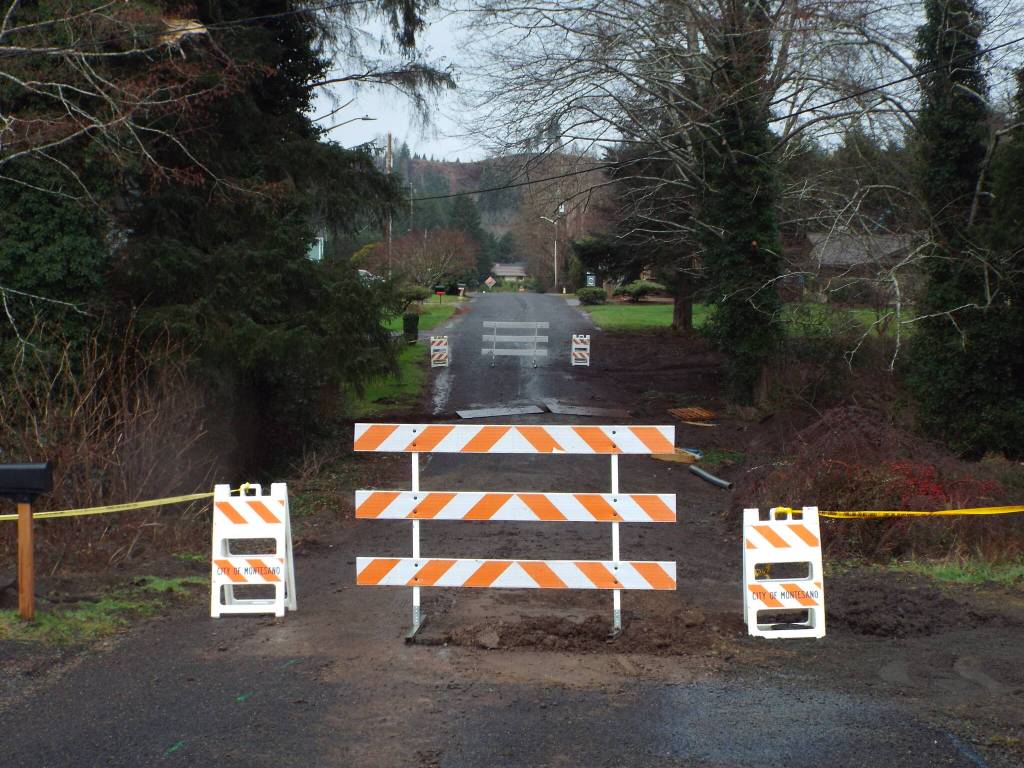
During the Montesano City Council meeting on Jan. 27, the city council approved adoption of Resolution 1032, an emergency declaration for the culvert failure on Talbot Street.
Prior to the council’s approval, Public Works/Community Development Director Mike Olden, P.E., gave an overview of the situation.
On Jan. 19, a water main break occurred on North Talbot Road due to the 24-inch culvert failure in the section of roadway north of Park Avenue; Talbot Road crosses over the Scofield Creek drainage, which flowed through the culvert. The water main break caused additional scouring in the area and exposed a two-inch gas main.
The reason for the emergency declaration, Olden said, is because “this road failure can affect one of our bigger pressure sewer mains, and it’s also a threat to utilities and water mains, and a significant safety and environmental concern, especially if the sewer mains were to fail; it would cause a lot of damage. We also have a threat to property.”
This threat to property is due to the Scofield Creek drainage backing up. At Olden’s request, a county surveyor examined the area and determined there is potential for flooding upstream of the culvert.
“There’s a pretty significant property that has some flooding potential that’s a good five to 10 feet below the top of the road,” Olden said. “What that means is if the water backs up, eventually that property would have at least five feet of water inside the building.”
The city has installed a diesel pump to pump the water out, and as of now, the water level hasn’t risen but that may change due to the rainfall expected over the weekend.
“If it really gets to be pretty evident that [the pump] is not going to keep up and that we’re going to have some upstream flooding, we will come in and start hauling out dirt out of that roadway so we can get a channel down to where it won’t flood upstream,” said Olden.
As for replacing the culvert, the Washington Department of Fish and Wildlife requires it be replaced with a fish passage structure because Scofield Creek drainage is fish bearing.
“The main challenge with a fish passage structure is it’ll take several years to complete, and it’ll probably range somewhere in the $1 million,” Olden said. “The good news is that Fish and Wildlife will allow us to do something temporary to deal with these emergent issues. However, if we do something temporary, they are going to put us under a memorandum of understanding or agreed order to install a fish passage.”
A reason for the $1 million price tag is because the drainage has a wide stream bottom and any structure would need to be at least 15-foot box culvert or large pipe.
“The other obvious solution is to open it up and have a stream flowing through there again,” Olden said.
Olden’s priority is to prevent upstream flooding and protect and preserve the utility corridor in case the road fails. City crews have already deadheaded the water pipes on either side of the culvert, and the gas company was scheduled before this past week to terminate both ends of the pipe and reroute the gas.
“The most difficult piece we have is our pressure sewer line; it’s one of the larger pressure sewer lines we have,” said Olden. “Fortunately, probably 15 years ago, we put in a loop system that allows us to take this one out of service temporarily, but we really need to preserve this corridor, especially for that sewer line for the future. And there’s a little uncertainty of whether cutting that off is not going to cause some maintenance problems for us. So we’re putting in some ability to put in a temporary bypass through the ravine or whatever we end up with there.”
For the immediate future, the road will remain closed.
Of the two solutions to temporarily alleviate the situation, installing a temporary culvert or digging out the channel, digging out the channel is the most cost-effective. Installing a temporary culvert would cost an estimated $200,000 to $300,000, and it would be removed when the fish passage structure is later installed. Digging the channel down to a satisfactory level or to the location of the old stream bed would cost between $50,000 to $100,000, which Olden cautioned is a rough estimate.
As for the permanent fish passage structure, “we don’t have $1 million in our back pocket right now to just go in and put the fish passage in without some help financially,” Olden said. “In the next three to five years, we’ll be beating down people’s doors to see what kind of funding we can bring in.”
After reviewing the budgets, Olden expects that there are funds in the budget to do the channel work. He is also looking into whether Federal Emergency Management Agency (FEMA) funding could cover a portion of the costs; nearly a decade ago, storm damage associated with this culvert had been eligible for FEMA funding and the current storm damage may also make it applicable for FEMA funding.