Lillian Walker: a civil rights pioneer, always educating
Published 1:30 am Friday, June 26, 2026


DEAR READER: One of the bravest, most inspirational people I’ve ever known was a tiny Black woman with the heart of a lion. Her gumption changed Washington history.
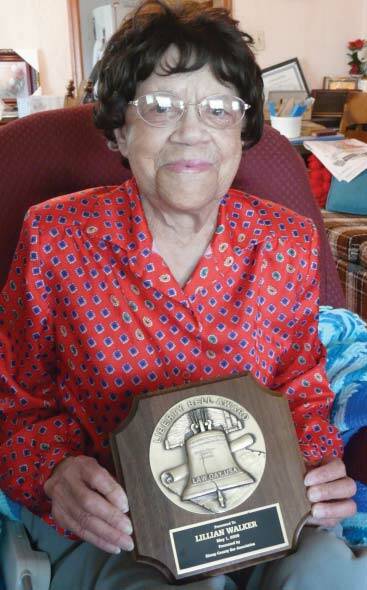
Lillian Walker was 95 when we first met, introduced to me by Judge J. Robin Hunt of the Washington Court of Appeals. Mrs. Walker had just received the 2009 Liberty Bell Award from the Kitsap County Bar Association. “Her courageous persistence to insist on equal rights has brought about change in our community,” the citation said. “She is the living embodiment of Lincoln’s Emancipation Proclamation and Martin Luther King’s dream. And she has accomplished these goals without rancor, but rather with an attitude that others simply needed to be ‘educated.’”
After listening to Mrs. Walker’s self-effacing acceptance speech, Attorney General Rob McKenna said it was the closest he would ever come to meeting Rosa Parks. I can’t put it better than that.
LILLIAN WAS BORN in 1913 in a shack on a 20-acre farm in rural Illinois. Her parents were mixed-race “mulattoes,” with links to a Tennessee slave master. Her parents had 11 children, six of whom died young. “Lord knows, life was hard,” Mrs. Walker told me, eyes misty. “Think of my poor mother. But they were never negative. Dad always said, ‘You can do anything anybody else can do.’”
She walked barefoot to a two-room elementary school. High school was three miles farther. “My folks insisted that we go to school. You didn’t dare miss a day. And in my family if you got a whipping at school, you got a whipping at home.”
Her dream was to become a doctor. After graduation from high school, she knew “we couldn’t afford college.” If she couldn’t be a doctor, she at least wanted to be a nurse. She was hired at a clinic for Blacks and other poor folks while taking correspondence courses in nursing.
In Chicago, she met an industrious, handsome young man, James T. Walker Sr.
As World War II enveloped the globe, James set out for Bremerton where the Navy shipyard was booming. He immediately landed a job and wired Lillian to join him as soon as she could. They married in Seattle. And, with everything they owned in a shopping bag, rented a room in Bremerton from a Black lady.
FOR BLACKS bogged down in the South and industrialized North, World War II provided an opportunity to enter the workforce, learn a trade and lead better lives. Thousands migrated to the Pacific Northwest.
But Jim Crow was here, too, together with trade union resistance to integration. The Aeronautical Mechanics Union local and Boeing management stonewalled the hiring of blacks — and white women — despite the growing need for war workers and President Roosevelt’s 1941 executive order calling for fair employment practices in labor and industry.
Bremerton was home to about 100 blacks in 1940. By the summer of 1944, about 4,600 were working for the military at the Navy Yard, the Ammunitions Depot and the Torpedo Station.
Bremerton’s population overall zoomed from 15,000 in 1940 to 75,000 by 1944. People of color and whites worked together with less animus at the Navy Yard, but Blacks knew that moving up to plum jobs would be tough. Nevertheless, James worked his way up to electronics inspector; Lillian became a custodian. And in 1944 she was named postmaster at Sinclair Park, the segregated housing project in Bremerton.
The Walkers became charter members of the Bremerton branch of the NAACP.
BLACK FOLKS were angry because many Bremerton businesses, including cafes, taverns, drug stores and barber shops, displayed signs saying, “We Cater to White Trade Only.” Woolworth’s lunch counter discriminated against blacks into the 1950s, and was the site of NAACP sit-ins. One morning, utterly without provocation, two white sailors jumped James Walker.
The bigots were part of the shipyard city’s wartime growing pains. “Bremerton was a white supremacist town,” Mrs. Walker told me. “I’d never experienced anything in Illinois like we encountered when we came here.”
The good news was that when Black folks began to assert themselves — despite salvos of death threats — righteous white people joined the cause. One was the Walkers’ neighbor, who vowed to shoot anyone who attacked Jim and Lillian for daring to expect equality. Another was a woman who stood shoulder to shoulder with Lillian when she was refused service at a downtown cafe.
Civil rights law was a paper tiger in Washington state. The 1890 Legislature, recoiling from the virulent anti-Chinese riots of the mid-1880s, passed a Public Accommodations Act that granted “all persons within the State of Washington … of whatever race, color or nationality … full and equal enjoyment” of hotels, theaters and restaurants, as well as trains, boats and coaches. The 1895 Legislature turned hard right, removing the penalties from the Public Accommodations Act. The move went largely unchallenged for years because prior to World War II, there had been few Blacks in Washington state.
James and Lillian Walker set out to change things. The Bremerton branch of the NAACP played a leading role in a statewide struggle that took another 25 years to achieve lasting victories. The state’s civil rights pioneers moved to the halls of the state Capitol to press their case for equal rights. Forging coalitions with progressive unions, ministerial associations and service clubs, they formed “Civic Unity” and “Civic Society” committees.
James Walker was the second president of the Bremerton branch of the NAACP; Lillian was the secretary. The Walkers played key roles in the push for a Fair Employment Practices Act, which was enacted by the Legislature in 1949.
BY THE END of the war, most of the whites-only signs in Bremerton had come down. An undercurrent of racism remained. The U.S. Supreme Court’s landmark 1954 decision on school desegregation galvanized the modern civil rights movement.
All that was lost on the Bremerton drug store owner who refused to let James Walker buy a cup of coffee at his soda fountain. “I didn’t serve n——- in Texas,” he declared, “and I’ll go to hell before I serve them here!”
To hell you say? The Bremerton branch of the NAACP was pleased to oblige.
After a strategy session with a Seattle civil rights attorney, James and his friend Whittier Johnson volunteered to throw down the gauntlet. The drug store man “didn’t know he was set up because we had white and black witnesses” there when he refused to serve the two men, Mrs. Walker told me. They filed a Kitsap County Superior Court complaint asserting that their civil rights had been violated.
The druggist settled out of court, grudgingly agreeing to cease discrimination. It was one more seemingly small step on the road to equality.
WHEN A SON and daughter arrived, the Walkers immersed themselves in the PTA, Campfire Girls, Cub Scouts, Boy Scouts and their church. James was a Mason; Lillian was an the Eastern Star and treasurer of the Bremerton Garden Club. She was also on the Regional Library Board.
When James died in 2000, their friends — a thousand strong — kept her “upright and engaged on the sunny side,” as she put it.
The PTA gave her its Golden Acorn. The YWCA gave her its Founder’s Award. The NAACP called her “a living treasure,” and the National Association of Colored Women’s Clubs awarded her its Lifetime Achievement Award.
“We’ve come a long way in Bremerton,” Mrs. Walker said in 2009. “America has come a long way, too. But ignorance loves backsliding. It’s like cancer. If you let it go, it keeps spreading.”
She died three years later. Her legacy is immortal. Clearly, we still have a lot of “educating” to do.
John C. Hughes was chief historian for the Office of the Secretary of State for 17 years after retiring as editor and publisher of The Daily World in 2008.