DNR confronts operating cash crunch
Published 1:30 am Tuesday, May 12, 2026
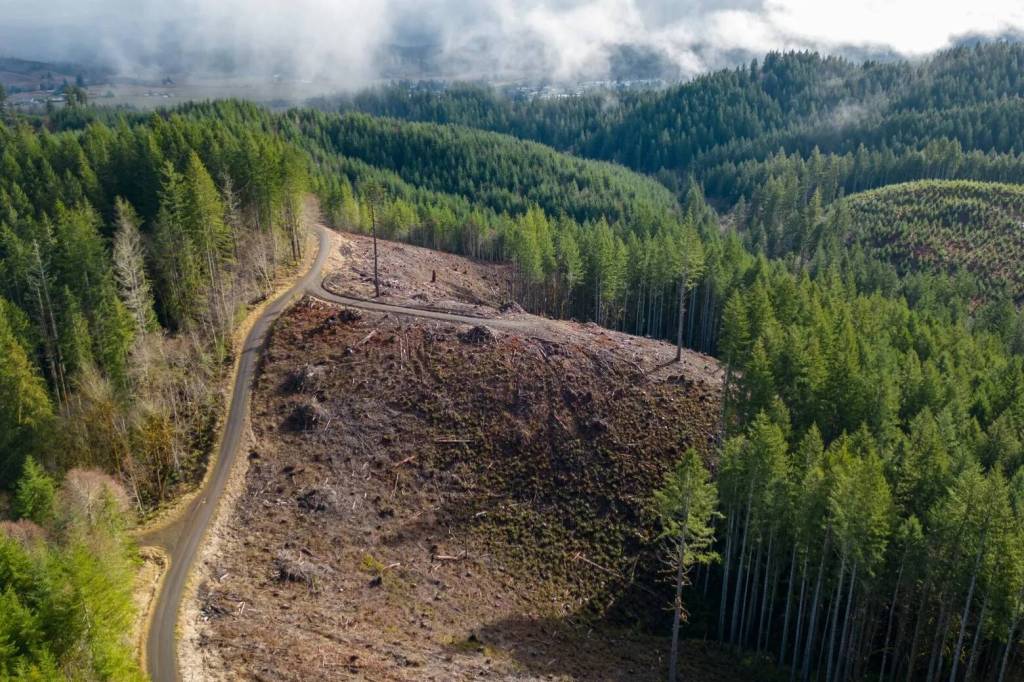
A regional timber industry group warns that Washington’s Department of Natural Resources is headed for deep budget trouble that will result in state worker layoffs and force taxpayers to foot more of the bill to keep the agency running.
Counties that rely on logging revenue from land the agency manages could be at financial risk, too, argues the American Forest Resource Council.
While it’s become common for the group to clash with the department, they’re not the only ones complaining.
Foresters inside the agency are pointing to Public Lands Commissioner Dave Upthegrove’s decision to pause some timber sales for eight months as a reason for the looming deficit in a key operating account, which covers many of the department’s expenses for managing timberland.
The account is on track to go negative by mid-summer.
Upthegrove and other agency leadership say recent management decisions are not to blame for the low balance. They say it has less to do with recent timber sale activity on state land and more to do with the timing of when logging revenue reaches the agency.
That’s because the Department of Natural Resources is only paid 10% of the auction price at the time of a timber sale. Loggers then have three years to harvest trees and often wait until lumber prices are higher to cut.
“We have more than $20 million in sales that we haven’t gotten the money from yet because the trees haven’t been removed,” Upthegrove told the Standard.
He rejected the idea that his policy decision to move older tracts of trees — which some call “legacy forests” — out of the logging rotation has anything to do with the budget difficulties. Upthegrove ordered last year’s pause on sales to identify which forests to set aside.
“It’s darn near nothing to do with this conversation about older forests,” Upthegrove said.
Timber harvesting hit a 22-year low last year, but it’s on the rise now, according to Heath Heikkila, director of government affairs with the American Forest Resource Council.
“It’s a cash receipts business,” Heikkila said. He argues that if Upthegrove continues his policy of foregoing logging of some older forests, there will be “inevitable layoffs” at the agency.
He also made a case that the issues around timber prices are more nuanced than what the department’s leadership is presenting.
“While it is true that some commodity wood products have seen reduced markets in recent months, many of the sales that were paused or pulled by the agency contained wood types that go into products for which very strong markets remain,” he said.
Amanda Hacker, president of the Washington Public Employees Association, one of the unions that represents Department of Natural Resources employees, believes agency leadership is at fault for the low account balance.
“DNR leadership has attempted to attribute this situation to market conditions and external factors, without acknowledging the role of its own decisions,” Hacker said.
“When you stop generating revenue for the better part of a year, the outcome is entirely predictable,” Hacker added. “The current shortfall is the direct result of those choices.”
The timber sale pause, she said, will have consequences that extend beyond this fiscal year because it creates a gap in the revenue pipeline that will eventually hit.
Hacker also emphasized that if the agency falls behind managing forest land due to its budget problems, it could bog down sales and hurt revenue for schools and counties.
“This is not just about agency operations,” she said. “It affects trust beneficiaries, rural economies, and the public at large.”
Five of the nearly 30 paused timber sales were added to 77,000 acres of “structurally complex” older forests that will remain out of the logging rotations.
Five others in the Elwha River watershed are still on pause due to action the Legislature took last year, according to Michael Kelly, communications director for the agency. All others were eventually sold.
Sales that were paused or canceled under Upthegrove’s directive were a “double whammy” on the agency budget because it had already spent money to do prep work but never received the revenue, said Heikkila.
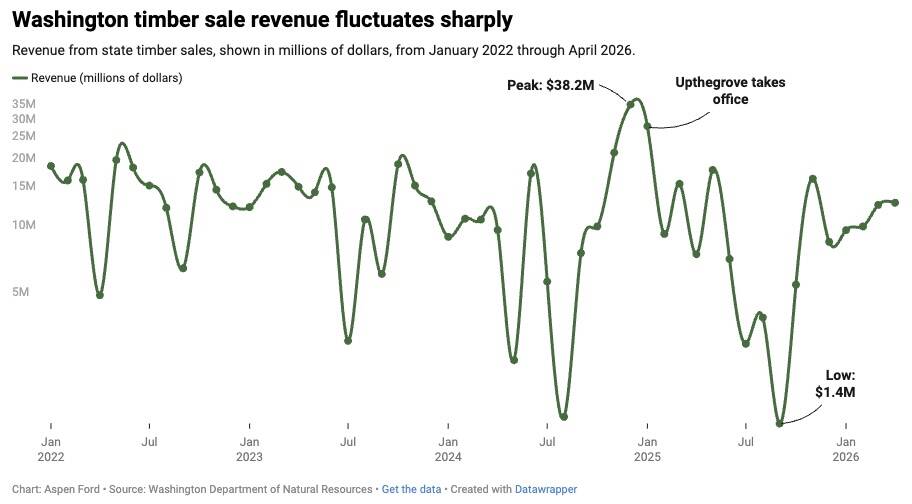
Monthly timber sale revenue hit a four-year high, at over $38 million, in December 2024, just before Upthegrove’s inauguration. In September last year, the same month that most paused timber sales went back online, the monthly sale value was just $1.4 million.
The latest available data from April shows the agency sold $13.8 million worth of timber for the month.
The Department of Natural Resources receives 25% of timber sale revenue. The rest goes to counties and junior taxing districts, including schools and fire districts.
Now, an account funded entirely by state timber sales is projected to be in the red by June, and it’s not expected to bounce back in the next fiscal year, the agency’s revenue forecast shows.
The Forest Development Account funds land management, timber sale prep and at least partial salaries for hundreds of employees.
The account balance has fallen from nearly $19 million to just over $1 million in the span of two years, balance sheet records obtained by the Standard show.
“Whatever challenges may face the agency, our union scientists and field staff can’t work toward addressing them if they aren’t getting paid,” said Ava Clarridge, president of Washington Federation of State Employees Local 443, which represents more than 500 department employees.
“DNR management needs to meet the state’s sustainable timber harvest level to support that account and the state workers who depend on it,” Clarridge added.
In February, Duane Emmons, assistant deputy supervisor of state uplands, directed employees to stop certain work on state logging lands, including some thinning and surveying, until further notice.
“Expenditures have been exceeding revenues the last four quarters. We’re in this situation largely because of factors outside the agency’s control,” Emmons wrote, citing the timing of when logging revenue comes in, tariff uncertainty and the fluctuating timber prices.
If timber harvests continue increasing as they did in March and April, the Forest Development Account could start ticking back up, Emmons said in an interview, but with fuel prices high, purchasers could choose to delay harvesting and the revenue could keep falling.
“It’s really a wait-and-see game right now,” Emmons said.
As for the possibility of layoffs, “we haven’t even considered it,” he added.
“We’re nowhere near the 2009 recession, where we had to lay off a number of staff. The economy is not at that level. This is, you know, a short-term blip.”
In former Public Lands Commissioner Hilary Franz’s first term, the agency faced a similar decline in the account, Emmons said. In response, it deployed the same strategy of limiting management practices until the deficit passed.
But the problem may be bigger than just the timing of logging and revenue collections. Upthegrove suggested there could be a more structural issue, as timber prices have not kept pace with inflation, which is driving up the agency’s costs.
“As our cost goes up and the revenue stays the same, I’m beginning to question whether or not we’re selling timber at a loss,” he said. “We have to be incredibly, incredibly efficient in order to make this all balance out.”