Have you seen the noxious weed garlic mustard?
Published 1:30 am Wednesday, October 1, 2025
In early September, the Benton Soil & Water Conservation District (Benton SWCD) announced that the Oregon Department of Fish and Wildlife found garlic mustard on private property south of Corvallis, Oregon.
Fortunately, through the swift, coordinated effort of Benton SWCD, Oregon Department of Agriculture, and Greenbelt Land Trust, the acre of garlic mustard is being treated.
Why would the Grays Harbor Noxious Weed Control Board share a Facebook post about garlic mustard found in a county in Oregon? Because this class A noxious weed is also found in Washington state. And perhaps more importantly for people who care about forests, garlic mustard poses a threat to the native plants that grow in the forest understory.
“Similar to yellow archangel, it appears very early in the season and will establish dominance before natives have a chance to re-emerge or germinate,” Danika Davis, the Grays Harbor noxious weed coordinator shared via email. “But, like most noxious weeds, it can really establish anywhere.”
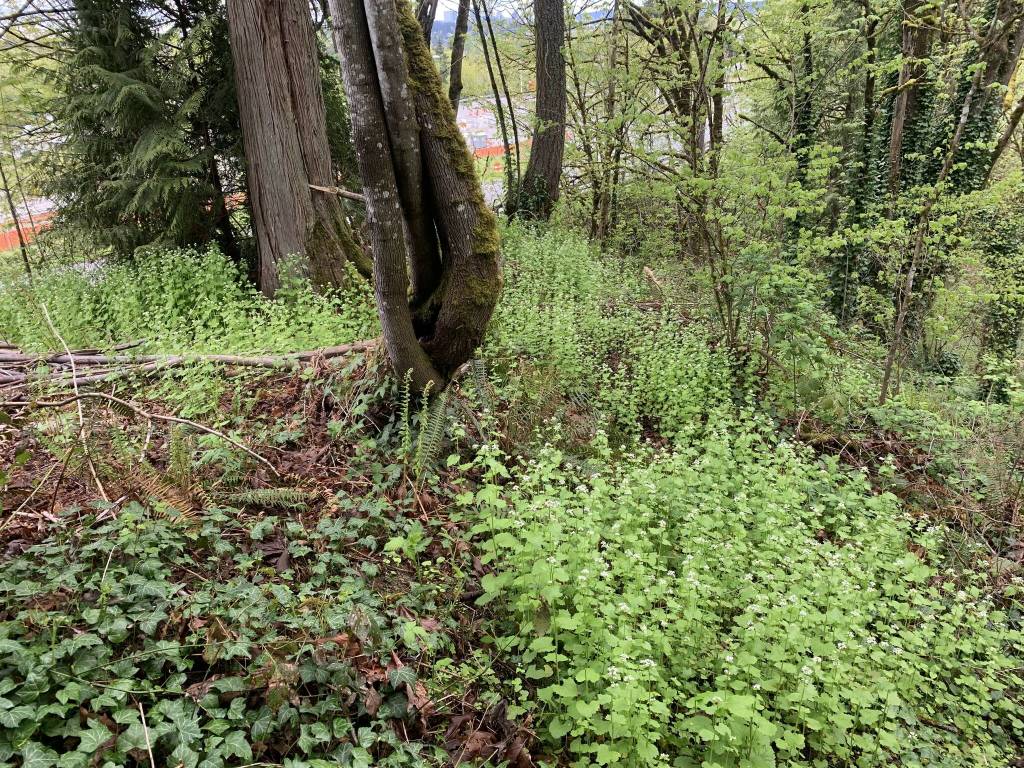
Garlic mustard, as its name implies, smells like garlic. This perennial plant is native to Africa, Europe and Asia. It grows up to three feet high and has white flowers. Garlic mustard is allelopathic, meaning it produces chemicals that may affect other plants and it’s been documented to negatively affect soil fungi, which other native plants need for their growth.
It does resemble natives, which can make identification challenging. On the King Department of Natural Resources and Parks Garlic Mustard webpage, they list these commonly mistaken native plants: common nipplewort, fringe cups, mallow, money plant, piggyback, stinging nettle and wild violets.
In Feb. 2024, the Washington Department of Agriculture published a map of garlic mustard’s distribution in the state: Clark and Spokane counties have infestations ranging from 100-1,000 acres, and King and Whatcom counties have infestations ranging from 10-100 acres. At this time, Grays Harbor County has no known infestations, which is why Davis is proactive in alerting people to this plant.
“We are so heavily focused on the river systems (due to our priorities being dictated by our grant funding (and salmon habitat restoration is super important)), the fear is that this plant could be introduced and spread rapidly before we even detected its presence,” Davis wrote via email.
The extent to which purple loosestrife has spread in Grays Harbor County is an example of what happens when a noxious weed goes undetected. And earlier this summer, the King County Noxious Weed Program found an infestation on Vashon Island, demonstrating the ease in which this plant is carried to new locations and become established.
As for where people can be on the lookout for where garlic mustard might be found, Davis wrote that “we will most likely see it in a high-traffic area such as a rest stop or popular destination/attraction; that is assuming it isn’t brought in via material such as gravel, mulch or hay. Weeds that come in with contaminated materials can end up anywhere. I know there’s a large infestation in Clark County and a few of them in King County, so I would honestly expect it to come in via a major highway (either on tires, shoe treads or through contaminated materials) versus natural spread from an adjacent county.”
If people think they have found garlic mustard, contact Davis at danika.davis@graysharbor.us.