A new location decided for Elma High School’s Davis Field
Published 1:30 am Tuesday, June 30, 2026
After a series of facilities meetings this spring to discuss infrastructure projects for the Elma School District to pursue, a consensus has been reached for Davis Field.
At the facilities meeting held on June 17, Superintendent Chris Nesmith announced to the audience that Davis Field and the track will be moved to the new elementary athletic complex.
Prior to this announcement, Nesmith gave a recap of information shared at earlier meetings regarding the infrastructure realities the district is facing and that support why the decision to move was made
An inspection of Davis Field by the district’s insurance company reported ADA accessibility concerns, limited restroom access, saturated soils and drainage concerns. The latter two issues means turf can’t be placed, which means Davis Field can’t host playoffs.
As for the track, the inspection cited surface damage, sinkholes affecting three lanes and deterioration resulting from repeated floods. Repairing the track will cost about $30,000.
Pursuing grants isn’t an option because not enough games are played at Davis Field to qualify. Additionally, the report said that relocating the athletic facilities would improve athlete safety and reduce insurance costs.
“The question is how do we honor where Davis Field has always been but how can we be most fiscally responsible?” said Nesmith.
Because of this reality, Nesmith outlined for the audience why moving Davis Field to the elementary athletic complex makes long-term fiscal sense. The $1.2 million grant from the Recreation and Conservation Office (RCO) will fund the installing utilities and irrigation, leveling and applying sod.
“Any work we need to do, the foundation is in place so we can now just continue to add fields,” Nesmith said, adding “It’s literally going to be a great big grass field with irrigation and utilities.”
Proponents for moving Davis Field were students who attended the last facilities meeting. They called out their high rate of injuries and being unable to build as reasons for justifying the move.
Additionally, integrating Davis Field within the new athletic complex is feasible under the existing RCO grant.
“We’ve already got clearance from RCO,” Nesmith said. “We thought we were going to have to when I first presented this. … RCO has already said that we can begin implementing this work.”
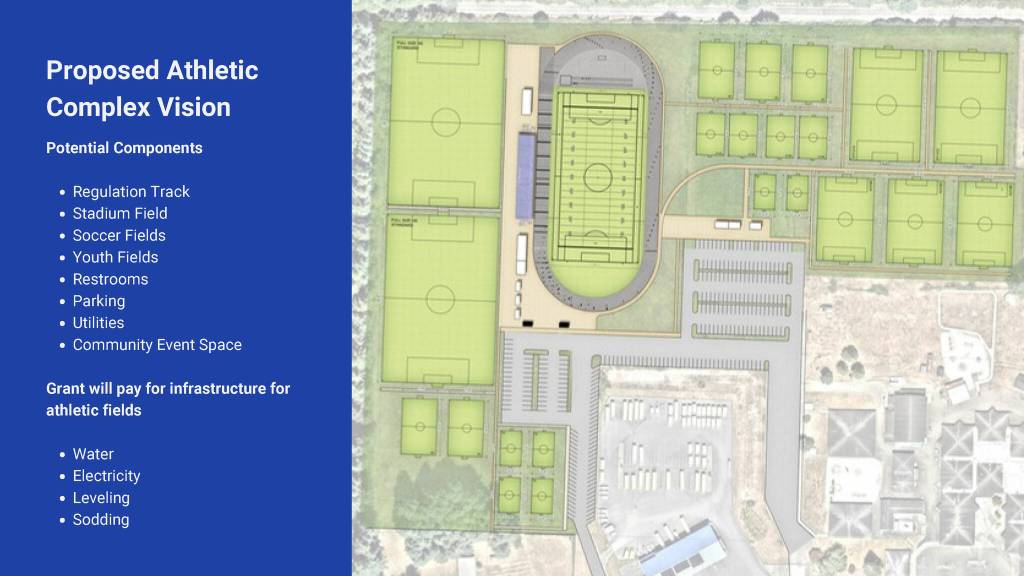
SCJ Alliance, the consultant working on the project created a mockup of what the field and track configurations could look like, which Nesmith shared.
“The only things that are non-negotiables is we would like to see where the track would go and where we would like to have the stands,” said Nesmith. “We want the field running north-south, so nobody has to play into the sun, and we want the stands facing to the east, so no one has the rain blowing in their face.”
A breakdown of the estimated costs for each component of the project is: the track — $1 million, the football field — $3 million, stadium seating and press box — $1.6 million, and restrooms — $350,000. Hosting playoff games would require adding concessions — $600,000 and locker rooms — $700,000. In total, the current estimate is $13 million with soft costs.
Anticipating the audience asking about funding, Nesmith provided a crosswalk of funding sources and the component funded. A district commitment of $2.1 million could fund the stadium seating and press box. This would leave the field, asphalt removal from the elementary, new parking, concessions and locker rooms not covered, and a shortfall of $8.9 million.
As for how to close that gap, “the board would like to know what your thoughts are,” said Nesmith.
Based upon Aberdeen’s Rep. Jim Walsh’s recommendation, the district could pursue a 2027 legislature ask of $1.5 million.
“We took an hour tour out in Eatonville, and we feel really confident in the $1.5 million ask of cloning exactly what Eatonville has asked for and that will pay for the track and for the bathroom,” Nesmith said.
(In 2025, the Eatonville School District received at $1.2 million grant from RCO to renovate their track and field facilities at the high school, which included installing multipurpose synthetic turf. With a sponsor match of $1.45 million, the total project cost was $2.65 million.)
Additionally, funding could come from a proposed capital project levy. The proposed timeline would for the levy to be placed on the February 2027 ballot; if it passes breaking ground could occur as soon as August of next year.
“This is also part of the other reason we’re moving it [Davis Field],” Nesmith said. “If we move it, we can do pieces. … The nice part is, we get to have that conversation. Where Davis Field is located now, we don’t.”
To Nesmith’s impromptu straw poll of whether the audience supported a move of $2.1 million to make a commitment, many raised their hands in favor of the commitment.
As for next steps, they include the school board approving the 2027 budget, finalizing the scope of the project and conducting a feasibility study for the capital project levy in preparation for a meeting in August.
“We’re not sitting around doing nothing to do now in August,” Nesmith said. “We’ve been planning for a grant and trying to engage SCJ Alliance and start knocking down prices so that way it can bring you some more actionable information.”
Following the meeting, the Chance Brogan Memorial Foundation announced on Facebook that their remaining funds of $58,357 were donated to the Elma School District for the new stadium project.
“The school district has agreed that these funds will be used exclusively for the construction of the stadium when the project is ready to move forward,” they wrote. “We would like to sincerely thank everyone for your support and generosity. Your contributions have helped make this possible, and we are grateful for the community’s continued commitment to this project.”
At the school board meeting held the following week, the agenda included a facilities meeting update.
“We are fortunate enough to have this piece of property in our possession that we can actually act on, which is one of the things that actually I believe RCO said was probably one of the reasons why we were able to get that [grant],” said Michael Smith, chairperson of the school board. “Because the fact that we had the property, we have a need, we’re shovel ready. I know the whole district has been working really hard to put away money so that we could actually update some facility stuff. And I know that our staff has been creative in ways that we can go about doing that.”
In their Facebook post on June 21, the Save Davis Field Foundation provided a recap of the June 17 facilities meeting and shared that, “One important point discussed is that approximately two-thirds of the proposed levy projects are focused on student safety and infrastructure needs, including asphalt replacement, parking improvements, and other essential campus improvements. The athletic facilities are only one piece of a much larger conversation about improving district facilities for current and future students.”