GHC to hold public meeting about Lake Swano Dam
Published 1:30 am Friday, March 13, 2026
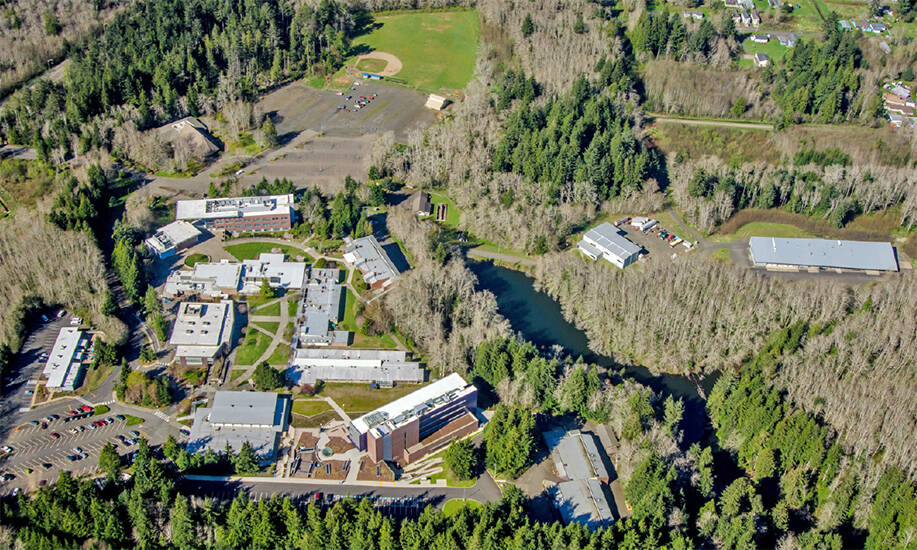
Grays Harbor College and KPFF Consulting Engineers will host a public meeting on March 16 at 6 p.m. to share information about the current condition of the Lake Swano Dam and discuss potential next steps.
The meeting will take place in the Jane Goldberg Boardroom on GHC’s Aberdeen campus (1620 Edward P. Smith Drive in room 3320) and will also be available on Zoom.
The Lake Swano Dam, located on the South Aberdeen campus, underwent a stability analysis in 2023, which concluded that the dam does not meet the standard factor of safety for seismic events or slope stability and may be at risk of future failure.
An alternatives analysis is currently underway. Options under evaluation include removing portions of the existing structure and reinforcing the dam to meet required safety standards, or fully removing the dam and replacing it with a culvert or bridge structure, which would drain Lake Swano and restore the area to a creek.
The history of Lake Swano
The Alder Creek watershed and Lake Swano have a long and colorful history. Human activities, since Europeans settled the area, have played a significant role in the shaping of the present landscape. Early in this century much of the lower two-mile reach of Alder Creek was ditched to drain the low-lying area of South Aberdeen and facilitate street construction and urban development. Lake Swano itself is an artificial lake.
It was created in 1948 by Swano Katalinich, the owner of a gravel pit located on the east side of Alder Creek. In the process of building an access road to the gravel pit, Katalinich dammed the stream, forming a small reservoir behind the dam. This reservoir later became known as Lake Swano.
The first Grays Harbor College classes were held on the present campus in 1958. Shortly thereafter, Dr. John M. Smith, a biology instructor began utilizing Lake Swano and its surroundings for educational purposes.
In 1962, the college purchased the Katalinich gravel pits, including the lake. During the following year the student council and campus clubs initiated the planning of a Swano Lake Improvement Project. The Engineers Club took the lead on the planning, but the project was never implemented. The project was revisited in 1969 when Dr. Smith and Dr. James Bicknell revised the plans. In 1970, Dr. Bicknell organized the Students for Environmental Action (SEA) group to construct a trail around the lake. A path was cleared along the east and west sides of the lake, but due to an apparent lack of interest and funding, the project was abandoned.
During the 1970’s, Dr. Smith and Don Samuelson, a fisheries instructor, developed a college fisheries program, utilizing the lake and Alder Creek as resources for salmon rearing. The first adult salmon returns resulting from their efforts was documented in 1974. In 1987 an Aquaculture Center, complete with a fish hatchery, was constructed along Alder Creek below the lake. The following year a fisheries habitat interpretive trail was constructed along the west side of Alder Creek, heading north from the hatchery. This trail was a joint effort of the college and the Grays Harbor Poggie Club, with funding provided by the Ben B. Cheney Foundation.
In 1984, a Lake Swano Committee was formed to plan the construction of the trail around the lake. Two years later, with funding provided by the Associated Students of Grays Harbor College, the Fish and Wildlife Club greatly improved access to the lake by installing steps down the hillside from the Natural Sciences (300) Building. In 1989 a Trail Planning Team was formed. It included college, as well as off-campus representation. A year later, a foot path was established completely around the lake.
In 1992, the Grays Harbor College Model Watershed interpretive trail construction began in earnest when the college was awarded a Centennial Clean Water Fund grant from the Washington State Department of Ecology (DOE). The aim of the grant was to construct 1.5 miles of interpretive trail, develop water quality education curricula and an implementation strategy, develop and implement a water quality public awareness program, and develop a water quality enhancement strategy for the Lake Swano/Alder Creek watershed. Approximately 1.8 miles of trail were surveyed and designed under this project, and with construction assistance provided through Washington State Department of Natural Resources “Jobs for the Environment” funding, roughly 1.4 miles of trail were installed. Curricula were gathered, a curriculum guide was compiled, and a baseline study of Lake Swano was performed. Interpretation research was conducted; however, funding was inadequate to complete a comprehensive interpretive plan, thus only trail head signs were installed.
Funding for a second phase of the project was awarded to the college by DOE in 1996. This second phase called for the completion of Americans with Disabilities Act (ADA) accessible trails, development of an interpretive plan and installation of interpretive signs, implementation of a watershed education center plan, creation of a public awareness plan, and water quality monitoring and enhancement.
In 1999, community collaborations were established and the accessible interpretive trail was completed. Today, the trail around Lake Swano is a popular destination for the Grays Harbor community.