Working through grief and finding love through humor and song in Hello, Dolly!
Published 1:30 am Friday, March 6, 2026
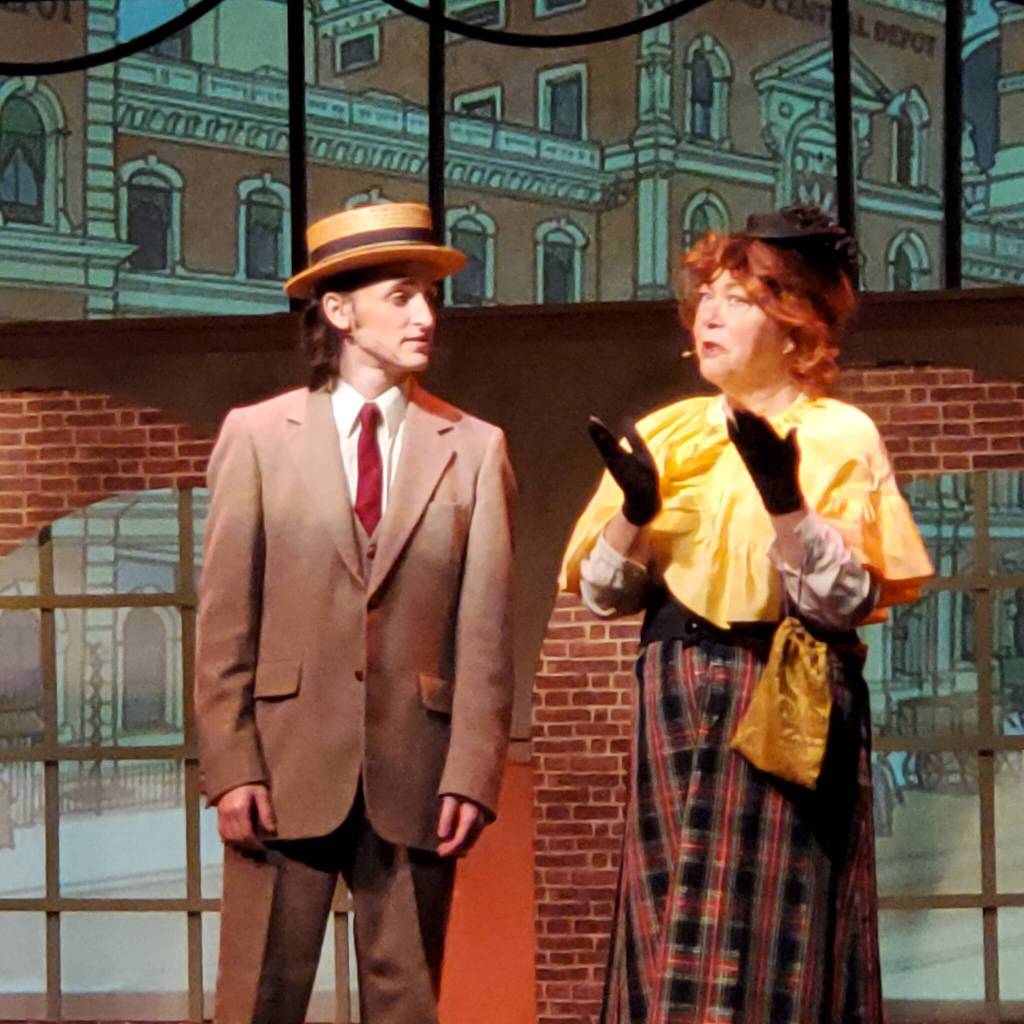


Early in the first act, exploding tomato cans and a dance sequence featuring performers in colorful costumes and bearing equally colorful parasols capture the humor and energy that is Hello, Dolly! And the appearance of a doctor’s buggy on loan from the Running Anvil Carriage Museum, located in Montesano, adds a historical touch to the musical’s set.
Directed by Dr. Andrew Gaines, head of Theatre Arts & Communication, Hello, Dolly! is the story of Dolly Gallager Levi, a widowed matchmaker who schemes to make a match of her own. For Patty Sundstrom, who plays Dolly, this isn’t the first time she’s acted in Hello, Dolly! When she was seven years old, Sundstrom was a performer in the parade and her father was Cornelius, the head clerk at the feed store that is owned by Horace Vandergelder, a widower.
“The message of having lost a spouse and moving on in life, that never hit me until we started doing the character analysis,” for this production, Sundstrom said. “And we’re like, ‘Oh, she’s ready to move on,’ and that’s what the parade’s about.”
The parade Sundstrom is referring to is part of the “Before the Parade Passes By” song that Dolly sings. This exploration of embracing the joy of life while honoring grief is a possible reason for its popularity since debuting in 1964.
Art Hoover, a retiree who’s a member of the ensemble and board member of the Driftwood Players in Aberdeen, said when reading the script, he was amazed at how funny and uplifting the play was.
“She [Dolly] says before the parade passes by, ‘I’m going to get back in there and live,’ because she feels empty. She’s a widow and feels like her life’s been on hold,” Hoover said. “And that’s a wonderful message for everyone, to roll up your sleeves and get out and live, and be involved with people.”
As a preview to opening night on Friday, March 6, The Daily World chatted with Gaines and a few of the actors before their dress rehearsal on March 3.
What follows is our conversation edited for length and clarity.
The Daily World: What motivated choosing Hello, Dolly! for the winter musical?
Dr. Andrew Gaines: This is my eighth year at the college, and we’ve settled into a bit of a rhythm that the seasons are curated now, oscillating back and forth between different styles or genres.
Starting back two years ago, we did Oklahoma! a Golden Age classic that some consider the first musical. It was a huge crowd pleaser; it was the first show that I’ve ever produced here that sold out.
Last year we did Groundhog Day, a musical with a contemporary rock score that was modestly attended, so I thought next year let’s do another Golden Age classic, and then next year we’ll do a contemporary show.
I like that idea of mixing it up, exposing audience members to different styles, but also exposing our actors to different things too. It’s important to diversify our offerings for multiple kinds of constituents, be they community actors or musicians.
One of my missions working at Grays Harbor College has been to try to produce shows that have never been done here in this space before.
TDW: What makes Hello Dolly! a classic?
Gaines: When it opened in 1964, it soon became one of the longest-running shows in Broadway history. The title song, “Hello, Dolly!” was number one on the Billboard charts by Louis Armstrong, famously knocking out the Beatles. It’s been a fixture in American culture for a long time, so in order to gain classic status, we need longevity, and it’s withstood the test of time.
TDW: Why do you think the story has withstood the test of time?
Gaines: One of my thoughts is that this is a show that just exudes pure joy. There’s a precious innocence about it. One of the main characters tells us, ‘I’ve never kissed a girl. I’m 33 years old and I’ve never kissed a girl and I better start sometime.’
That a 33-year-old man never kissed a girl and that’s not something to be ashamed of is so pure and so innocent that maybe it does make us as audience members kind of yearn for simpler times.
But also the source material for Hello, Dolly! dates back 200 years. This is an adaptation of an adaptation of an adaptation. The first version of this play written in the 1800s was a British farce, which was then adapted by a German playwright some 100 years later, which was then adapted by Thornton Wilder in early 1900s. Thornton Wilder, a very famous playwright, Pulitzer Prize-winning playwright who wrote Our Town, which is a favorite touchstone of mine because that was the first production I ever staged here.
He wrote a play called The Matchmaker, which was turned into a movie and then that was adapted into this musical, Hello, Dolly! Why has the source material been such an of interest to artists?
This is a story that asks a really simple question: What happens when a matchmaker needs her own match? That on its face is not necessarily a premise that should withstand the test of time, but here’s the twist— three of the main characters have all lost their spouses.
Going back to my first main point, it’s a story of exuding love and joy and innocence and playfulness, and sometimes it’s a little corny, but also so fun. But then underneath the surface, if you’re paying attention, there’s grief.
One of my favorite lines in the play is, ‘Isn’t the world full of wonderful things?’ Again, so innocent and so open. The world is full, because what’s the antithesis? Seeing the world as dark and foreboding and miserable?
I do wonder if one thing that’s helped this story be not just a corny tale with some really catchy tunes, is that it’s about something deeper, but arguably more subtle.
TDW: Circling back to the behind-the-scenes tech work that we chatted about backstage, such as lights, do you think audience members are unaware of the amount of tech support that is needed to stage a play?
Gaines: Speaking as an audience member, it seems magical. Sometimes it’s subtle because there’s so many sensory inputs. The music changes or the actors dance in a new way, and then we are enhancing, creating ornamental effects around it to complement it.
As an audience member, it may be happening at an unconscious level — there’s a new verse and I’m now feeling something different. Oh, I didn’t even realize that the lights turned red unless someone had pointed it out.
It is interesting looking under the hood, as it were, of the production and noticing there’s a lot of mechanics that are going on supporting it, some of which are invisible.
A really good example of that is the spotlights. Sitting above us is what we’ll call the catwalk, and there’s a spotlight on right now. When a song starts, typically, the lights dim. The stage lights dim and a spotlight comes on. As the spotlight is tracking the actor’s movements, the spotlight operator has to learn where to go. You don’t want to see what we call searchlights, when an actor steps out of the spotlight and then swings over. As soon as the actor steps out of the spotlight, audience now knows there’s a spotlight operator.
But if the operator is so attuned and has studied the actors’ movements, they anticipate. Think of it like synchronous swimming.
TDW: You’ve already done a few other interviews and promos for Hello, Dolly! What haven’t you shared yet?
Gaines: One thing that I haven’t been able to share is that my role as a director in the Bishop Center is different from other directing assignments I’ve had in my career. In this setting, I am not just the director, but I’m also lighting designer, associate choreographer, associate set designer and helping with props and set dressing. Every director contributes to all the departments, but the expectations for how much I am responsible for far exceed any directing assignment I’ve ever had in this particular theater.
I am so grateful for all the help I do have. I definitely would not be able to help the production become as fully realized as it is without all of these talented artists. I have an associate lighting designer. We have a lead choreographer. We have so many hands with the set painting and the props and costuming. If you look at the program, you see my name a lot because I contribute a lot, and I’m very proud of what me and all of the team have accomplished.
TDW: What makes theater the reason why everyone invests their time to stage performances?
Gaines: I’m compelled to do it because theater is such a powerful medium that is such an important contrast to what we typically enjoy as entertainment. This is a human art form — so many human hours have gone into developing this, and not in isolation, collaboratively. It’s a synchronous event where we have 40 performers. We’ve got a dozen stage crew. We’ve got 25 members in the pit. We’ve got four spotlight operators. We’ve got a couple of technicians in the back, and all the invisible people who did work to get us there. Let’s say 70 people synchronously all working together moment by moment, taking you through an experience.
TDW: Gary, you were in Anne Frank as Mr. van Daan. Did Hello, Dolly! rehearsals overlap with performing Anne Frank?
Gary Morean: Our initial cast meeting and read-through of the show was done while Anne Frank was cooking.
TDW: Why did you audition for Horace Vandergelder?
Morean: Patty, who is playing Dolly, and I, this will be our fifth time playing either husband and wife or getting married. We like to do theater together, and she wanted to come back.
I actually played Horace in the straight show at Driftwood 15 years ago. The original script Wilder wrote in the ’30s was The Merchant of Yonkers, which he then rewrote it, tweaked it a little bit, and it became The Matchmaker, which was a big hit on Broadway.
TDW: Patty, what attracted you to the role of Dolly?
Patty Sundstrom: She’s just one of those iconic roles that’s on my bucket list that I needed to play. There’s just some really great, we’ll call them divas if we will. She’s such a big character, a big role and I like a good challenge. Plus, I’m sort of a diva.
TDW: Having worked together many times, how does that come across on the stage?
Morean: We can pretty much anticipate what’s happening with the other person. We can even feed each other lines on stage without anybody really even knowing.
Sundstrom: No pun intended since we have a dinner scene together.
TDW: Why does Hello, Dolly! keep being staged?
Sundstrom: Oh, I think just that the message of getting back into life after loss.
Morean: The three main romantic leads are all widows, widowers. I’ve lost my spouse, she’s lost her spouse, and Mrs. Malloy has lost her spouse; that’s the original person I’m being set up with. There’s a sense of it’s time to move on.
TDW: What do you love about the production that you think other people will resonate with?
Morean: The music is great. The dancing is fun. There’s a lot of energy on stage. The orchestra is great. One of the largest pits we’ve ever had that Bill’s [Dyer, director of Music at GHC] ever conducted here. The good old-fashioned musical.
Opening night of this musical was Friday, March 6 at the Bishop Center for Performing Arts, and shows continue today and Sunday, and March 13-15. Tickets are available at https://www.ghc.edu/bishop.
Productions
March
The Shootout Saloon – Stage West Community Theatre
Oyhut Bay Seaside Resort, Ocean Shores
Supper, suspects, and a showdown-welcome to The Shootout Saloon. Two nights only, and if you miss it, even the tumbleweeds will gossip about you. Western attire welcome. An interactive murder mystery.
March 7 at 6 p.m. https://www.stagewestcommunitytheatre.org/
The Tortoise and the Hare – Montesano School District
Simpson Elementary Gym 519 W Simpson Ave, Montesano
The Missoula Children’s Theatre’s twist on Aesop’s classic is a hare-raising, ab-shell-lute whirlwind of fun! Taylor Tortoise and Curly Hare’s competitive antics are getting out of control, and all the other animals in their little town outside of Cape Canaveral, Florida, get roped into the shenanigans. When a group of astronauts comes through town, Curly Hare comes up with their kookiest stunt ever – to be the first animals on the moon!
March 7, 2 and 4:30 p.m. No cost for admission.
April
Once Upon a Mattress – Elma High School Drama
April 16 and 17 at 7 p.m. and 18 at 2 and 7 p.m.