Ocean Shores, Westport launch petitions over foghorn
Published 1:30 am Wednesday, August 27, 2025

The Battle of the Beaches usually involves an annual high school football game between North Beach and Ocosta.
There’s a trophy and everything. However, North Beach hasn’t beaten Ocosta in football since October of 2016, and if the residents of Westport have anything to do with it, that win streak will extend beyond the gridiron.
Residents of Ocean Shores recently launched a change.org petition to “Regulate Noise Pollution from South Jetty Sound Device,” while South Beach residents have started their own petition to keep the foghorn.
The petition against the Westport foghorn, originated by Ocean Shores resident Jonathan Cannon, states, “Ocean Shores is a quiet ocean environment. However, since June 8th, 2025 many homeowners in our neighborhood have been experiencing intrusive, pointless noise pollution emanating from a sound device located on the south jetty, near Westport.”
Cannon alleges that the Coast Guard is in violation of its own regulations and has tried to enlist the assistance of numerous elected officials including U.S. Rep. Emily Randall, D-3rd District, whose staff member, according to Cannon, has experienced the noise from the foghorn first-hand.
Cannon wrote: “On Aug. 11, 2025, I received a call from a field representative with Congresswoman Emily Randall’s office — she said the noise was clearly audible while we spoke on the phone. On Aug. 12 she came to our house to listen to the noise in person. After hearing it on our deck for a while we went inside. We closed our double-pane windows and the noise was still annoying. When she asked us if we would have bought here knowing that sound would be present we realized she appreciated the issue. We reviewed all the documents, emails, and illustrations I have received from the Coast Guard. She agreed the device was clearly malfunctioning and would address the issue with Congresswoman Randall and Senator Cantwell at their meeting the week of Aug. 18th. On Aug. 14th she notified me that a letter to the Coast Guard was being prepared to address the malfunctioning device.”
Cannon added, “As many of us know, the device operates erratically. It emits noise for a few days and nights, and then goes silent — at no point is there a correlation with weather conditions. It generates noise at odd intervals; its sporadic operation makes it undependable for boaters and irritating for everyone else.”
So far Cannon’s petition has garnered all of 33 verified signatures.
The Westport petition, started by “KJ,” and titled “Save the South Jetty Foghorn” states, “For years, Westport has thrived as a community-driven area, boasting the 10th largest marine market in the United States. The foghorn situated at the South Jetty has not only been a crucial safety measure for our working marina but also a beloved staple of our local culture. The removal of this foghorn would not only pose a safety hazard for boats navigating our waters but also signify a disregard for the traditions that have shaped our community.”
KJ goes on to write, “However, a small group of individuals seeks to silence the foghorn, citing concerns over noise pollution and property values in Ocean Shores, a popular tourist destination. While the aesthetic and economic considerations of the area are valuable, they should not overshadow the need for maritime safety and the preservation of our community’s traditions.”
KJ’s position has 984 verified signatures.
And yet a third petition, started by Westport City Administrator Tom Cappa, suggests making the foghorn even louder.
Cappa wrote: “By increasing the volume of the foghorn, or even adding a second one, we can better protect our fishing fleet, commercial vessels and recreational boaters. This is not just about sound, it’s about safety, tradition, and keeping alive the connection between our community and the sea. Enhancing the foghorn ensures Westport remains both a beacon of safety and a proud maritime town.”
Cappa’s petition has 110 verified signatures so far.
According to Van Isle Marina in British Columbia, “Foghorns, or fog signals, were historically used on land, from a lighthouse or other building, to warn sailors away from dangers when visibility was poor. In more recent times, they have adapted into an onboard navigation tool, used internationally as a sounding device.”
According to Fog Horn, a University of New Hampshire Undergraduate Ocean Research Project conducted from 2008‐2009, “Audible warning signals are necessary for ensuring the safety of nautical vessels in inclement weather conditions where a visible navigation beacon may become obscured. … Warning signals have been used for centuries as a method for warning nautical vessels of the presence of hazards and obstacles in open water. Such signals become necessary when visibility conditions are such that a warning beacon cannot be seen in time for the ship to change course. Thus, the nautical warning signal — or foghorn, as it is more commonly known — is an invaluable tool for navigation.”
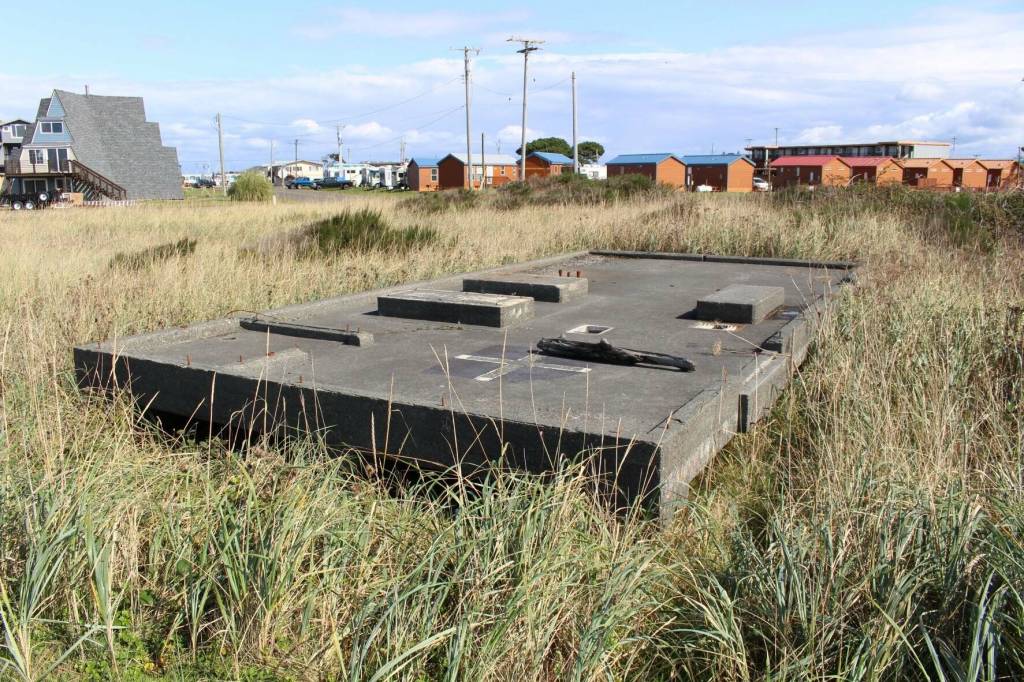
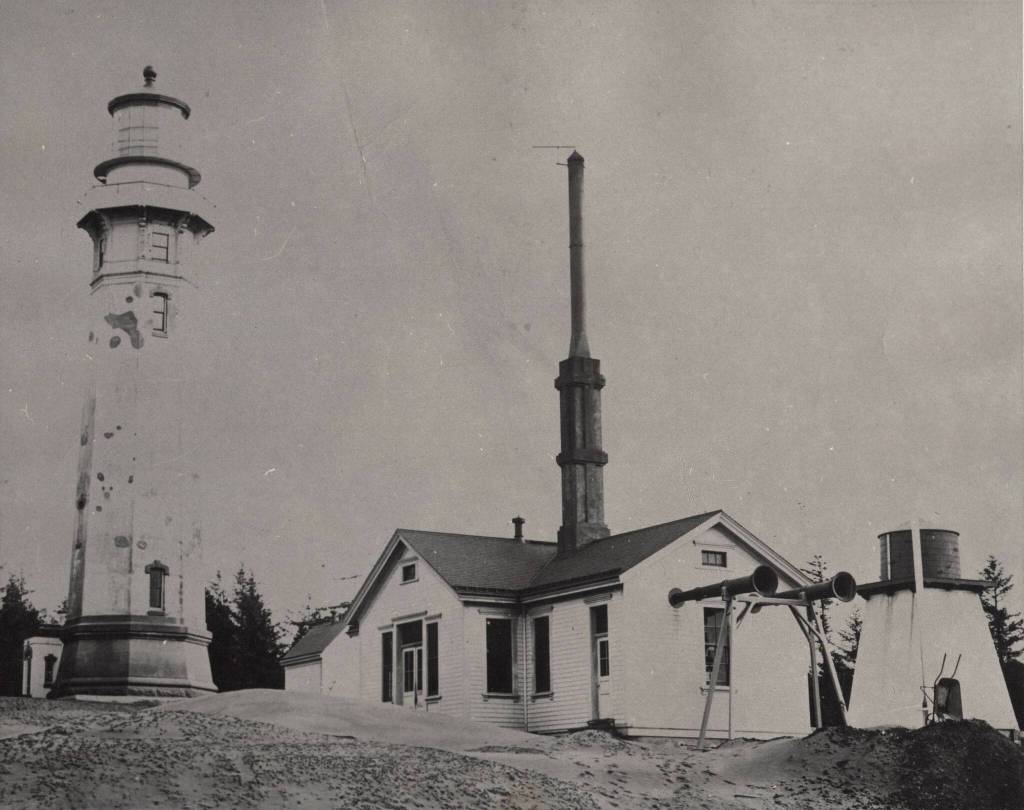
Westport’s fog signal dates back more than 100 years. The original fog signal building burned down in 1923. A new building, which included air sirens, was completed in 1926 and remained in service until 1946. The United States Coast Guard built a new fog signal near the south jetty at Half Moon Bay. Today, there is no permanent fog signal, however, the Coast Guard seasonally places a portable unit on the south jetty.
According to The History of Fog Signals by Wayne Wheeler posted on the United States Lighthouse Society’s website, “The first fog signals were rockets and cannons (or fog guns) developed in Europe in the 18th century. The first fog signal in this country was a cannon, which was installed at our first light station, Boston, in 1719. Ships entering Boston harbor fired a cannon and the keeper responded in kind. …
“The Coast Guard took over the Lighthouse Service in 1939 and after WWII began to make sweeping changes in the aids to navigation of this country. Compressed air strikers were replaced by battery-powered strikers that eventually tore themselves apart. Trumpets were gone by the 1950s and sirens and whistle signals by the late 1960s. Slowly the service phased in new electronic horns and phased out the difficult to maintain diaphones (the last were those on lightships) leaving, today, just a few diaphragms and the new electronic pure tone signals in existence.”
Although many land-based foghorns may be extinct, the Coast Guard is still compelled to place one at the south jetty as summer fog is quite common in the area.
And late Tuesday afternoon, the city of Westport announced a resolution passed by the city council.
“The Westport City Council has officially passed a resolution supporting the continued operation and sounding of the South Jetty foghorn. The foghorn is more than just a navigational aid, it’s a lifesaving safety feature, a cultural landmark, and a reminder of our proud maritime heritage. For generations, it has guided vessels safely through fog, storms, and low visibility conditions in and around Grays Harbor.”
The current petition score is South Beach 1,094 — North Beach 33. If a petition is the final arbiter, and recent football history is any indication, it looks like the trophy will be staying in South Beach.