Hoquiam’s ‘Theatre Beautiful’ 7th Street a national treasure
Published 1:30 am Saturday, November 15, 2025



Dear Reader:
Situated along its picturesque river, with handsome historic buildings that have managed to survive the highs and lows of an old timber-town’s existence, Hoquiam appears on the cusp of a renaissance.
The Polson Museum is one of the finest small museums in the Northwest; the Carnegie Library was remodeled and expanded in 1990 with great respect for its cultural and architectural significance; City Hall, the Post Office, Train Depot and Elks Lodge are intact, functioning landmarks; the LaVogue Building features a first-rate coffee shop-cafe-bakery, with the potential for so much more; Brunch 101, the 8th Street Ale House, and the Hoquiam Brewing Company are gems, and Emerson Manor — once the city’s finest hotel — has been preserved as apartments. There’s even a bona fide bookstore—so long as people care enough to support it, rather than just going to Amazon.
In contrast, Aberdeen’s once-grand hotel, the Morck, stands cold and empty, naked as the eyes of a clown, to borrow a great line by John Prine.
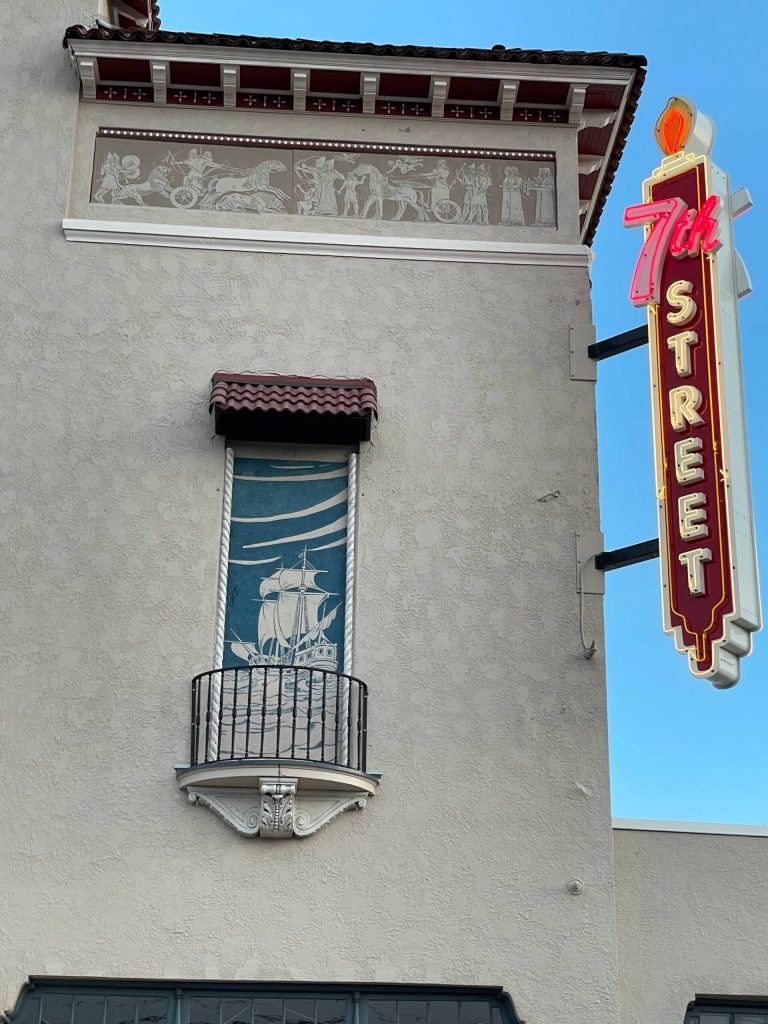
Of all these great buildings past and present, the most stunning survivor is one of the most unique and historically important theaters in America. On the night it opened in 1928, the 7th Street lived up to its billing as “Hoquiam’s Theatre Beautiful.” Today, freshly repainted, its Assyrian war chariot friezes and sailing galleon alcoves painstakingly restored, its “atmospheric” Spanish garden interior more stunning than ever, the 7th Street is an architectural masterpiece—a testimony to the vision and perseverance of hundreds of volunteers over the past 50 years.
I don’t want history to forget the spiritual godmother of the 7th Street’s survival: Else Korvell was a five-foot-tall force of nature. Hoquiam’s first female City Council member bristled when anyone called her “Elsie.” “It’s pronounced ‘Elsa,’” she’d scold, proud of her Danish roots. The former public health nurse arrived in Hoquiam in 1949 with her husband Jack, an old-school family practice doc who made house calls.
Else immersed herself as a patron of the local arts, boosting community concerts and organizing bus trips to performances in Seattle, Portland and Ashland. A movie-fan as well, she was aggrieved in 1958 when the 7th Street ended its reign as the Harbor’s premier first-run movie theater. So was I. Some of the happiest days of my childhood involved riding the bus from west Aberdeen to downtown Hoquiam for Saturday matinees at the 7th Street. On Christmas Eve 1954, I saw “White Christmas” at the 7th Street with my Mom and Aunt Madge, with Bing Crosby, Danny Kaye, Rosemary Clooney and Vera-Ellen in Paramount’s new high-resolution VistaVision. The concession stand crew and ushers were dressed as Santa’s elves.
FAST FORWARD to March 26, 1967. A feature story on the reopening of the 7th Street as a movie theater won me my first front-page byline as The Daily World’s Hoquiam reporter. Grays Harbor Theatres Inc. had taken over Fox West Coast’s leases on the 7th Street and Aberdeen’s venerable D&R Theater. The new company’s local managing partner was 31-year-old Al Balin, one great guy. We bonded over our love for movies.
Unfortunately, the 7th Street’s box-office receipts fell well short of expectations. There was even an attempt to attract a broader clientele by showing “art-film” movies, including Federico Fellini’s classic La Dolce Vita. That added up to arrivederci for the 7th Street’s second act. It reverted to beauty pageants, community concerts and high-school theatricals.
In 1975, Else Korvell began lobbying the City Council to purchase the theater and recruit a community board to spearhead its renovation. The doubters said the previous owners “ran up a bill of $500 a month just to heat the place on weekends.” One councilman said Else was “being a little bit selfish in this deal. She wants the opera down here,” but that kind of music was for “all those long-hairs,” not the “common people here.”
“Wanta bet?” Else shot back, emphasizing she wasn’t just talking about opera. With its wonderful acoustics, the 7th Street would be a great venue for all kinds of shows and music — “Country and Western, rock concerts, you name it,” she said. “Maybe even movies again.” In any case, “it would be so shortsighted” to let a community treasure lapse into disrepair. “It’s dusty and musty, but it doesn’t take much imagination to know that it could really be a grand place again,” the councilwoman said. “What we need is a group representing ‘The Friends of the Theater’ to pursue state and federal grants” and funding from cultural organizations to save nationally important historic buildings.
Thwarted for the time being, Else never gave up — by working behind the scenes to save the 7th Street.
In 1976, an enterprising young couple, Robert and Cheryl Serredell, purchased the theater, literally moved in and set about renovation on a shoe-string, hoping to at least break even. The meager profits from second-run movies and concert rentals could not keep the marquee illuminated.
THE BREAKTHROUGH came in 1986 when Ed Bowers, a philanthropic Hoquiam businessman, emerged as the major donor in a $100,000 fund drive that allowed the Grays Harbor Community Concert Association to purchase the theater. The 7th Street Theater Association went on to become one of the most fruitful labors of love in Grays Harbor history.
State Rep. Jim Hargrove, a Hoquiam Democrat with growing clout in the Legislature, championed the first of many capital budget grants to renovate the theater. The entire Coastal Caucus joined the cause.
Slowly at first, but surely, the transformation began. Volunteers with diverse skills — carpenters, painters, electricians, theater majors — took on all aspects of the restoration, from the leaky roof to the antique projection gear. Today the 7th Street is a wonder to behold. The popcorn is fabulous, too. No pretend butter!
Though Else never lived to see her dream come true, she must be smiling. Young at heart, she would have loved the sold-out Macklemore rap concert at the 7th Street in 2016.
I’ll write more about Harbor-area theaters in the weeks to come. Sadly, one for which hope had long vanished, is set for demolition.
John C. Hughes was chief historian for the Office of the Secretary of State for 17 years after retiring as editor and publisher of The Daily World in 2008.