McCleary initiates annexation review process on 43 acres
Published 1:30 am Monday, November 10, 2025

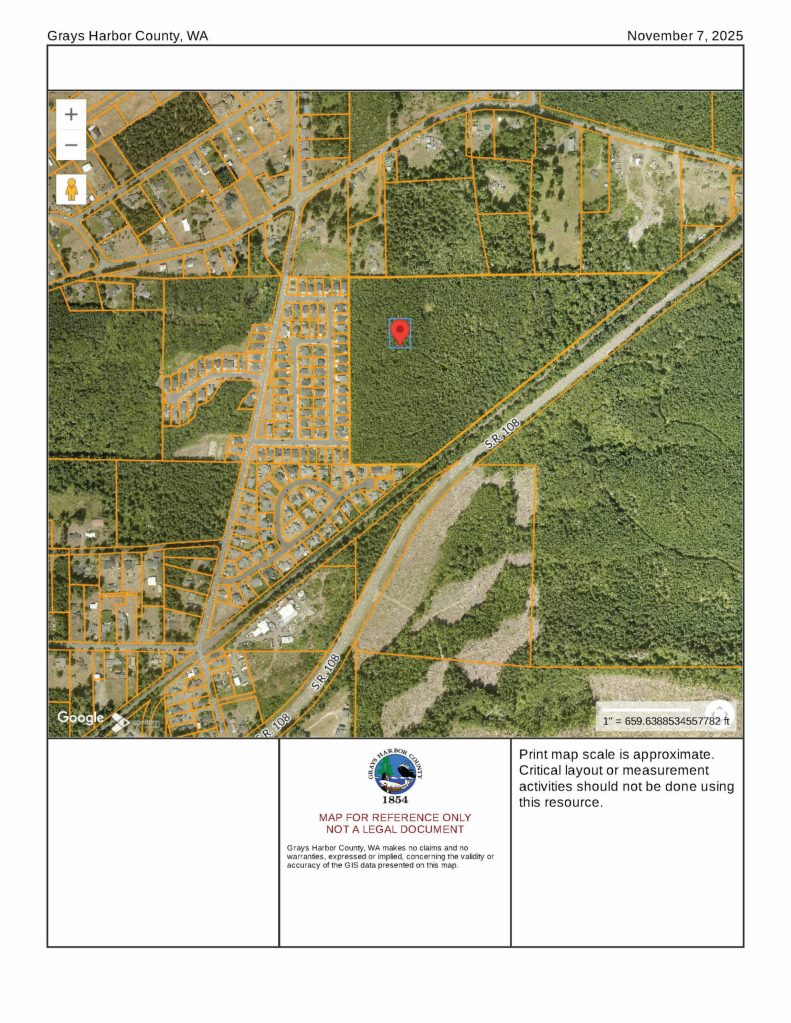


During the McCleary City Council meeting on Nov. 5, the council approved Resolution 786, initiating the annexation review process for Ranch at Camp Creek LLC’s property. Located behind the subdivisions on Summit , the 43-acre Ranch at Camp Creek parcel is owned by Mark Studer, a Montesano resident and developer.
Studer introduced himself to the city council during the Sept. 10 meeting and discussed his vision of a large-lot subdivision that would have between 65 to 70 homes depending upon set asides for retention ponds and streets.
By approving the resolution, City Administrator Jon Martin told the council, “You’re telling us, as the city staff, to start working on the process. We already had initial conversations with the county, and we’d have to go to the boundary review board. There’s multiple steps that we would need to go through.”
This parcel was the subject of annexation several years ago; different this time is that Port Blakely Tree Farms has sold the property.
To learn more about what is annexation and its implications for the city and residents, The Daily World spoke Richard Sepler, who describes himself as having “been a planner for what seems like forever.”
For over 30 years, Sepler has been an affiliate faculty member with the University of Washington Department of Urban Design and Planning and teaches a practicum course where the students work with communities. “It’s a win for the students,” he said. “They do real world work. The jurisdiction they’re working with gets lots of horsepower and enthusiastic folks doing the work and a great plan.”
Sepler worked in Grays Harbor County as a hearing examiner for the cities of Hoquiam and McCleary, as well as for Shelton, Ferndale, and Mount Vernon. He was the planning director for the cities of Bellingham and Port Townsend, and was a past president of the American Planning Association for Washington State, whose chapter has nearly 1,200 members.
What follows is our conversation edited for length and clarity.
Question: Before we discuss annexation, I’d like to know whether your experience as a planner influences how you look at the cities or towns you visit?
Sepler: Like anything else, God’s in the details. My wife chides me sometimes when we travel abroad because I’m fascinated with their stormwater systems. It’s not exactly the thing we’re supposed to be looking at when we’re standing in Paris.
When I look at and read a city, you look at the sense of community that it portrays and it designates. You look at the infrastructure they’ve provided. And you look, to some degree, the uses and the sense of place that’s created.
We could approach a city in a bunch of different ways. We could approach it purely on an economic basis, and we can talk about annexations and how they affect the economy of the city and how they either add or detract.
We can approach it a community way and say, ‘How does this annexation make a better community? Let’s bring in things we aspire to achieve and what we all agree is our end.’
It is also what you don’t annex, what you don’t bring in–preserving areas that we value for their open space.
Question: What is annexation?
Sepler: Annexation is a provision that’s established in the RCW [Revised Code of Washington] that allows a city to take rural lands that are administered by the county and to incorporate them into the city. It’s a process that’s defined by steps in the RCWs and the WACs [Washington Administrative Code].
Typically, it’s initiated by a citizen petition, and it’s based on the percentage of the property value of the owners who signed up to come in. But cities can also force an annexation, at least the hearing portions of it, because it’s been in their plans to bring property in.
The reason folks want to come into a city, typically, is urban services: better services, public services, and participatory. They’re part of the community and the issues don’t stop at the property line. They can’t participate on councils, planning commissions, or shape the future of that community.
Question: What are the benefits or drawbacks to a city when citizens petition to annex?
Sepler: What you really want to be evaluating is whether [annexation] is part of your plan. Do you have capacity to provide the services at the level you set, which typically are higher than the county standards.
A good example I’ll use is Bellingham. The area that we wanted to annex was one where we inappropriately, many years ago, extended services but didn’t bring it into the city. It turned into one of the challenging areas in terms of crime and poverty; a school that was 100 percent free and reduced lunch. We felt it was our obligation to remedy that error because we made it happen by extending services but not bringing it in. Kids were walking into the street to go to school because there were no sidewalks.
That area would have one deputy who patrolled an area where 4,000 people lived. If the city was there, our level of service would establish four officers and two detectives for that square footage.
Folks want to come [into a city] largely because they may not be able to develop the density they want without urban services. They need the water, they need the sewer, and it increases the potential yield or density.
The great challenge of annexations is cities love annexing commercial lands because they make money and that sales tax comes to the city. The challenge is when you bring in rural areas is usually rural densities aren’t high enough to pay for the services that they need provided.
A University of Utah study found that outside of an urban area, it’s two to three times more expensive to provide services than inside, but when you expand, it’s more costly. If a city takes in low-density residential, the money it gets from property tax isn’t going to cover the cost of the increased number of parks, the increased number of roads, the increased sidewalks that our level of service say we need to provide in the city. And the expectation is we’re going to do that.
You have to sit there and say, ‘What are the costs for the community to bring this in? Will we get enough revenue to cover it?’ Some jurisdictions have argued that their level of service is so low that they might break even on it.
Question: Where can the public learn about what services the city currently provides and the level of service?
Sepler: The city should have a comp [comprehensive] plan that talks about their scheme and where they wish to grow and their level of service. If not, the city administrator is a great person to ask about how many police officers, firefighters, street crew, and books in the library-all those kind of things. There is also a capital facilities plan and if they don’t have one, they should.
It’s good to have it out there because folks need to understand the implications of making decisions and increasing service is typically costly.
Question: The city does have a “City of McCleary’s Wildcat Creek Aquifer Sustainability Plan Project,” a capital facilities plan, and a comprehensive plan update, all of which were published within the last couple years. Based upon these reports, can residents confirm that the city can indeed provide services if the property is annexed, such as aquifer capacity and waste treatment plant capacity?
Sepler: In terms of water, the state has requirements and cities have to outline their capacity and their anticipated use in the future. You can actually go track down their plans about their operations of their facilities and see what their capacity is. Clearly you shouldn’t annex unless you have the capacity and you should have a reserve so that you’re not just going right to the red line because things change.
Question: How can people reconcile situations there have been subsequent issues because developers were allowed to build where in retrospect they probably shouldn’t have been versus there won’t be a problem developing a given parcel?
Sepler: To be honest, the great propensity of development goes just fine, consistent with the studies. Once in a while, things happen that we tend to focus on more because they’re the things that get into the news.
The typical way to review [a proposed development] is ask the applicant to prepare a study that deals with, for example, wetland areas and hydrology. If the city doesn’t have the staff expertise to review it, which many small towns don’t, they should have a consultant who solely works for them to review it.
Almost all of the easy to develop lots have been developed in Washington. Virtually everything that comes in has got some issue in terms of critical areas, wetlands, steep slope, transportation, and it’s prudent to always follow up. That’s how you protect your jurisdiction.
Question: During the annexation public hearing, what should the public ask of the council or what should the council ask of the developer to decide if this is a decision is beneficial to the city?
Sepler: The first thing is to listen to the proponent and what they proposed to provide. Then the questions are, ‘Are they providing everything to city standards and ensuring that it’s maintained and properly built.’ Folks need housing, and if this is a way of addressing it, that’s a good thing.
It’s important to ask the city, ‘Do you have adequate capacity to accommodate this? How will this affect our police service? How will this affect our fire service? How will it affect our parks? Will there be any downstream impacts by this coming in?’
Will this prompt improvements that the city needs to fork over elsewhere because of level of service of intersections or deficiency in roads? It’s fair to know exactly what we’re getting into and what the city’s obligating, if anything, to make this happen.
And then the very first question should be, is this consistent with our plan? Have we always envisioned this growing that way?
Question: As someone who has a degree in forestry, it’s difficult to see this nearly 43 acres of forestland be developed, but the parcel isn’t large enough to manage effectively, and unfortunately the market is determining the highest and best use is for housing, especially since there is a need for housing in the county.
Sepler: The sense for me is how much housing does McCleary need, and what kind of housing does it need, and what densities does it need. If you tell me it’s all affordable housing and it’s going to be for folks who live in the town and work in the general area, that’s great.
The GMA, as much as it’s maligned in some parts of the state, does say you have to provide a full range of housing options. In all the jurisdictions I’ve worked with or assisted through the University, we didn’t look at annexation solely for $1,000,000 ranchettes. We were looking getting affordable housing in there too.
We want to get a variety of housing types to come in because we have a variety of needs. Homogenous, middle to upper housing is great; we need that too, but we have a crying need for common wall construction and different types, such as duplexes, too.
Question: If the public wants to learn more about annexation, where can they look to for that information?
Sepler: I always tell my graduate students one of the best resources in Washington, and it’s all free, is Municipal Research and Service Center. [https://mrsc.org/] They’re funded by the Legislature, and they serve cities, counties, and ports. They are an information clearinghouse.
Unfortunately, you have to be from one of the jurisdictions to ask a question, but their online resource is tremendous. They’ll frame all the issues, tell you the relevant laws and what to look for, and give you examples elsewhere.