Celebrating Wild Thyme Tree Farm’s dedication to forestry
Published 1:30 am Tuesday, August 11, 2026
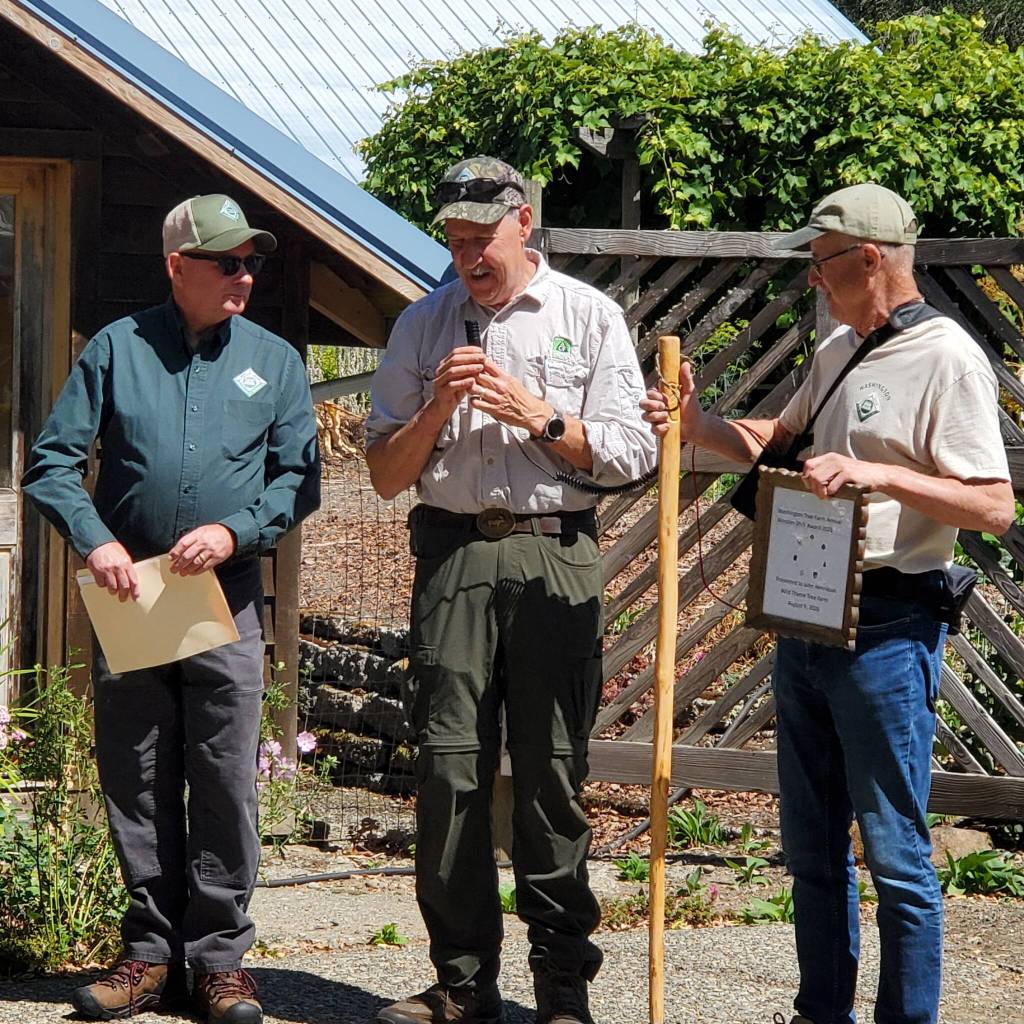


Of the over 50 people choosing to spend their Sunday afternoon at Oakville-based Wild Thyme Farm, many raised their hand to the question of whether they had previously visited the farm. That over half of the group returned for another tour reflects why Wild Thyme Farm was recognized as the 2026 Tree Farmer of the Year by the Washington Tree Farm Program.
Each visit affords the opportunity to learn something new from John Henrikson about westside forest management and tour a scenic, idyllic tree farm.
Prior to the tour getting underway, Keith Townsend, co-chair of the Washington Tree Farm Program with his wife, Yvonne, and Henrikson welcomed the attendees.
“I’m really excited about seeing all the things that John and his brothers are doing,” Townsend said. “And I’ve known John for a couple of years now, and after hearing the stories about what’s happening here, I just really marveled at the tenacity that John and his brothers have.”
Bob Obedzinski, the central west inspector coordinator for the Washington Tree Farm Program, shared why he nominated Wild Thyme Farm for the state award.
“[John] has the energy to do things. He has the energy to think about things, he has the energy to get involved, so that’s really important,” Obedzinski said. “He also has dedication, and that dedication is more than just a dedication to the tree farm. It’s a dedication to understanding.”
Another reason was family and community. Not only Henrikson’s immediate family but the extended family created through his serving on committees at the local, state and national levels, such as the National Standards Committee for the American Tree Farm System.
“And finally, science,” Obedzinski said. “I think John really thinks about the science of forestry and management and things like carbon. … He thinks about each of the things that he does out here, down to individual trees, sometimes down to shrubs. All those things, he thinks about them.”
Dave New, a former chair of the Washington Tree Farm Program, presented Henrikson with a bottle of maple syrup and a jar of peach preserves made of ingredients that came from his family’s tree farm and the nearby Boyer Tree Farm.
And just like John, “those of us who are tree farmers do things with our land other than just raise trees,” New said.
With a carved wooden stick in hand, Obedzinski gave a history lesson of the wood stick through the centuries.
“Some cultures actually say that by taking a wooden stick, especially shamans, they say by holding it to the ground, you can make contact with your ancestors. And you can make contact with the natural world,” he said.
The stick has also come to represent wealth, wisdom, power and courage, which “if you’re a tree farmer, those are all characteristics that we think you have to have to have a tree farm,” Obedzinski said to the group.
To Henrikson, Obedzinski said, “And I’d like to really thank you for just being involved with [Washington] Tree Farm [Program] and everything you do for Tree Farm and for the well-deserved award that you’re getting now.”
Now his turn to speak, and balancing a stick, plaque and letter, Henrikson said, “I’m really honored to see so many people here; I know most of you.”
Though many in the audience know the story of how Henrikson and his brothers came to own Wild Thyme Farm, he provided an overview of why everyone was gathered here today.
The four brothers purchased the property in 1987, but it wasn’t until the ice storm of December 1996, which laid waste to a third of the red alder stands, that spurred Henrikson on a trajectory of learning about forestry. He credits the Washington Farm Forestry Association and the Washington Tree Farm Program as helping him to become an informed and active landowner.
Recognizing what attendees really wanted to see, Henrikson got the group walking to the most recent management activity.
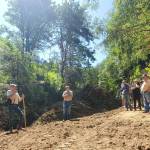
A couple months ago, Henrikson’s alternate plan for managing the riparian area had been approved by the Washington Department of Natural Resources. With the naturally regenerated red alders on a trajectory to age out of the canopy over the next couple decades, brush would inevitably fill the space and the buffer wouldn’t become conifer dominated, which is a desired future condition for providing shade for the stream. By proactively harvesting the aging red alder, Henrikson could then replant conifer species and set the buffer onto a trajectory of the desired future condition. The red alder that regenerated following the 1996 ice storm are being left to continue growing.
“Alder by definition can never contribute to a desired future condition because it doesn’t last; it literally melts away,” Henrikson said.
Of the native tree species in the Pacific Northwest, red alder is one of the youngest species, living to about 100 years and maturing around 60 to 70 years.
And as for the harvesting mess that everyone was walking through, the torn-up road with the bare soil exposed and piled logging slash, “we’ve been through this before and it cleans up real quickly in a couple of years and you hardly notice it,” Henrikson said.
As for Henrikson’s knowledge for how to manage Wild Thyme Farm’s forest, “this would have been inconceivable to my 30-year-ago self when I got into forestry,” he said. “[I] just didn’t have the vision or the experience or the expertise. And it’s because I’ve visited so many tree farms and see everybody does it differently. Everybody does something a little better than I do it. And also I look and say, ‘Well, why do you do that?’ So I have my own criticism, but mainly the experience I have is that my eyes are opened.”
For the final stop, the group visited the agroforestry portion of Wild Thyme Farm, which is now approaching its third decade. It comprises the buffer of the fish-bearing Garrard Creek and is adjacent to the meadow that floods during the winter. The agroforestry area features a mixture of nearly 20 species of fruit-bearing shrubs and hardwood and conifer trees, native and introduced, with black walnut, honey locust, blueberries, and birch among the planted species.
“It amazes me to this day that looking behind the barns here, there was nothing between here and the forest and the meadows,” said Henrikson. “And now we have almost too many trees. There are beeches and walnuts and butternuts and basically a food forest and edible landscape. And a big part of that’s coming on now.”
Earlier in his opening remarks, Henrikson highlighted the role of family and community in helping to create the farm.
“We have an amazing community here. We have several folks here who do professional work for us, everything from tree pruning to road work, construction, all across the board,” he said. “And it feels really good to have neighbors right next door, practically next-door neighbors, who have this amazing skill set and to keep that money circulating in our local community because we wouldn’t be anywhere without that.”
One of those community members in attendance was Kirk Hanson, the director of forestry for Northwest Natural Resource Group. He enrolled Wild Thyme Farm into the Conservation Reserve Program (CRP) through the USDA Natural Resources Conservation Service and took the lead in designing planting the agroforestry plantings.
To the question of seeing his work bear fruit, literally, especially since it was the first agroforestry buffer enrolled in CRP, Hanson said, “that’s pretty rewarding. … We don’t really know what’s going to work, especially the agroforestry.”
At the end of the tour, everyone gathered for lunch, with tree farmers sitting alongside neighbors and members of the Washington Tree Farm Program committee.
“I grew up in the area and have a little bit of property,” said Jolynn Amrine. “And I’m really excited about what he’s doing here and I think he could inspire a lot of the neighbors.”