Which Republican party has our assessor just joined?
Published 1:30 am Saturday, April 25, 2026
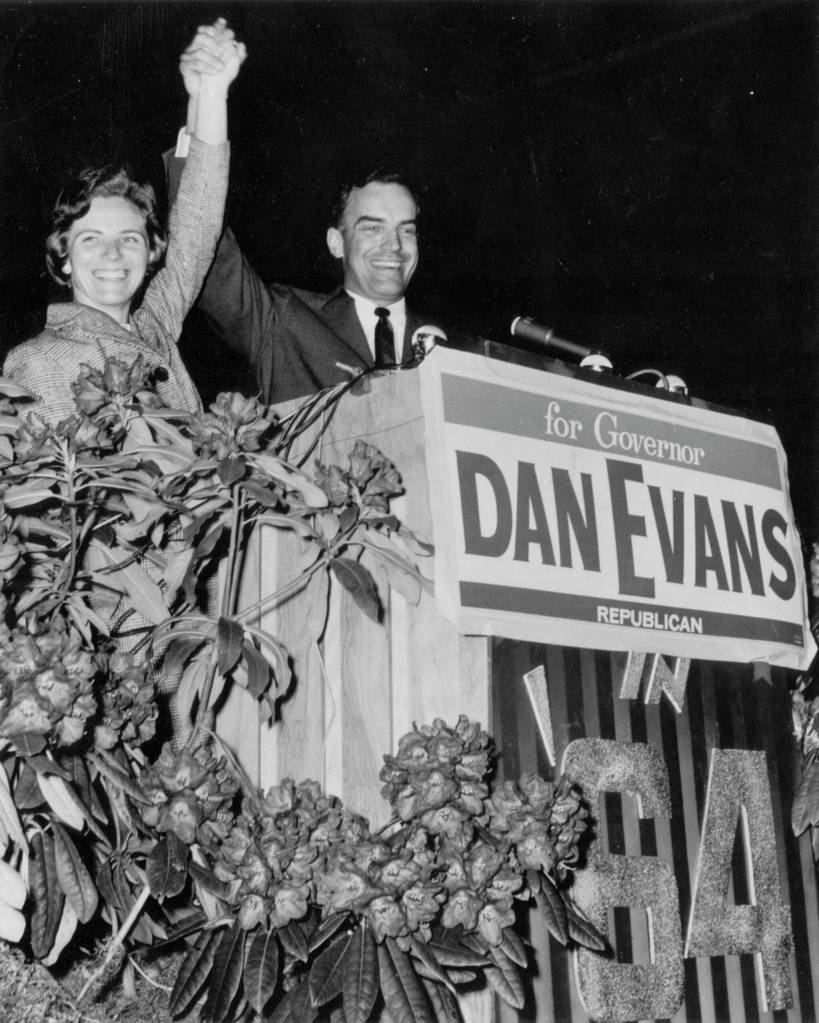



DEAR READER: When 38-year-old Dan Evans, the minority leader in the Washington State House of Representatives, resolved to run for governor in the spring of 1963, a series of polls agreed on one thing. Among the six prospective Republican candidates, he was dead last. Only five percent favored his candidacy.
The front-runner was a pulpit-thumping young Lutheran minister, Richard G. Christensen, who a year earlier had given U.S. Senator Warren Magnuson the fight of his life in his bid for reelection.
The Evans braintrust — fellow Eagle Scouts and former Jaycees, outdoorsmen and college-educated Korean War veterans — countered with a statewide, grass-roots network of volunteers. More than a few disillusioned Democrats signed up, alongside Evans’ corps of young mainstream Republicans. They were reformers at heart, latter-day “Bull Moose” good government activists.
After hundreds of meet-the-candidate breakfasts, service-club luncheons and visits to weekly newspaper editors who’d never before met a bona fide candidate for governor, Mo Mentum began to swap jerseys, as old sportswriters used to say. The Rev. Christensen was still leading as election year dawned, but Evans was now running third.
Evans, ever the civil engineer, issued a detailed political platform called “A Blueprint for Progress.” His volunteers mimeographed, addressed, stamped, sealed and mailed it to more than a million households as he hit the campaign trail in the summer of ’64.
“It was an awesome effort,” Evans recalled in 2016 as I was editing his autobiography. “And the people I met as I visited every corner of the state were not so polarized as we are today. They’d shake hands and say, ‘Well, I tend to be a Republican — or a Democrat — but I usually vote for the person, not the party.’ When you rang a doorbell, they might even invite you in. Now, politics is so hyper-partisan that many good people are reluctant to run for office, and civility has been replaced by social media misinformation, half-truths and outright lies.”
Evans said being a candidate “amounts to offering a contract to the voters.” And they deserve to know “who you are, who you admire and what you really stand for, especially if you’re seeking partisan office.”
EVANS’ TRICKY mission in 1964 was to differentiate his centrist politics from those of the GOP’s arch-conservative standard-barer, Arizona Senator Barry Goldwater, the darling of the John Birch Society and King County’s old-guard Republicans. Evans said his political heroes were Abraham Lincoln, the emancipator; Theodore Roosevelt, the apostle of progressive reform, and Dwight D. Eisenhower, a former five-star general who nevertheless cautioned Americans to be wary of the growing power of the “military-industrial complex.”
The Birchers, like extremists on the left, trafficked in “fear, frustration, hate and hopelessness,” Evans said, warning, “Our party embraces this ‘philosophy’ only at its peril.” His “blueprint” called for fiscal integrity, equal rights, open government, growth management, strong schools, and “open-mindedness to keep the faith with all the people, not just members of our party.”
Evans handily won the Republican nomination, out polling Christensen by nearly 110,000 votes. And on Nov. 3, 1964, he defeated the two-term incumbent, Albert Rosellini. Otherwise, a blue tidal wave had swept across America, with Lyndon B. Johnson — successor to the martyred JFK — winning 61.1 percent of the popular vote. Rosellini was one of only two Democratic governors defeated nationwide.
Our first governor to serve three consecutive terms, Evans in 1982 was named one of the top 10 U.S. governors of the 20th century. He went on to serve in the U.S. Senate. Afterward, working with former Democratic governors Booth Gardner and Mike Lowry, he championed higher education and environmental protection. It was my privilege to be with him three days before he died peacefully in 2024, a few weeks short of his 99th birthday.
I’m sharing all this so we can remind ourselves of an era when a nationally respected Republican leader declared, “I would rather cross the political aisle than cross the people.”
WHEN I READ the front-page news that Grays Harbor County Assessor Dan Lindgren was seeking re-election, the intriguing rest of the story was on page A-7. Lindgren, we learned, is changing his political affiliation from the Democratic Party to the Republican Party because, “Over the past several years, I have spent a great deal of time reflecting on my personal values and how they align with my party affiliation. I have come to the conclusion that my values now align more closely with the Republican Party.” Lindgren emphasized that his decision was “purely based” on his “integrity,” promising that on his watch the Assessor’s Office will continue to “apply the law fairly and consistently to everyone. …”
For the record, people I respect from both sides of the political aisle tell me Dan Lindgren is a first-rate county assessor. Further, I am genuinely impressed that he has spent a great deal of time reflecting on his personal values. Life is a journey. We should all follow his example of introspection because these truly are “times that try men’s souls,” in the immortal words of Thomas Paine, just as they were in the winter of 1776 when our revolution was in jeopardy.
As a practical matter, one might ask, “What’s the difference between a Democrat County Assessor and a Republican County Assessor?” Does one round up and the other down?
But it is Lindgren who has begged the question of party affiliation. He could seek re-election with no party affiliation. But he says becoming a Republican is meaningful to him. And the decision matters to us, too. He wants our votes. He won’t get mine until I know what kind of Republican he has become:
Do his personal values now align with those of Donald J. Trump, to whom the majority of American voters identifying as Republicans owe allegiance — never mind that the president, without a shred of credible evidence, holds fast to the big lie that the 2020 election was “stolen” from him, and that he issued wholesale pardons to the insurrectionists who stormed the U.S. Capitol, clamoring that his vice president be hanged for upholding the rule of law? Never mind, also, that our president has brazenly weaponized the Justice Department to prosecute his political enemies; that he and his minions have undermined and mocked the constitutional prerogatives of Congress as a coequal branch of government and are now intent on rolling back voting rights while casting spurious doubts on the security of our elections.
The danger in daring to deviate from the MAGA masquerade is to be branded a traitor by Trump, or at least a “nitwit” by Chairman Walsh. But, as Lindgren has said, integrity matters most. This above all: to thine own self be true. I’m certain the Mainstream wing will welcome his conversion if his heart is still truly with small-d democracy rather than lockstep authoritarianism.
I’m not implying there’s any opportunism here, but as a matter of street-level retail politics, Lindgren might come to regret the timing of this decision. The political winds along the Harbor and across America seem to be shifting as Trump’s arrogance accelerates. I’m told that at least one other local politician has had second thoughts about switching parties.
John C. Hughes was chief historian for the Office of the Secretary of State for 17 years after retiring as editor and publisher of The Daily World in 2008.