Port’s success is the legacy of Frank Lamb, citizen of the century
Published 1:30 am Saturday, February 21, 2026


DEAR READER: Though Aberdeen is no longer “The Lumber Capital of the World,” as the sign at the east city limits boasts, the Port of Grays Harbor is on a roll because its chips are no longer in one basket.
The Port’s 2025 banner year was capped by its selection as Port of the Year by the Washington Public Ports Association. Posting record cargo-handling numbers across its deep-water terminals, the port set records for auto imports and the export of wood chips, soymeal and liquid bulk cargoes. The expansion at Terminal 4 is expected to double exports and create as many as 80 family-wage jobs.
The Westport Marina, meanwhile, is the state’s top seafood-landing port. And the Satsop Business Park — a debacle transformed into an asset — is leasing 300,000 square feet of warehouse space. Bowerman Field, new drainage installed, is now the coastal home base for Life Flight Network.
A few days after the award was announced, a snippet of news from Jan. 3, 1991, appeared in The Daily World’s Editorial Assistant Karen Barkstrom’s “World Gone By” column. Forgive the cliché, but it does seem like only yesterday that Doug Barker, a first-rate reporter, wrote this:
“Facing an unparalleled financial problem in the very near future, the Port of Grays Harbor has asked Governor Booth Gardner for more than $13.5 million in state ‘bootstrap’ funding so it can continue to wean itself from the log export business.
“A letter to Gardner from Port Executive Director Cliff Muller and Port Commissioner John Stevens asks for direct aid to pave cargo yards, build warehouses, remodel the Westport Marina and hire more salesmen to sell the Port’s services around the world. It also wants help making bond payments for the next three years.”
The double gut-punch of timber harvest cutbacks to protect the Northern Spotted Owl and the meltdown of the Washington Public Power Supply System decimated Grays Harbor’s economy. It was the most demoralizing decade of my 60 years as a journalist and historian.
In a shameful betrayal, the Clinton Administration’s promises of substantial, ongoing transition funds fell far short of reality. Soul-sapping generational poverty set in. Against long odds, the Port struggled to gain traction.
FAST FORWARD to 2000. As the search for a new executive director was under way, my friend Dan Peterson, one of the great longshore leaders in Harbor history, told me he was certain the Port commissioners would hire “The Big Man for a big job.”
And they did: Gary Nelson, a manager with diverse experience in the forest products industry, was the 6-foot 10-inch namesake son of Elma High School’s legendary 7-foot basketball star of the 1950s.
When Nelson arrived, the Port’s operating budget was $5.2 million. Only 21 vessels had called in the previous year.
During his 24-year tenure, Nelson assembled a terrific team, presciently promoting Leonard Barnes as his deputy to oversee the Port’s business development, industrial property leases and airport and marine terminal operations.
The Port’s turnaround has been astounding — unquestionably the highlight of business activity on Grays Harbor in the first quarter of the 21st Century.
With the leadership of Nelson, Barnes and a proactive Port Commission, the Port attracted $275 million in private investment in its facilities and diversified to include the Satsop Business Park. The Port handled more than 3 million tons of cargo in 2023, Nelson’s final year at the helm.
A CRUCIAL FACT about the very existence of the port is that it has a foot on either side of Myrtle Street. If it had been called “the Port of Aberdeen,” the plan would have been dead in the water at the outset in 1911.
Frank H. Lamb, the most visionary businessman in Hoquiam history, saved the day for the Port of Grays Harbor by shrewdly exploiting inter-city rivalries to advance the common good.
The founder of what became the Lamb-Grays Harbor Company, was a renaissance man.
Born in New Jersey, Lamb came west in 1894 to study botany at Stanford University. There, he fell in love with Alice Emerson, the daughter of pioneer Hoquiam lumberman George H. Emerson.
Lamb went on to graduate from the Biltmore Forestry School, America’s first, and became an early member of the Sierra Club before signing on as a timber cruiser and logging camp superintendent for George Emerson.
Lamb founded his own timber company at the turn of the 20th century and went on to establish a landmark machinery firm. He held 22 U.S. and foreign patents for logging and milling equipment.
He founded the Hoquiam Library, Hoquiam Chamber of Commerce, Hoquiam Elks, and Rotary Club, of which he was an international vice president.
He headed the state Chamber of Commerce, traveled widely in Europe and the Far East, and served on President Theodore Roosevelt’s White House Conference on Natural Resources, together with the legendary forester, Gifford Pinchot.
In his spare time, Lamb wrote four books and organized Hoquiam’s 50th anniversary celebration. But his enduring achievement is the role he played as the Father of the Port of Grays Harbor.
THE SAFE ARRIVAL of a ship at Aberdeen in the 1880s was a big event for the fledgling timber town. “With no jetties, no buoys, and no charts, more ships in those years were wrecked on the beaches than ever entered or even tried to enter the Harbor,” wrote Aberdeen historian Anne Cotton.
By the turn of the century, Aberdeen and Hoquiam boasted a dozen sawmills. But shipping remained a challenge. The Army Corps of Engineers had deepened the north channel and begun work on the South Jetty, hoping to stabilize the mouth of the Harbor. After four years, however, the funding ran out and the unfinished jetty began to erode, becoming a navigational hazard itself at high tide.
“After all of their work, the Harbor was worse off than ever, with only a 12-foot draft at low tide,” Ryan Teague Beckwith wrote in “On the Harbor.” Lamb and other business leaders lobbied the government to resume work.
In 1907, the Corps began construction of a new jetty on the north side of the Harbor. That same year, Populists and Progressives pushed through a bill allowing “public facilities for shippers and others.” But Governor Arthur Mead vetoed it at the urging of the Northern Pacific Railroad, saying it infringed on private property rights.
In 1911, Frank Lamb and other proponents of public ports brokered “a brief marriage of convenience between progressives and capitalists.” They drafted a new bill to sidestep the constitutional prohibition of “special improvement districts” by allowing voters to create port districts to dredge channels, build and run public docks and terminals.
The Port District Act was signed into law in 1911. King County voters created the state’s first public port district three months later.
Frank Lamb was hard at work here.
“I followed my usual plan of first securing endorsements from the Hoquiam and Aberdeen Chambers of Commerce and awakening interest through addresses to clubs and fraternal groups,” Lamb wrote in his memoirs. “I set out to generate newspaper publicity and met with reporters and editors. Then I went before the county commissioners with an application for an election to determine whether the voters of Grays Harbor desired to form a port district.”
Though they weren’t happy about it, the commissioners set an election for Dec. 12, 1911.
“With a great deal of jawboning,” Lamb recalled, “the remainder of the county, which was dependent on agriculture, was prompted to see that an increase in commerce and population on the waterfront of Grays Harbor would help them. A port district would provide increased markets for farm products and increase the value of their farms.”
A rising tide would lift all boats, Lamb said, campaigning for a Port District that would diversify the local economy. New jetties and maintenance dredging would allow the Harbor to attract bigger ships, he said.
WHEN THE BALLOTS were tallied, Lamb’s plan passed by a three-to-one margin and the Port of Grays Harbor became the second in the state. The voters also elected Lamb to the three-member port commission, a post he held until his death in 1951.
Lamb immediately met with his new fellow commissioners, Angus McNeill, a real estate broker from Montesano, and W.J. “Billy” Patterson, Aberdeen’s ebullient wheeler and dealer. It was famously said that on the Harbor BPOE stood for “Billy Patterson Owns Everything.”
Lamb figured McNeill would be a foot-dragger, worried that the new port would mostly benefit Aberdeen and Hoquiam while short-changing East County.
But surely Patterson would be on board. No such luck. Patterson had interests in lumbering and insurance, in addition to his cushy post as cashier of Hayes & Hayes Bank, the Harbor’s leading lender. Patterson was solidly in league with the timber companies and mill owners who had docks of their own and loathed the idea of any new taxation.
With Commissioner McNeill’s support, Patterson thwarted Lamb’s dreams for the next eight years.
The newly formed Port, meantime, could not spend any money for docks or other improvements until it came up with a “comprehensive plan.”
The commissioners hired a consultant, who produced a plan so comprehensive that Lamb said it would have sufficed for the Port of New York. Miles of docks would have stretched across the mudflats of Grays Harbor. Nonetheless, the plan was resoundingly approved by the voters in 1913.
THEN CAME the breakthrough: The state of Washington gave the Port a 68-acre tract that straddled Myrtle Street. “Because of the long-standing rivalry between the two cities, the land was seen as the perfect compromise to the problem of favoritism,” Beckwith wrote. The Port now had ample property for a dock and terminals, plus the ability to levy taxes and issue bonds.
Billy Patterson parried, making a deal with McNeill to fund stream control projects near Montesano instead of funding the docks and terminals.
Frank Lamb’s next move was decisive. Determined to “smoke them out,” he hatched a plan to build a smaller port dock at the foot of 8th Street in Hoquiam and rolled out the proposal just before the fall elections in 1919.
“The scheme worked exactly as I had planned,” Lamb wrote. “At a largely attended and acrimonious meeting” at Aberdeen City Hall, Patterson and McNeill voted it down.
“The people of Hoquiam were incensed and started an alliance with Elma and other East County interests to replace McNeill with a commissioner who would work with me,” Lamb wrote.
Aberdeen voters, meantime, worried that the port would end up in Hoquiam.
Joe Vance, a lumberman from Malone who sided with Lamb, was persuaded to run against McNeill. Vance won handily with support from Aberdeen and Hoquiam.
Billy Patterson, who no longer controlled everything, surrendered.
Frank Lamb and Joe Vance appointed an engineer to draw up plans for slips and docks at the Myrtle Street site.
The Port issued bonds to build docks and rented a dredge to deepen the inner channel.
On Sept. 26, 1922, more than a decade after the vote to form a port district, the terminal at Pier 1 was dedicated.
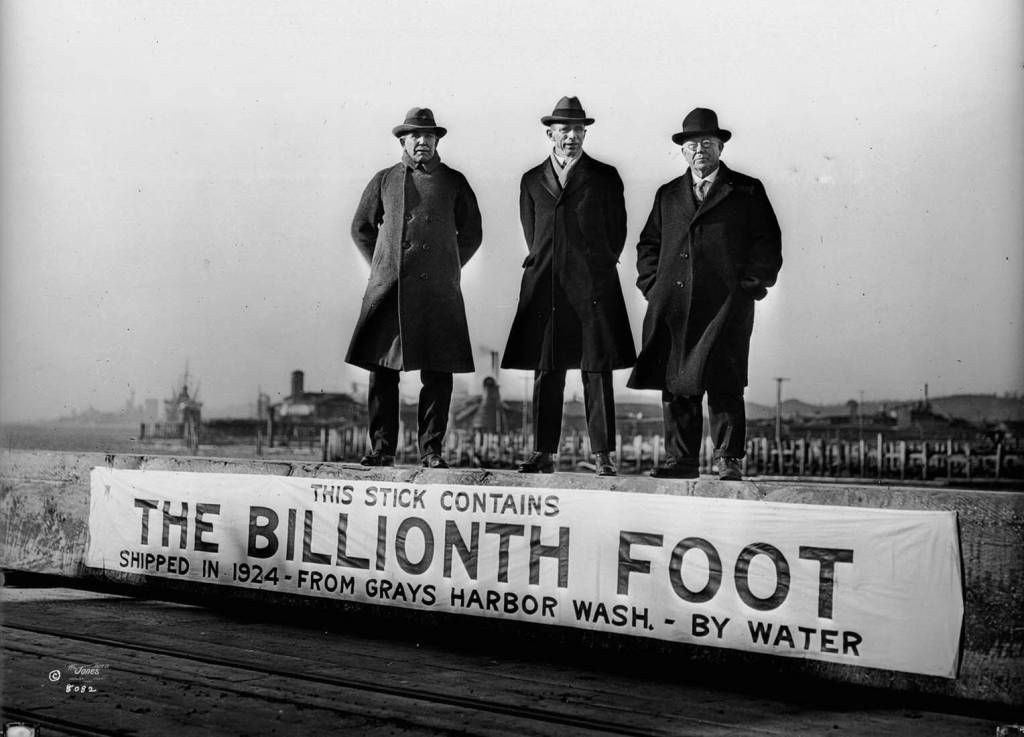
Two years later, on Dec. 21, 1924, the “billionth board foot” of lumber exported from the Port of Grays Harbor that year was loaded onto a Japanese steamer. No port in the world had ever even come close to shipping that much lumber in a single year.
Frank H. Lamb, unquestionably, was the Citizen of the 20th Century on Grays Harbor. His legacy now reaches into the second quarter of the 21st.
John C. Hughes was chief historian for the Office of the Secretary of State for 17 years after retiring as editor and publisher of The Daily World in 2008.