Flock cameras and the Great Facebook Olympics
Published 1:30 am Wednesday, July 22, 2026
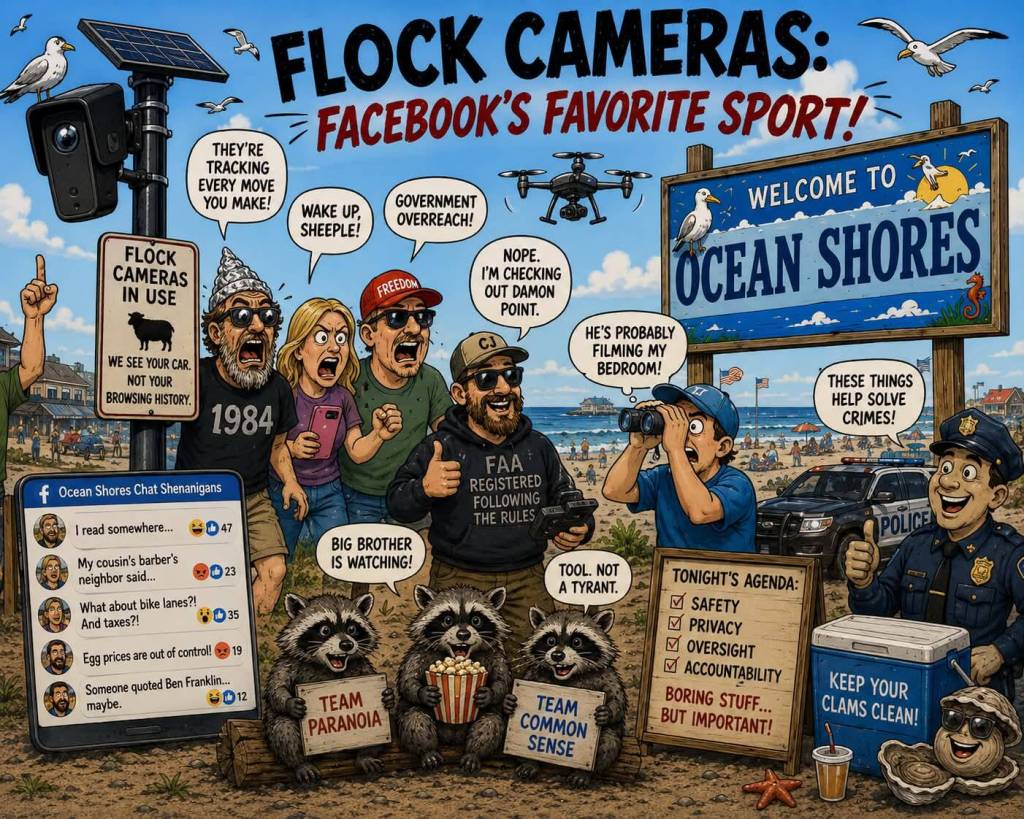
If scientists ever decide to study human behavior, they can save themselves a whole lot of grant money. Just post the words “Flock cameras” in a local Facebook group and go make a pot of coffee.
By the time the first cup is poured, the comments will already be off the rails.
One person is convinced the government is tracking every trip they make to the grocery store. Another is ready to nominate the cameras for Citizen of the Year because they’ll solve every crime from stolen bicycles to missing garden gnomes.
A few comments later, George Orwell has entered the chat. Benjamin Franklin gets quoted — accurately or not is anyone’s guess — and somehow we’re arguing about bike lanes, taxes, potholes, and why nobody in Grays Harbor knows how to merge.
It’s honestly impressive.
Somewhere underneath the digital food fight is a question that’s actually worth talking about.
Can technology help keep communities safe without sacrificing the privacy people expect?
That’s not exactly the kind of sentence that goes viral. The truth is a lot less dramatic than Facebook would have you believe.
Automated license plate readers have helped recover stolen cars, identify suspects, and locate missing people. That’s not really debatable.
At the same time, it’s perfectly reasonable for people to ask who can access the data, how long it’s kept, who audits the system, and what happens if someone abuses it. Government works best when people ask questions, and technology shouldn’t get a free pass simply because it’s new.
I get a front-row seat to that kind of thinking every time I fly my drone around Ocean Shores.
I’m registered with the FAA, I follow the federal rules, I stay within the operating requirements, and I spend most of my flights looking at the coastline. Yet every now and then someone acts like I’m hovering outside their bedroom window gathering state secrets.
Sorry to disappoint, but Damon Point at sunset is a whole lot more interesting than your curtains. If my drone is pointed anywhere, it’s probably at an eagle, a crashing wave, or one of those seals that couldn’t care less about Facebook debates.
Funny how a camera can convince people they’re the main character.
There’s another part of this conversation that deserves attention, too.
Most law enforcement officers use technology exactly as intended. But history also tells us that, on occasion, some people have misused law enforcement databases and investigative tools. Those incidents are rare, but they happen, and pretending otherwise doesn’t help anyone.
That’s why oversight matters.
Clear policies. Regular audits. Limited retention periods. Accountability when someone crosses the line. Those aren’t anti-law enforcement ideas. They’re pro-public trust.
Meanwhile, Facebook has already moved on to Round Two.
One side believes the cameras know what you ordered at McDonald’s last Thursday, what aisle you visited at Walmart, and whether you switched to decaf.
The other side acts like mounting another camera on a utility pole will eliminate crime forever and maybe fix the potholes while it’s at it.
Reality, inconveniently, refuses to join either team. Maybe the cameras are a useful investigative tool. Maybe they also deserve careful oversight. Maybe both of those things can be true at the same time.
Unfortunately, moderation doesn’t earn many likes.
Nobody jumps online to announce, “I attended tonight’s council meeting and really appreciated the thoughtful discussion on data retention policies.”
Nope.
We want fireworks.
We want ALL CAPS.
We want memes, reaction GIFs, and someone threatening to move to Montana because of a camera attached to a pole.
By the next morning, half the internet is convinced we’re living in 1984. The other half is wondering why everyone is so worked up.
And somewhere in the middle are the rest of us, trying to have an honest conversation before somebody changes the subject to parking, clam digging, or whose cousin knows somebody who “heard something.”
Maybe that’s the funniest part.
The cameras didn’t create the argument. They simply gave Facebook another excuse to do what Facebook has always done.
Argue.
As always, dear readers, keep your clams clean.
CJ Ripley is an Ocean Shores resident.