Volunteers rally to repair High Rock Lookout after devastating vandalism
Published 1:30 am Monday, July 13, 2026
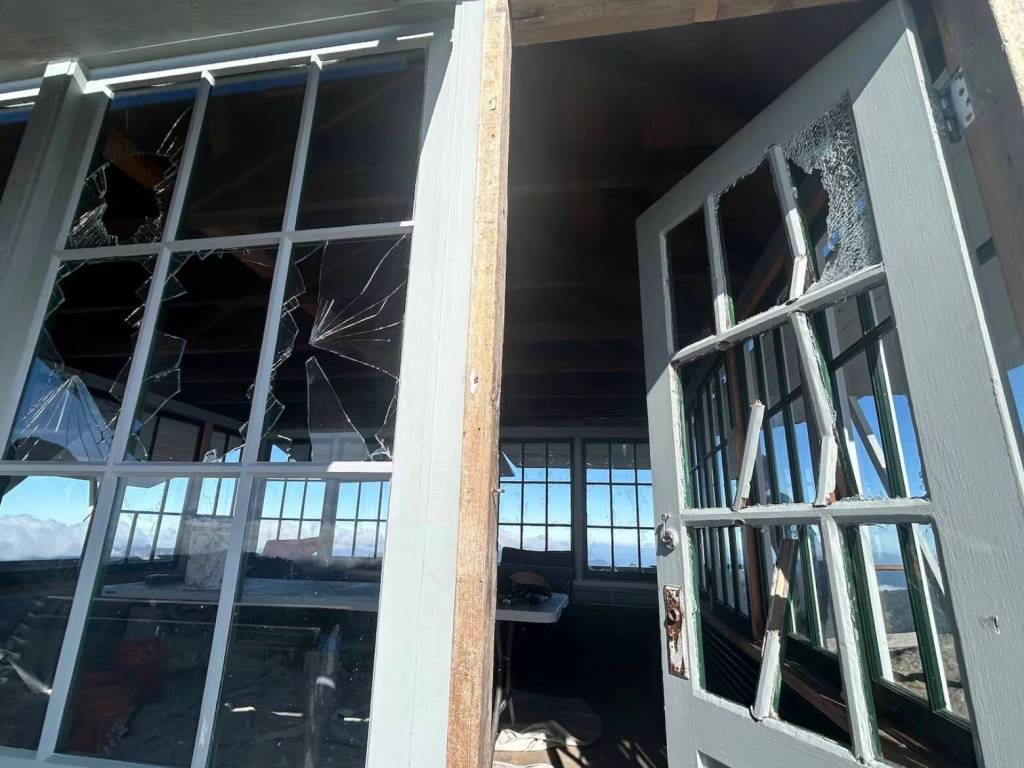

Don Allen was about to drive home from work when his phone began buzzing with messages. His screen filled with images of broken windows, shattered glass, and a bludgeoned door. There had been a break-in. But it wasn’t Don’s home. In fact, for Don, it was even worse.
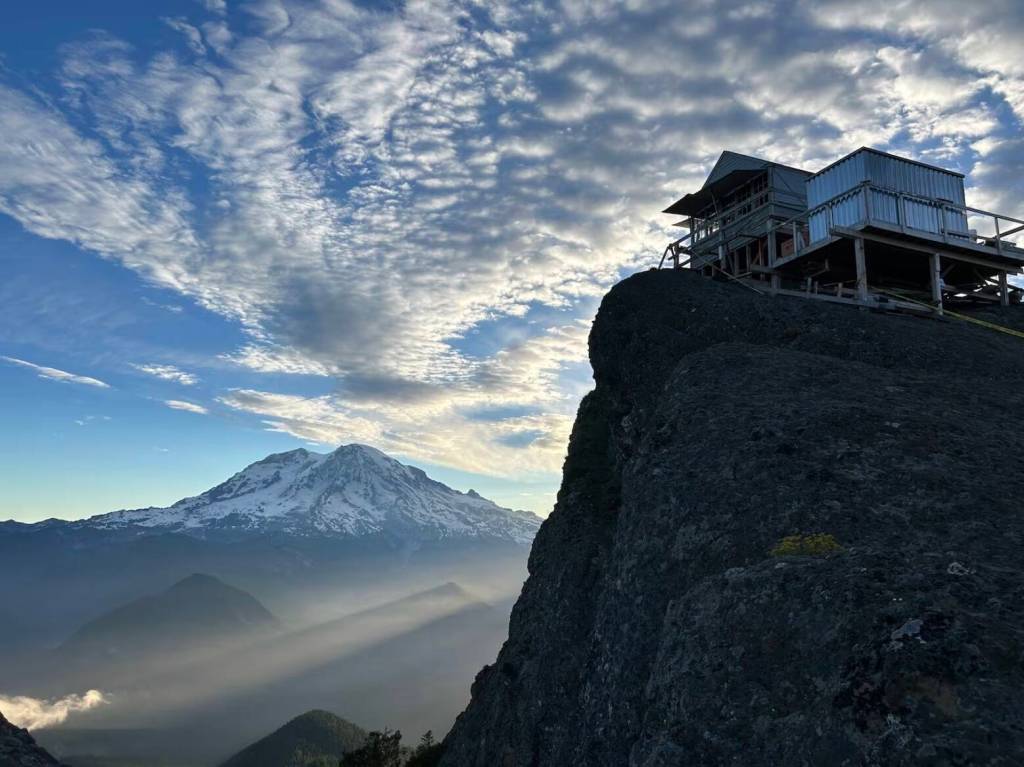
It was a tiny, 95-year-old wooden structure perched atop a 5,685-foot pinnacle in Washington’s Gifford Pinchot National Forest. For the past decade, on weekends and time off from his job as a manager of an electronics company that manufactures CO2 sensors, sixty-three-year-old Don Allen had been making the three-hour drive from his home in Portland to lead a volunteer effort to save the historic High Rock lookout.
Images of the destruction posted on social media sent shockwaves through the community leading the restoration effort, and across outdoor enthusiast groups that appreciate the site for its historic significance and unequaled view of Mount Rainier.
“I had people calling me that night and talking to me ‘til after midnight because they needed just to talk to somebody,” Don said. “A lot of people were really severely affected by this. They wanted to know what we were going to do about this. They needed reassurance.”
Our team at “Oregon Field Guide” has been reporting on the restoration of High Rock for more than five years, documenting the work of volunteers of the non-profit Sand Mountain Society as they carefully dismantled the building board by board, repaired and restored every historic piece, then backpacked and airlifted the original material, tools and supplies back up to reassemble the lookout.
Last September, we filmed Don and volunteers as they put in long hours to wrap up the summer season and secure the lookout for the coming snows. Up to that point, the lookout had survived 94 winters. With the restoration nearly complete, Don hoped their work would last another century.
“It was all just so carefully and meticulously restored. Flawless, just like new,” he said.
They locked the door and battened down the windows with heavy shutters, snugging it up for the winter until they could return after spring snow-melt to put the finishing touches on the decade-long restoration project.
Our plan had been to return to High Rock and film the final scene of the lookout in all its restored beauty. The images of broken windows shattered that plan.
Instead, I joined Don as soon as he could head up to respond to this unanticipated situation. With years of work undone in a single day, I feared this could be the story’s new ending.
Don had devoted his entire adult life to fixing broken lookouts; now I wondered: where was Don’s breaking point?
A change of plans
Just a few days after the news of the vandalism, I met Don at sunrise on June 19 as he prepared to head back to High Rock.
Don had planned to spend the next several days working at Gold Butte Lookout in Oregon’s central Cascades range, one of the Sand Mountain Society’s most successful projects. Instead, he unloaded that equipment, repacked his truck with replacement supplies, and headed toward the site that had become the largest, most complex, and most consuming project in his life.
His first stop was in Centralia, Washington. The owner of a family glass shop, Curt Ivie, had heard what happened and reached out to Don. He offered to donate the material needed to replace the glass broken at High Rock — but not simply new glass, rather something much rarer: panes salvaged from the windows of a 1920s building.
Historical materials carry something that modern replacements cannot replicate, Don said. He points out subtle surface undulations and imperfections, like small bubbles in the historic panes. These are traces of the old manufacturing process of “rolled glass,” he explained. When sunlight shines through and spills onto the floor, it looks like ripples of water on a mountain lake. A detail not many notice, but that means everything to Don.
After Curt hand-cut several panes, Don carefully loaded the bundle into his pickup and headed to the ranger station in Randle, Washington.
Some 50 volunteers had spent more than a half-dozen winter weekends here repairing original lumber from the lookout, stripping blistered paint, filling gouges carved by pocket knives, sanding off graffiti tags, priming, painting, and preparing the wood to go back onto High Rock.
Don retrieved a few old aluminum frame backpacks, the kind needed to haul heavy loads up to the rocky summit of High Rock. Then we headed for the trailhead, winding up miles of bumpy gravel road.
Don’s old Toyota Tacoma pickup kicked up dust as he swerved around potholes. After so many years of driving this road, in all hours of daylight and darkness, he seemed to know it by heart. More than once over the course of the project, working nearly 24-hour shifts, he’d even had to pull off to the side just to get an hour of sleep.
Several volunteers from Joint Base Lewis-McChord were already waiting.
Accustomed to carrying heavy packs over difficult terrain, the military personnel divided tools, supplies and 5-gallon containers of drinking water. Don shouldered the bundle of the vintage replacement window glass.
The hike to High Rock is less than two miles in distance, but it climbs roughly 1,350 feet. Every pane of glass, every tool needed for the restoration, food, camping gear, and drinking water, has to travel this trail on someone’s back.
At the top, a rocky outcropping rises above the trees, like the knuckle of a bony finger. The small wooden lookout perches on the tip of this pinnacle, surrounded by sheer cliffs on three sides that fall more than 500 feet to the forest below. This epic view has made High Rock such a popular hiking destination and one of the most photographed places on public land in the Pacific Northwest. Its remoteness has also made it a target for vandalism.
Picking up shattered glass
The lookout was cordoned off with yellow tape that read “police line do not cross.” Because High Rock is a heritage site in a national forest, the vandalism was a federal crime, and an investigation is underway. A volunteer stood guard, redirecting curious hikers to keep a safe distance.
Don unscrewed the sheet of plywood temporarily covering the door that had been smashed in.
As he stepped into the lookout, shards of glass crackled. He quietly touched splintered wood, noticing shards of embedded glass. “There are places where you can see they were trying to hit the glass and they hit the wood with something like a screwdriver, something sharp.”
The photos of the damage were upsetting, he said, but here in person he could see just how violently the building had been assaulted.
He carefully stepped to another broken window. The entire framework had been obliterated. He’d seen vandalism at lookouts before, but not to this extent, and not so much destruction directed all at once.
“It’s really disturbing to think that anybody would do that because it’s absolutely so pointless,” he said with a deep sigh. “It was so clear that this building was being cared for. And I just felt sick about it because I know how much work went into all of this.”
Every window represented dozens of hours of careful work.
In workshops, restoration experts like Chris Gustavson of Albany, Oregon, taught volunteers traditional methods of repairing the historic windows. Old glazing was painstakingly removed. The weathered wood was repaired and repainted. Individual panes of glass were hand-cut and installed before each window was reglazed.
“Windows are really the soul of a lookout,” said Don.
Stand inside the High Rock lookout, and it becomes obvious why. Even the name evokes the experience, not just a noun, but a verb: to look out.
In every direction, the windows frame a view of the wilderness stretching to the horizon: Mount Rainier to the north; the snow-capped peaks of Mount St. Helens, Mount Hood, and Mount Adams to the south; the Goat Rocks wilderness to the east, and the jagged Sawtooth Ridge, Puget Sound, and the Olympic Mountains to the west.
As we moved from window to window, Don stopped often, quietly examining each frame.
Over the years, I’d watched him organize volunteers, solve impossible logistical problems, coordinate helicopter operations and somehow balance all of it with his full-time job. I’d never heard him dwell on the personal sacrifices.
What many people don’t see are the countless miles on his pickup, the weekends he surrendered, and the money he quietly spent because the project simply needed something.
He doesn’t keep score, though his odometer and his personal bank account do.
Last fall, we filmed the lookout with a fresh cedar shingle roof, restored clapboard siding, and four walls of gleaming windows. It looked perfect, and yet exposed. I asked Don: “Why devote so much of your life to restoring a building you don’t own and can’t truly protect, knowing all of this hard work can be undone?”
Last fall, the question was hypothetical; now it’s real. So I asked again.
“You just keep fighting,” he said quickly, as if by reflex. But then he paused, looking down at the floor of broken glass.
“Is it wise?” he said quietly, as if asking himself the question. Then he held up his hands and shrugged as if that line of thought could never be answered.
“I feel a responsibility to see it through. The volunteers are looking to me to have hope, and I’m getting it from them. They don’t want to give up.”
As we talked, hikers continued arriving at the summit.
Many already knew what had happened. Nearly every group stopped to thank the volunteers. Some asked how they could help.
“I guess I still have hope,” Don said, “because as I’m walking up the trail, 90% of the people I pass say, ‘Oh, you’re working on the lookout. Thank you for doing that. Don’t give up!’
“The public response has been tremendous and supportive. It’s almost brought more people in, in a positive way. So there might be a silver lining.”
As the afternoon wore on, we filmed Don and Chris gently prying a window sash from the wall, setting it on sawhorses, and carefully pulling the shards of broken glass with pliers.
After cleaning the old glazing off, Chris gently set in the custom-cut 1920s glass and smoothed fresh glazing putty into perfect shape. Then he and Don carefully lifted the window into the wall opening and nailed it back into place.
One window, once again perfectly restored, with nine panes of authentic Depression-era rolled glass, gleaming in the afternoon sun. Just like they had been.
Sixty-seven more panes to go.
The door and windows too damaged to fix on the mountaintop would need to be prepared for another trip down the steep, rocky trail.
The journey the windows had already made once, they would now make again.