How WDFW is studying coastal and Puget Sound white sturgeon
Published 1:30 am Wednesday, June 24, 2026
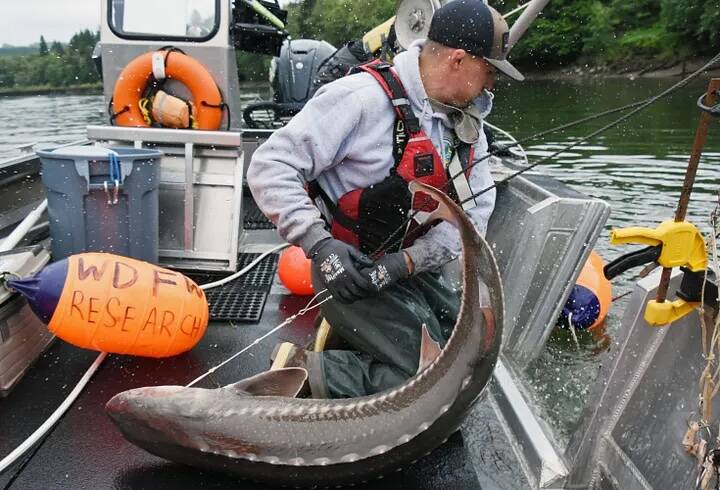
Cruising up a coastal river, Washington Department of Fish and Wildlife (WDFW) scientists scan the water for orange and blue buoys. As they approach a buoy, one of them carefully pulls on the line and feels a tug.
After a few uncertain moments, they see a flash of white and something big — just as they’d hoped. A prehistoric fish surfaces, bony plates lining its body and whisker-like feelers protruding from its face. The research team hoists it into the boat and gets to work.
While WDFW has monitored white sturgeon in the lower Columbia River for decades, the Department only recently secured funding to expand monitoring to Washington’s coastal and Puget Sound estuaries and rivers. Since last year, staff have been capturing white sturgeon in these areas and implanting them with acoustic tags to better understand their movements and connection to the primary population in the Columbia.
White sturgeon are native to the West Coast, found in rivers, coastal bays, estuaries, and Puget Sound, and can enter the ocean to move between these areas. There are three main spawning populations with access to the marine environment: the lower Fraser River in British Columbia, the lower Columbia River in southwest Washington, and the Sacramento-San Joaquin river system in California.
‘At the heart of the Department’s mission’
The lower Columbia River is Washington’s primary white sturgeon spawning ground with access to the marine environment. In collaboration with the Oregon Department of Fish and Wildlife, WDFW has monitored fish in the lower Columbia for decades but has lacked resources for other areas. Recent legislative funding has allowed the Department to expand white sturgeon surveys into Puget Sound and coastal areas.
“We’re trying to understand the full picture of how sturgeon live and move through these water bodies,” said Laura Heironimus, WDFW’s sturgeon, smelt, and lamprey unit lead. “When are they showing up in each river? Where are they feeding? Are they spawning there? What’s threatening their future? Answering these questions is at the heart of the Department’s mission to support biodiversity and native species conservation and management.”
To achieve this goal, staff plan to alternate primary tagging locations, catching fish year-round. Last year’s efforts mostly concentrated on the coastal estuaries, including Grays Harbor, Willapa Bay, and their tributaries. This year, staff have shifted their main focus to Puget Sound’s major rivers. They will continue to tag white sturgeon in the lower Columbia and will track movements between rivers and estuaries.
So far, WDFW has tagged 39 white sturgeon in the lower Columbia River downstream of Bonneville Dam; 28 in Willapa Bay, including the Willapa and Naselle rivers; 26 in Grays Harbor and the lower Chehalis River; and 22 in Puget Sound tributaries, including the Skagit, Stillaguamish, and Snohomish rivers. This summer, staff aim to tag 53 more fish in Puget Sound rivers and 40 more in the lower Columbia.
Researchers use nets or setline gear, depending on the waterbody, to catch sturgeon. They measure and weigh each fish, collect a genetic sample, scan for existing tags, implant tags for those without, and return fish live to the water. When a tagged fish enters an area, the tag transmits a high-frequency sound to a receiver, which records the date and time for each individual.
WDFW is using the receiver data to learn more about sturgeon distribution, migration, habitat use, and how fish captured in different areas interconnect.
WDFW considers white sturgeon a Species of Greatest Conservation Need and carefully manages sturgeon harvest in the Columbia River. In coastal and Puget Sound rivers, white sturgeon recreational fisheries are open for catch-and-release fishing only. Anglers should check the fishing regulations for river-specific rules as well as any emergency rule changes.
Green sturgeon are also found in Washington, with one population listed as threatened under the federal Endangered Species Act. Anglers may not fish for or retain green sturgeon. Since 2019, WDFW has implanted acoustic tags in 119 green sturgeon.
A collaborative, long-term study
Sturgeon spawn every few years and can reproduce multiple times. On average, female white sturgeon reach maturity around age 25 and can release over 1 million eggs during each spawning event.
“On the coast and in Puget Sound last year, we found female sturgeon that were expected to spawn this year,” said Jake Velarde, WDFW’s Coastal Washington and Puget Sound sturgeon biologist. “Do they spawn in those rivers and estuaries, or do they return to one of the main spawning populations? We want to answer that question.”
The acoustic tags are expected to last for 10 years. With a small team working across Western Washington — and sturgeon capable of living 100 years or more — it could take several years for researchers to collect meaningful data. But early results are already intriguing.
“We’re finding Columbia River fish with Passive Integrated Transponder (PIT) tags in coastal estuaries and Puget Sound rivers,” Velarde said. “On the Skagit River last year, we found a PIT-tagged fish from the Fraser River. We knew Fraser River fish were using the lower Columbia — and vice versa — but this was our first official documentation of them migrating into Puget Sound rivers.”
WDFW is working with other state, federal, and tribal governments, as well as commercial fishers, guides, recreational anglers, and supportive residents, on the project.
Velarde, based out of WDFW’s Southwest Washington Region, is collaborating with staff from the Department’s Coastal and North Puget Sound regions, including scientists conducting hydroacoustic (SONAR) monitoring surveys on the Skagit River.
“They found a lot of sturgeon this year, contacted my team, and we went up to sample those fish,” he said. “This project has brought together different groups within WDFW to expand our bandwidth. We’ve also connected with recreational anglers who are always out there fishing for sturgeon. They’re passionate about it and want to help us understand the species more.”
White sturgeon are culturally important to many tribes. The Confederated Tribes of the Chehalis Reservation and the Stillaguamish Tribe of Indians are contributing monitoring support for this research.
WDFW has provided tag readers for some tribal biologists and recreational anglers to scan and record their catch. Some residents have also allowed the Department to place acoustic receivers at their docks.
“We’d like to form more connections with local communities that have a vested interest in sturgeon conservation,” Heironimus said. “Community members provide historical context on the area and local fisheries, and these relationships help to build trust and transparency around our work. By bringing together different perspectives and information, we can improve our research and have useful discussions on species conservation and management.”