Gov. Spellman saves Puget Sound: ‘a national treasure’
Published 1:30 am Friday, June 5, 2026
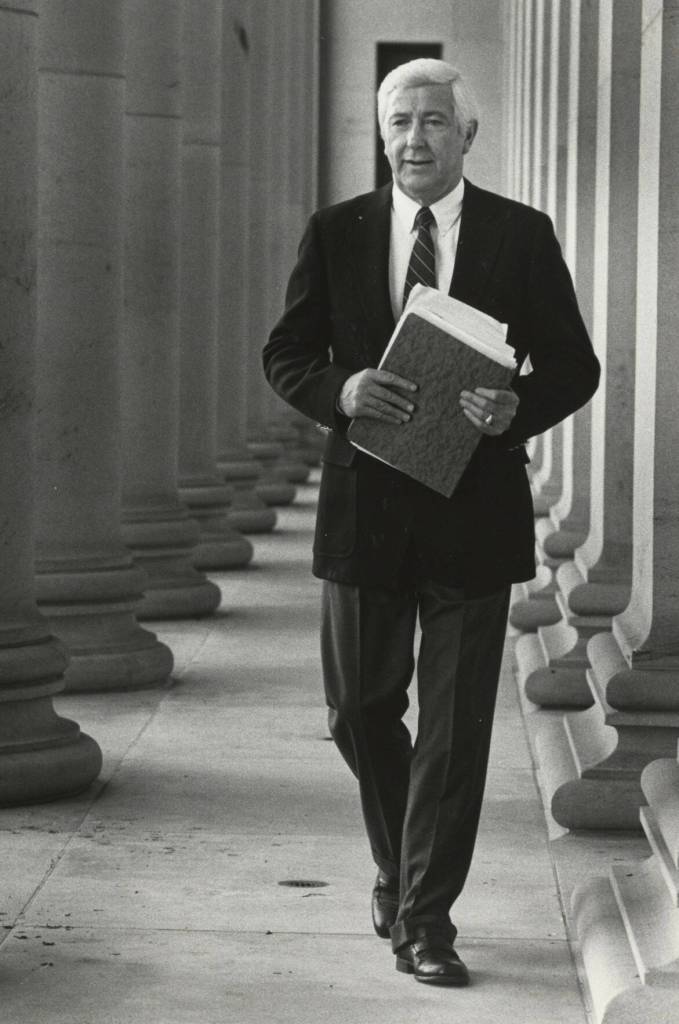



DEAR READER: Our series of profiles in political courage continues today with John Dennis Spellman, a former Jesuit seminarian who fought patronage and racism as King County Executive and deserves better than to be remembered merely as “our last Republican governor.”
His father, a legendary football coach, warned that “politics will break your heart.” Spellman was resolute, even when the luck of the Irish seemed to desert him.
In 1981, when Spellman took office as governor, succeeding the mercurial Dixy Lee Ray, the state was in a billion-dollar hole. Spellman ordered a hiring freeze and proposed “humane and realistic” cutbacks in state services. Arch-conservatives in his own party — he called them “Troglodytes” — demanded deeper cuts to education and social services. The battle lines were drawn for four tumultuous years.
Spellman also made it clear he was reserving judgment on an issue that would become one of the defining moments of his political career: Northern Tier’s proposed oil port at Port Angeles and pipeline beneath Puget Sound. Tribes maintained the pipeline could damage fish runs in violation of their treaty rights. But the Reagan Administration was adamant that energy independence was a national security issue. The Army Corps of Engineers and the Environmental Protection Agency would have their say as well.
ON JANUARY 27, 1982, after 5½ years of hearings that produced 40,000 pages of testimony, the state Energy Facility Site Evaluation Council, voted to deny permits for the oil port and pipeline. The final decision would be Spellman’s.
Over the next 71 days, he was subjected to unrelenting pressure — from the corridors of the White House to union halls in Bellingham, Boise and Bismarck; from farmers and fishermen, iron workers and environmentalists; from fellow governors, party leaders and legislators, senators and congressmen, school children and senior citizens. The Governor’s Office received 7,500 letters on the issue. When the Port Angeles High School Roughriders traveled to Bainbridge Island for a baseball game, Northern Tier sponsored the radio broadcast.
All told, it was “perhaps the most imposing array of public and private interests ever to try to twist the arm of a Washington governor,” People magazine concluded in its profile of a “little-known Western politician” who was “bucking president and party.” No “outraged Chinese governor could stop the emperor from building the Great Wall,” the magazine said. “But today one of the nation’s mightiest public-works projects — the $2.7 billion, 1,490-mile Northern Tier Pipeline designed to carry Alaskan crude oil from Puget Sound to Midwestern refineries — is being blocked by a single man, Governor John Spellman of Washington. …”
The Site Evaluation Council’s decision boiled down to two major concerns.
The first was the stability of 22 miles of pipeline below Puget Sound between the Olympic Peninsula and Skagit County. The second was the risk of a disastrous tanker fire or explosion in the Port Angeles harbor.
The Denver oilman who headed Northern Tier poked a finger in the governor’s chest and delivered one unmistakable message: “We’re going to put the squeeze on you!” And they did.
U.S. Energy Secretary James Edwards urged the governor to meet with him, as well as Defense Secretary Caspar Weinberger and Secretary of State Alexander Haig, to discuss the “national-defense” implications of the pipeline.
Spellman politely refused, nor would he meet any other proponents or opponents. If he were to hear the administration’s views he would be required to reopen the entire site-review process, and “nothing has been presented to me” that would justify such an action.
IN A ROOM adjacent to the governor’s office, staffers were sorting mounds of mail. “A spill of biodegradable crude oil isn’t nearly as big a problem as unemployed people,” a Bellevue Republican wrote. The Deep-Sea Fishermen’s Union of the Pacific disagreed: “As ones who rely solely upon the Pacific Northwest region’s marine resources for our livelihood, we strongly and adamantly request that the governor deny permits for the Northern Tier pipeline, for his sake and ours.”
With unemployment nearing 12 percent — 20 percent at Port Angeles, where the issue pitted neighbor against neighbor — labor was out in force, demanding that Spellman not “turn his back” on 4,000 new jobs for Washington and 8,000 to 10,000 in all from Clallam County to Minnesota.
The jobs figures were hotly debated. State Rep. Andy Nisbet, a Republican from the Olympic Peninsula, said that once construction was over there’d be only 125 jobs. “There’s more permanent jobs for Clallam County at the new Safeway in Sequim.”
Each constituent received a form letter saying the governor valued input from concerned citizens but would base his decision solely on the record compiled by the Site Evaluation Council.
Everyone in the office knew the governor had been studying the report because he packed it back to the mansion every night, no matter how late it was. First Lady Lois Spellman wrote in her diary, “John seems terribly fatigued. I became greatly concerned he’s not watching his diet or getting any exercise, which troubles me.”
ON APRIL 8, 1982, Spellman announced his decision. Countless words had been printed and uttered telling him what he ought to do, he said, calling it “an epic process of due process.” But he would need only a few to sum up his feelings:
“It should be no surprise to anyone that I am rejecting the application of Northern Tier Pipeline.” He had read and considered the council’s findings, even surveyed the route by air. Northern Tier had a year to present its final case, yet only “begrudgingly” gave evidence. Spellman concluded that an underwater pipeline capable of carrying nearly a million barrels of oil a day through an area with a history of earthquakes that could liquefy soils in seconds would be a “very real threat to Puget Sound, which in my mind is a national treasure.”
As for Port Angeles, an explosion or fire could place thousands in harm’s way. Only 110 permanent jobs would be created by the project, while tens of thousands of people depended on Puget Sound for their livelihoods. He said he hoped to create many more jobs by promoting Washington ports as the hub of American trade with the Pacific Rim.
“It is the governor’s duty to protect the state’s environment, its natural resources and, above all, the interests of its people. … I am satisfied that the findings of fact, conclusions of law and recommendations of the council are supported by the record. I concur therein.”
NORTHERN TIER’S chairman said he couldn’t help thinking that if Dixy Lee Ray had been re-elected, they’d be ordering pipe. “She would have been less legalistic.”
A North Dakota official declared, “We’ve got to stop letting the Tom Haydens and the Jane Fondas make our energy policy for us. I really think Governor Spellman is afraid of a few little environmentalists pounding the table.”
Spellman had stood his ground. And Ronald Reagan, a former Western governor who maintained “the nine most terrifying words in the English language are ‘I’m from the government and I’m here to help,’” apparently wasn’t inclined to give him the full “Gipper” treatment when saber-rattling by the Energy secretary and other officials had failed to shake Spellman’s resolve. After his audience with the president, reporters on the White House lawn all wanted to know if he’d been “called on the carpet” over the pipeline. “It wasn’t even mentioned,” Spellman said.
The Washington Environmental Council saluted Spellman as its Elected Official of the Year. And the “Troglodytes” branded him an apostate.
Spellman lost his bid for re-election to Booth Gardner, a charismatic centrist Democrat.
Regrets? A few, Spellman said in 2013 as I was working on his biography. “But not about the pipeline. It was the hardest and easiest decision I ever made. Isn’t defending the environment the bedrock of conservatism?”
John C. Hughes was chief historian for the Office of the Secretary of State for 17 years after retiring as editor and publisher of The Daily World in 2008.