Grays Harbor Stamp Works: Right on the button since 1916
Published 1:30 am Friday, May 22, 2026


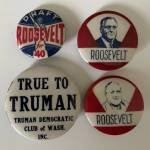
DEAR READER: Once a staple of every political campaign, from the city council to the White House, campaign buttons have fallen out of style, perhaps because politics is now so polarizing. People are reluctant to wear their hearts on their sleeves or their political persuasions on their lapels. You don’t even see as many MAGA hats these days.
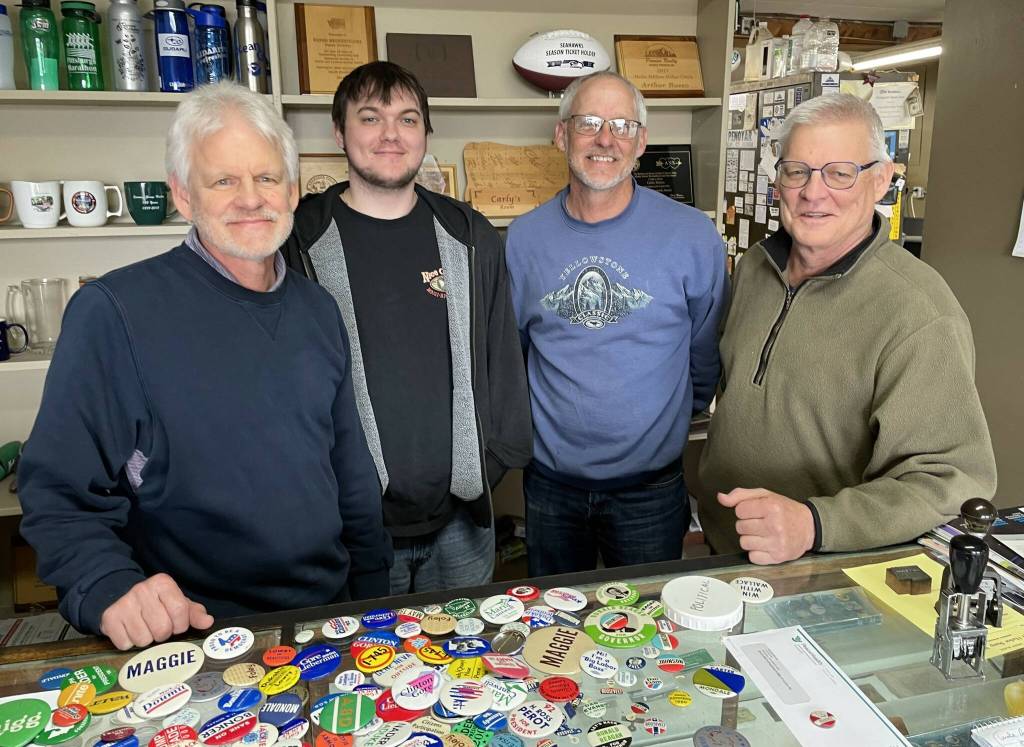
Ken Windell of Grays Harbor Stamp Works says campaigns are ordering more stickers than buttons, “maybe because people don’t like poking holes in their clothes.” Nevertheless, the 110-year-old Aberdeen business remains one of the nation’s top button-makers, also producing all manner of promotional items, from imprinted coffee mugs to name tags. The Stamp Works was honored in 2000 and 2009 as the marking industry’s U.S. Manufacturer of the Year.
From its earliest days, the Stamp Works’ status as a union shop has been a lucrative niche around the Northwest. Electrical Workers Union Local 46 in Seattle, which placed its first order for dues buttons in 1938, is still a customer.
The nondescript storefront at 110 North G Street belies the company’s national reputation for quality work at competitive prices. It’s rare to see one of their buttons — even those from the 1940s — with any discoloration.
Ken Windell’s 24-year-old son, Ryan, has joined his dad and uncles, Dave and Ron Windell, in the business, making the Stamp Works a fourth-generation enterprise. The three brothers began working with their grandfather, dad and uncle as teenagers. Industrious and good-natured, they love what they do, thrilled that Ryan, blessed with the same temperament, intends to carry it on.
“Someone said that for all of us to work together for so long, with no visible cuts or bruises, must say a lot,” Ken quipped.
RUBBER STAMPS, a staple of office work for generations, propelled the company to prominence during the Roaring Twenties when the Harbor was the lumber capital of the world. Then, in 1936, when Democrats descended on Aberdeen for a tumultuous state convention, Clary “Windy” Windell — grandfather to Ron, Ken and Dave — observed that the delegates were sporting campaign buttons produced by out-of-state vendors.
Clary Windell promptly purchased the celluloid button machine that’s still a mainstay at the Stamp Works. Ron operates the clacking contraption with a dexterity born of decades of practice. When he’s on a roll, he can crank out 700 to 1,000 per hour. It’s a wonder to watch the machine attach a celluloid-covered button-paper to its metal collar “collet” and pinback, a process patented in 1896 by the Whitehead & Hoag Company of New Jersey.
“It’s a working museum; that’s what it is,” says Dave Windell, pointing to a Heidelberg press from the 1950s. Around the corner, however, there’s a laser engraver.
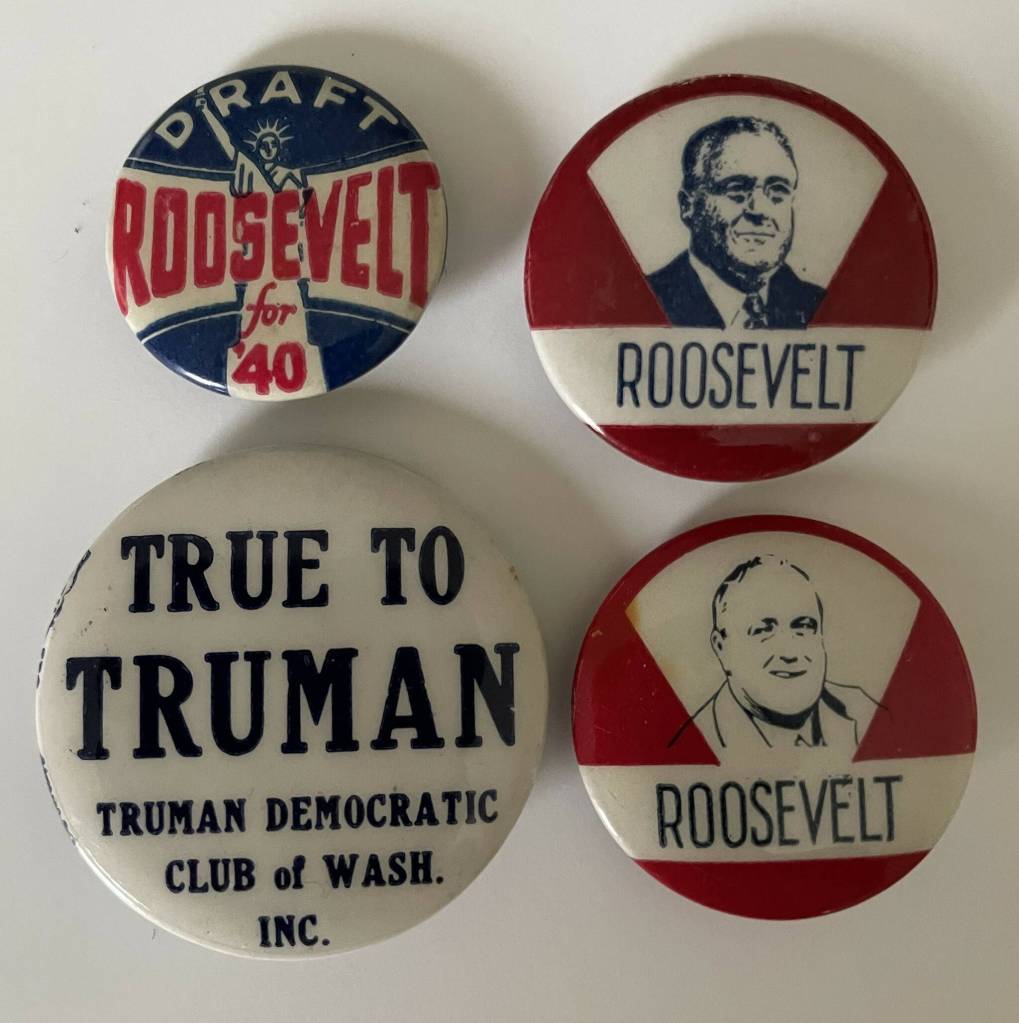
The Washington State Democratic Party and its allies began placing big orders with Grays Harbor Stamp Works in 1939 when Franklin D. Roosevelt was on the fence about seeking an unprecedented third term. The Washington Commonwealth Federation, a “Popular Front” leftist coalition with headquarters in Seattle, ordered 100,000 seven-eighths inch “Draft Roosevelt for ’40” campaign pins with a Statue of Liberty theme at $15.50 per thousand. The handsome little pin fetches $35 to $50 today. Do the math!
A total of only 1,000 of two unusual Roosevelt portrait pins were manufactured by Grays Harbor Stamp Works in 1940 for King County Democratic Headquarters in Seattle. The unique pins feature sketches of the president, not photos. The late Bob Windell, father to Dave, Ron and Ken, told me in 2000 that the Stamp Works made 500 of each design. Interestingly, the lighter portrait is now far scarcer, commanding $100; the darker version goes for $50 to $75.
RAREST BY FAR of the million or so pinbacks the Stamp Works has produced over the decades is a 1¼-inch “True to Truman/Truman Democratic Club of Wash. Inc.” pin, which has auctioned for nearly $1,200.
Patty Murray, Washington’s tiny yet tenacious senior senator, chose Grays Harbor Stamp Works to produce an iconic 2¼-inch pin for her first campaign in 1992. It features a pair of sneakers, symbolic of her being dismissed early on as just a “Mom in Tennis Shoes.”
The Stamp Works produced a version of the famous 1984 “Booth Who?” pin that two-term Gov. Booth Gardner distributed by the thousands early in his first campaign to capitalize on being a relative unknown and establish name familiarity.
When the Washington Power Supply System’s overly ambitious nuclear power plant program suffered a meltdown, Grays Harbor Stamp Works manufactured thousands of “Irate Ratepayer” buttons. And in the 1980s, when set-asides to protect the endangered Northern Spotted Owl decimated the economy of timber towns, the Stamp Works produced “Give A Hoot For People Too!” pins.
BUTTON COLLECTORS dream of finding the hobby’s Holy Grail, a 1920 Cox-Roosevelt button featuring photos of both candidates, a “jugate” in the parlance of button-collecting. Some Cox-Roosevelts have auctioned for as much as $185,850. A handsome young FDR, not yet crippled by polio, was the vice-presidential nominee on the Democratic ticket headed by Ohio Gov. James Cox. FDR whistle-stopped the state in 1920, including Grays Harbor. I keep thinking there’s a Cox-Roosevelt here somewhere, just waiting for me to claim it for $5 at a garage sale.
Campaign button prices at antique and collectible shows run the gamut from ridiculously overpriced to breathtaking steal. One year at an antique show in Ocean Shores, I acquired a $250 FDR pin for $4 while the next stall wanted $28 for a common Nixon-Lodge button worth no more than $5. Flea market vendors and everyday people who ask me what a button is worth are often disbelieving, sometimes offended, when I tell them their 120-year-old Teddy Roosevelt button is a wonderful, educational collectible but worth $20 at most. Some great older buttons are amazingly affordable because millions were produced. One is a classic John F. Kennedy portrait pin. Worth only $5 to $10, it’s still one of my favorites.
A word or two about eBay: It’s a mixed bag — a movable feast for knowledgeable collectors and a sure-fire way for the gullible to pay way too much for reproductions any self-respecting collector would smash with a hammer. Some sellers play fast and loose with “Vintage,” while others exhibit remarkable chutzpah. One eBay seller recently advertised a shabby Truman button reproduced as part of a Kleenex promotion in 1968 as “a great reproduction” that would be “safer to wear” than the original, lest it get lost or dented!
If you’d like to start a political button collection or determine the worth of a button you own, the best advice I can offer is to Google the American Political Items Collectors and become a member of the largest and most respected club in the hobby. The APIC web page, https://apic.us/, features a guide to fakes and reproductions.
What’s in your attic? A box of buttons? Maybe something special. Collecting anything is a treasure hunt.
By the way, the Stamp Works’ ubiquitous little “IT’S TIME FOR A CHANGE” button, first produced in 1940 as a Willkie pin, has been reissued off and on as a timeless notion. Someone should order a new batch.
John C. Hughes was chief historian for the Office of the Secretary of State for 17 years after retiring as editor and publisher of The Daily World in 2008.