Visiting graves: Conversing with the dead in area cemeteries
Published 1:30 am Saturday, January 17, 2026



DEAR READER: I love a great epitaph. G.N. “Pete” Vander Linden, the wise and witty longtime proprietor of Hoquiam’s Coleman Mortuary, always quipped that his grave marker should say, “I was the last guy to let you down!” Not an original line, granted, but Pete always delivered it with deadpan mischievousness. He also taught me how to make a perfect gin and tonic.
Merv Griffin, the talk-show host who invented “Jeopardy” and “Wheel of Fortune,” wrote his own actual epitaph: “I will not be right back after this message.” The Rev. Dr. Martin Luther King Jr.’s headstone borrows the soaring lines from his most memorable sermon: “Free at last. Free at last. Thank God Almighty I’m Free at Last.” It’s hard to top that. But I identify with seven-time Oscar winner Billy Wilder’s headstone: “I’m a writer but then nobody’s perfect.”
I love cemeteries, particularly the hillside resting places here on the Harbor. They offer great exercise, a sense of history, and opportunities for reverence and reflection. I talk to dead people all the time, especially old friends. One is Jim McQuade, whose remains were identified in 1999, 27 years after a surface-to-air missile brought down his helicopter in Vietnam. Jim died eight days after his 23rd birthday while searching for a missing comrade. He is buried with his remarkable Mom, Pat, who missed him every minute of every day.
I stop to chat with many others, too, including people I wish I had known.
At Aberdeen’s Fern Hill Cemetery, I visit two graves in particular several times a year. The first is the resting place of 25-year-old Laura Law, murdered in North Aberdeen on Jan. 5, 1940. Her son, just shy of 3, was left unharmed in his bedroom. Born in Finland, Laura was the wife of a controversial labor-union leader and herself an activist with the union’s auxiliary. An estimated 2,500 mourners attended her funeral. I have written widely about this vicious crime for nearly 60 years. It remains one of the most notorious unsolved murder cases in American history. And I expect to write more about it in the months to come. Among the many myths surrounding the case is the notion she was pregnant at the time of her death. While her tombstone reads, “Lea Laura Law, 1914-1940, and infant son,” the child buried with her was stillborn earlier in her marriage to Dick Law.
I always implore Laura to tell me the name of her killer. One day, a couple visiting a grave a few rows away overheard me. Their curious glances seemed to say I was either nuts or doing something spooky. Not guilty.
The late, great John Prine, one of America’s most introspective songwriters, reminded us that old people grow lonely:
So if you’re walking down the street sometime
And spot some hollow ancient eyes
Please don’t just pass ’em by and stare
As if you didn’t care, say, “Hello in there, hello.”
Doesn’t that go for dead people, too? Give it a go: Just say, “Hello in there.”
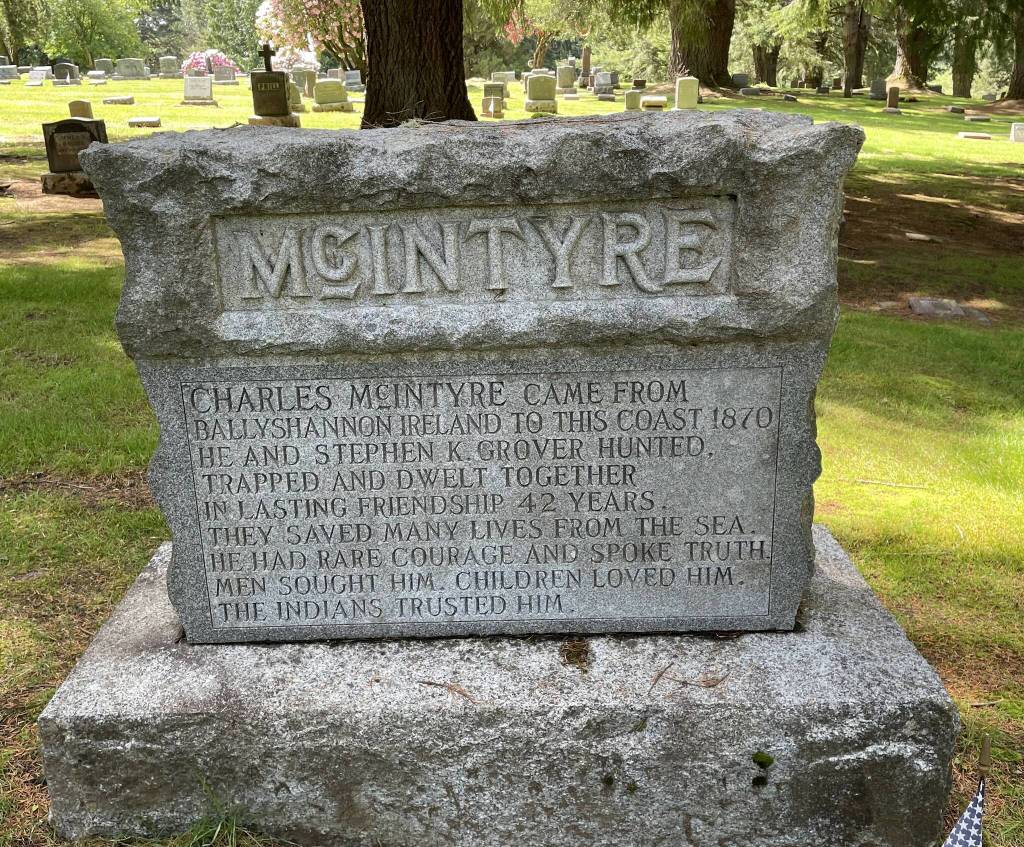
ANOTHER GRAVE that fascinates me is not far from Laura’s. The epitaph on Charles McIntyre’s imposing grave marker is one of the most eloquent at Fern Hill:
“Charles McIntyre came from Ballyshannon Ireland to this coast 1870. He and Stephen K. Grover hunted, trapped and dwelt together in lasting friendship 42 years. They saved many lives from the sea. He had rare courage and spoke truth. Men sought him. Children loved him. The Indians trusted him.”
Who could ask for more?
We know the rest of the story thanks to McIntyre’s prominent obituary in The Seattle Daily Times and Ed Van Syckle’s indispensable book “The River Pioneers.”
Charlie McIntyre, 61, died in Hoquiam on April 25, 1933, the “last survivor of a vanished occupation,” his hunting partner Grover having died in 1916. They were the most famous sea otter hunters on the north coast in the days when the prized furs fetched as much as $150 a pelt.
WHEN Captain Robert Gray set out from Boston in the Lady Washington in 1787, the merchants who commissioned the expedition had taken note of published reports “of the abundance of valuable furs offered by the natives of the country in exchange for beads, knives and other trifling commodities valued by them.” Captain James Cook, the British naval officer who visited the Northwest coast a decade earlier, said of the sea otter, “This animal abounds here — the fur is softer and finer than that of any other we know of. … The sea otter skins are sold by the Russians to the Chinese at from sixteen to ninety pounds each.”
By the 1800s, a single pelt sold for $400 in Canton. Between 1743 and 1823, some 200,000 were marketed.
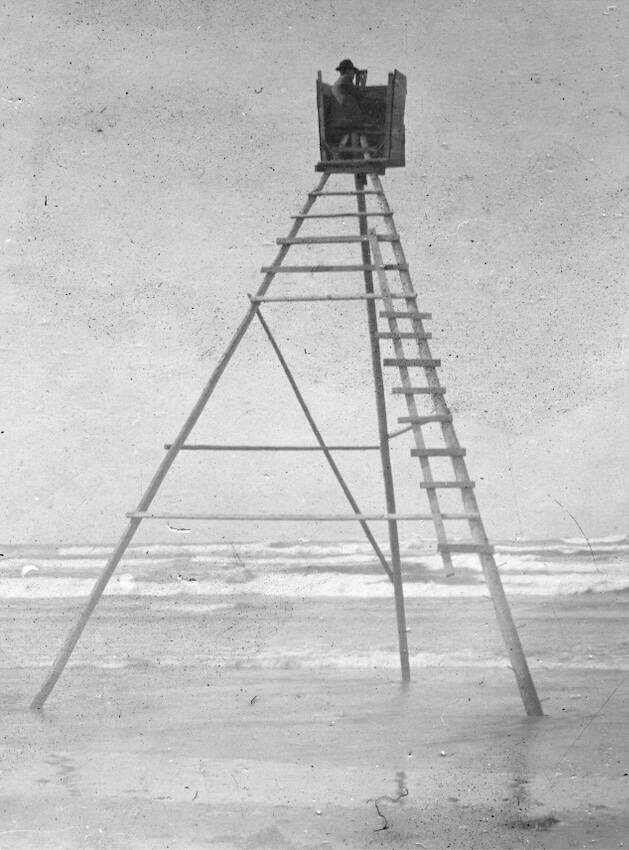
Grays Harbor boasted one of the largest populations of sea otter on the Washington coast. “In the 1870s and early ’80s, tall derricks, each with a little shelter at its top, stretched at extreme low-water mark” along the North Beach, The Times wrote. At one time there were nearly a dozen, some as tall as 60 feet, in the 10-mile strip between Brown’s Point and Copalis. With binoculars and a steady arm, “a 700-yard shot was not exceptional,” according to Van Syckle, “and some kills were made as far as 1,000 yards, or more than half a mile.” Ownership of the carcasses was determined by marked bullets, “as scrupulously respected as cattle brands,” The Times noted.
Legends in their own time, McIntyre and Grover graduated with ingenuity — and some help from the Indians — from a spindly tri-pod platform to a “shack stoutly bolted and lashed to the top of Copalis Rock, far outside the line of derricks and to be reached only under right conditions or weather and tide.” From that vantage point, McIntyre, Grover and another sharpshooter, Harry Wetherill, “took turns at vigils that might last anywhere from a couple of days to a couple of weeks.” McIntyre had developed a friendship with Samson John, a Quinault, who took the hunters to the rock in his canoe.
THE NATIONAL Marine Sanctuary Foundation says the last sea otter along the North Beach was reported to have been shot in 1911, its numbers devastated by the maritime fur trade and the advent of the day when “both the white and the Indian took up the gun,” Van Syckle wrote. “From then on the herds were doomed.” By 1900, Northwest coast sea otters were so depleted that only 127 skins were sold that year — one for $2,000 in London.
In 1969, I covered the release near Pacific Beach of 59 sea otter translocated from Alaska. The attempt to restore their presence along Washington’s north coast has achieved modest success, nothing, though, compared to their numbers a century earlier. Still, every sea otter alive today on Washington’s coast is descended from that recolonization effort, according to Lynda Mapes, the Northwest’s top environmental writer.
The Seattle Post-Intelligencer’s Rick Anderson, an old friend from our days together on the Grays Harbor College Timberline, was among the throng of media on the day the otter were released. A TV cameraman tried to muscle me aside when I positioned myself to get a good photo as the cages were opened. Rick tripped him. “Sorry about that,” he said, barely suppressing a smirk, as the irate fellow picked himself up from the surf. I got a great photo.
A Hoquiam kid to the core, Rick died at 77 in 2018; too young. Crime, cops and corruption were his forte in a half century as an award-winning columnist.
I need to find out where he’s buried. I have a lot of things to ask him.
John C. Hughes was chief historian for the Office of the Secretary of State for 17 years after retiring as editor and publisher of The Daily World in 2008.