‘Let it be brought forth that in America the law is king’
Published 1:30 am Saturday, July 4, 2026

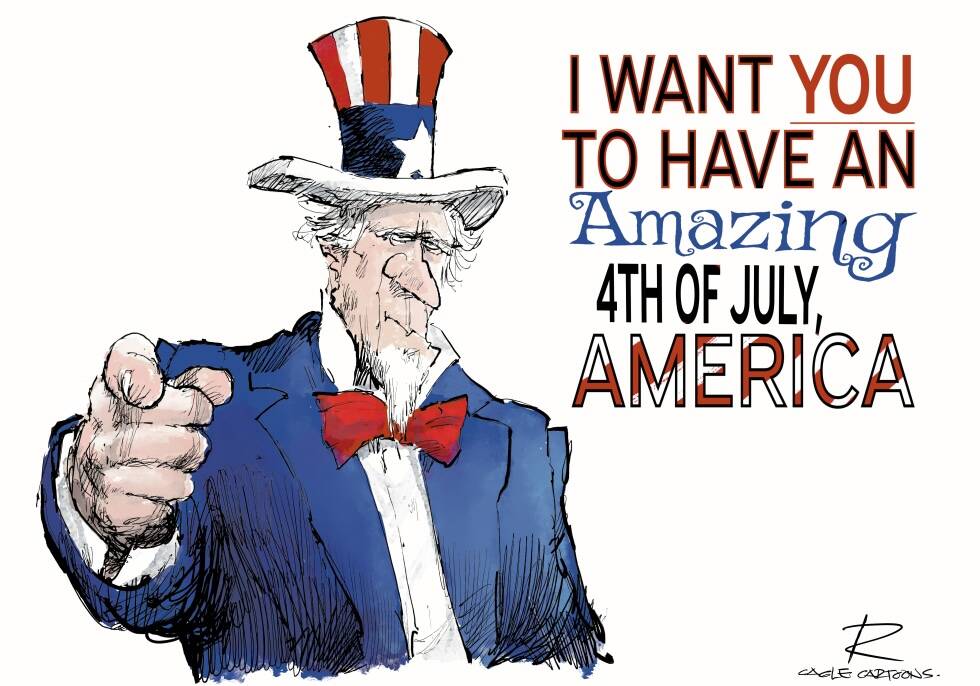


Dear America: Happy Birthday! There’s a lot of candles on your cake!
In the immortal words of the Grateful Dead, “What a long strange trip it’s been.” The good news is that you’re still kicking at 250, yet too old for a Medicare-authorized colonoscopy. (Par for the course, old friend.) The bad news is that we’re more fractured than at any time since the Civil War.
For the record, I submitted the first draft of this column to the Jim Walsh for Governor Committee and the White House Task Force on America’s Semiquincentennial, headed as our President puts it, by “the man who some say is the Greatest President in History.”
No objections raised to date, I’m pushing ahead. Call it a declaration of independence.
Some say Thomas Jefferson, who wrote the original, immortal Declaration in 1776, is our greatest president. I rate him behind Washington, Lincoln, Theodore and Franklin D. Roosevelt, but miles ahead of McKinley, Wilson, Kennedy, Reagan, both Bushes and Clinton, though if you had told me 10 years ago that I’d be missing “W” I would have been incredulous. Relatively speaking, I even miss Nixon. And if Spiro Agnew had been Trump’s vice president, that would have been a perfect pair of shameless extortionists. Mike Pence, by contrast, was a profile in courage when it mattered most, with democracy on the line as a mob stormed the Capitol, howling for his hanging.
IT PAINS ME when I hear some say the Declaration of Independence is outdated. H.L. Mencken, the brilliantly cantankerous critic, felt the same way in 1921 when he updated the Declaration for the unwashed masses, writing:
“When things get so balled up that the people of a country got to cut loose from some other country, and go it on their own hook, without asking no permission from nobody, excepting maybe God Almighty, then they ought to let everybody know why they done it. All we got to say on this proposition is this: first, me and you is as good as anybody else, and maybe a damn sight better; second, nobody ain’t got no right to take away none of our rights; third, every man has got a right to live, to come and go as he pleases, and to have a good time whichever way he likes, so long as he don’t interfere with nobody else. That any government that don’t give a man them rights ain’t worth a damn. …”
Well said, Henry!
Now, for MAGA Mixed Martial Arts fans of 2026, let’s put it this way:
“Bro’s: A lot of the SH*T this King has done is already on YouTube and TikTok. But it’s literally worse! Anybody that knows anything about Freedom will agree with us, the undersigned, that it all Sucks — especially the so-called Stamp Act. Stamps already cost too much. Literally. Now he’s recruiting our slaves to turn against us, when they know they’ve never had it so good. (So good! So good!) Our position is that all white men — even women who know their place — are pretty much equal and literally just as good as any King. He may think he’s better than us, but if this crap persists, we’ll kick his Royal Highness’s you-know-what into a place as low as it goes. This is the ultimate fighting championship! Stop the steal!”
SHIFTING FROM the ridiculous to reflection, we return to Thomas Jefferson — unquestionably a Enlightenment man. He braved the hangman and fomented rebellion at a time when “perhaps as many as a fifth of American colonists remained loyal to Britain.” For all his patriotic eloquence, however, Jefferson was also a man of his time — a double-standard intellectual who resoundingly declared “all men are created equal” while owning hundreds of enslaved human beings, one of whom bore six of his children. In his heart of hearts, Jefferson knew slavery was evil, writes Jill Lepore, the Pulitzer Prize-winning historian and staff writer for The New Yorker. But his “better angels,” to borrow Lincoln’s phrase, had a devil of a time with practical politics.
My six-times great-grandfather, who served with Jefferson in the Virginia Militia, owned a dozen slaves of his own. Archelaus Hughes — 33 years old, like Jefferson, in 1776 — put his life on the line for independence. I take pride that in due course he freed the human beings he had inherited and prospered even more.
LOGICALLY AND providentially, Jefferson was named to the five-member committee appointed by the Continental Congress to draft the Declaration of Independence. Benjamin Franklin, a gifted wordsmith, and John Adams, prickly but highly literate, were also appointed, together with Roger Sherman of Connecticut and Robert Livingston of New York, “both lackluster prose stylists,” Lepore writes.
Ben Franklin’s commitment to the revolution, it must be noted, was soul-sapping. His son William, the colonial governor of New Jersey, was a staunch Loyalist, utterly resistant to his father’s entreaties to join the rebel cause. Their estrangement would be permanent.
Jefferson’s cross to bear — the writing assignment — was light by comparison. He was no stranger to the perils of prose by committee, every accomplished writer’s worst nightmare; akin to the old saying that a camel is a horse designed by a committee.
A year earlier, Jill Lepore notes, “Jefferson had been saddled with the Pennsylvania delegate John Dickinson as the co-author of another declaration, the Declaration of the Causes and Necessity of Taking Up Arms, a mealy-mouthed explanation” of why the colonists were fighting brutish British attacks on their claims to self-determination. Dickinson’s preamble is mind-numbing mush:
“If it was possible for men, who exercise their reason, to believe, that the Divine Author of our existence intended a part of the human race to hold an absolute property in, and an unbounded power over others, marked out by his infinite goodness and wisdom, as the objects of a legal domination never rightfully resistible, however severe and oppressive, the Inhabitants of these Colonies might at least require from the Parliament of Great Britain some evidence, that this dreadful authority over them, has been granted to that body.”
Try diagramming that dreadful sentence.
NOW CONSIDER THIS: After some sage advice from Franklin, who is believed to have suggested substituting “self-evident” for “sacred & undeniable,” Jefferson gave us these soaring paragraphs:
“When in the Course of human events, it becomes necessary for one people to dissolve the political bands which have connected them with another, and to assume, among the powers of the earth, the separate and equal station to which the Laws of Nature and of Nature’s God entitle them, a decent respect to the opinions of mankind requires that they should declare the causes which impel them to the separation.
“We hold these truths to be self-evident, that all men are created equal, that they are endowed by their Creator with certain unalienable Rights, that among these are Life, Liberty, and the pursuit of Happiness. — That to secure these rights, Governments are instituted among Men, deriving their just powers from the consent of the governed …”
The grievance that might have bent the arc of the moral universe toward justice for enslaved Americans — the backbone of the South’s economy and political power — was in Jefferson’s draft of the Declaration. Slavery was part and parcel of an “assemblage of horrors,” Jefferson wrote, excoriating King George III for condoning “a market where MEN should be bought & sold.”
Jefferson always said the deletion “was made at the behest of delegates from South Carolina and Georgia,” Lepore writes, while “historians have suggested it was necessary because the passage was so patently hypocritical as to be embarrassing. … And its erasure marked the beginning of centuries of political attempts to pretend that slavery never happened.”
Shamefully, 250 years later, so-called conservatives — pseudo-Republicans — in many of our disunited states denounce these truths as “woke,” mandating public school curricula that whitewash history. They’re fond of quoting Jesus, yet keep denying that “the truth shall make you free.”
Our national work in progress continues.
Today, as we beseech God to bless America, we also remember the words of Thomas Paine, whose pamphlet “Common Sense” stiffened the resolve of the patriot colonists. “But where, say some, is the King of America?” Paine wrote, responding that here the law reigns above all. “Let it be brought forth … by which the world may know … that in America the law is king.”
JILL LEPORE’S books, “These Truths,” a history of the United States, and “We the People,” a history of the U.S. Constitution, together with Jon Meacham’s “American Struggle: Democracy, Dissent and the Pursuit of a More Perfect Union,” are essential companions to truthful American history in our 250th year.
John C. Hughes was chief historian for the Office of the Secretary of State for 17 years after retiring as editor and publisher of The Daily World in 2008.